- Date of death
- Age
- 23
- Hometown
- Modiin-Maccabim-Reut
Light a candle

The story
Yona Betzalel Breif was born in Jerusalem, the sixth and youngest son of Hazel Susan and David Chaim, in the spring of 2001, on a Wednesday, the fourth of Nisan. Their home, a warm and vibrant Jerusalem house, was always filled with sounds and laughter, the aromas of spices and baked goods, and above all – love. Older siblings – Nava, Micha, Yasmina, Libby, and Aviel – welcomed little Yona with open arms, and from his earliest days, it was clear there was something special about him, an invisible thread that bound everyone together. He wasn't just the youngest brother; he was the beating heart of the home, a quiet center of calm amidst the family bustle, always there to make peace, bridge small gaps, or simply offer a wide, bashful smile that would melt away any anger or argument. His parents saw him as the unifying glue, the one who always ensured the atmosphere was pleasant, that conversations flowed, and that no one felt alone. When everyone gathered around the laden Shabbat table, as plates emptied and voices mingled, Yona would sit there, listening, smiling, his quiet yet powerful presence warming the space.
When he was a young child, the family moved to Modi'in, where he grew up and was educated. He began his schooling at "Masuat Neria" Elementary School, and later continued to "Lapid" Yeshiva, part of the "Bnei Akiva" youth movement in the city. His teachers remember him to this day as an exceptional child, not just for his good grades, but primarily for who he was. He was a diligent student, whose curious eyes always sought to learn and understand, naturally polite, with a cheerful demeanor that made it impossible to be angry with him, even when a hint of mischief occasionally peeked through. He didn't need anyone to ask him for help; if he saw another child struggling with a task, with sad eyes facing a complex math problem or words that wouldn't form a sentence, he would approach quietly, with a confident yet unassuming gait, offering help wholeheartedly, in a soft and patient tone, until understanding dawned in the other child's eyes. He did this not for praise, but out of a deep inner drive to care for those around him, to alleviate their pain, even the slightest discomfort.
Even in his youth, a trait of foresight and planning stood out in him, alongside a determination to strive for excellence. When it came time to choose his high school majors, he decided to study mathematics at the five-unit level, not necessarily out of a natural love for numbers, but from an understanding that this was the way to pave avenues for higher education in the future. This was not an easy choice for him; mathematics demanded great effort, long hours spent poring over books, incessant practice, and often dealing with frustration when a solution wasn't immediately apparent. But Yona, with that quiet stubbornness that characterized him, never gave up on himself. He would sit for long hours at the worn wooden table in the living room, a small lamp illuminating the exercise pages, and only the gentle scratching sound of his pencil on paper would break the silence. He pushed himself to be better, not out of competitiveness with others, but from an internal drive to fulfill his potential, to maintain the high standards he set for himself, and to make the most of every situation.
Beyond the school benches, Yona found his natural place in youth movements. From a young age, he joined "Bnei Akiva" as a participant, and over the years, as he matured, he became a counselor. He loved the sense of community, the shared songs around the campfire, the deep conversations about values, the Land of Israel, and people. But his broad and sensitive heart also led him to another, no less special place: the "Krembo Wings" youth movement, which integrates children with and without special needs. There, in the weekly gatherings, amidst laughter and joy, small struggles and great triumphs, Yona felt that counseling was not just a leisure activity for him, but a way of life. He would bend down to eye level with a child refusing to participate, speaking to them quietly, with infinite patience, until the child opened up and joined the game. His sensitivity to others, the ability to see the person behind the difficulty, and the strong desire to connect people, found full expression in this activity. He knew how to form warm and genuine connections with every child, to give them a sense of belonging, strength, and hope.
Body and movement were an inseparable part of Yona's life. From a young age, he loved sports, and physical activity awakened in him a sense of vitality and liberation. He was strong, not just physically but mentally, and knew how to find solace and spiritual purification in running. Every Friday afternoon, as the sun began to set and the aromas of Shabbat spread through the streets of Modi'in, Yona would lace up his running shoes and head out for his regular ten-kilometer run. He loved these moments of quiet, when the rhythm of his strides merged with his breaths, and all his thoughts cleared. For him, it was a kind of spiritual preparation for Shabbat, a way to clear his mind and soul before the onset of the holy day. In high school, in preparation for his enlistment in the IDF, he joined a combat fitness group. He trained vigorously, pushed his limits, and his remarkable athletic talent quickly became apparent. The group's commanders recommended he enter competitions, but Yona politely declined. He didn't like competing with others, didn't seek the spotlight. For him, the real competition was always with himself – to spur himself on to be better, stronger, more resilient. He was quiet and focused, and only when he came home, tired but content, would a smile of satisfaction spread across his face.
After completing his studies at the high school yeshiva, Yona took another step on his path: he studied for a year and a half at "Bnei David" pre-military academy in Ma'ale Efraim. This was a significant period of ethical, spiritual, and personal deepening. He sat and studied, prayed, participated in long, soul-searching conversations with his friends and rabbis, and strengthened his faith. The academy reinforced his sense of mission and his desire to contribute to the state and society. He returned home with brighter eyes, with a deeper understanding of the world and his place in it, and with even greater determination to serve the country. He knew exactly where he wanted to go, and what he wanted to do.
On April 4, 2021, the longed-for moment arrived. Yona enlisted in the IDF, beginning his service in the "Duvdevan" unit of the "Oz" Brigade in the Infantry Corps – the unit he had hoped to serve in, the unit he had dreamed of since high school. It was the fulfillment of a destiny for him. Basic training was challenging, physically and mentally, but Yona endured it with quiet heroism. During basic training, his commanders noticed his unique personality. His integrity, captivating smile, and sense of justice made him a perfect candidate for a particularly undesirable role: organizing night guard duty and kitchen shifts. The commanders knew that no soldier could be angry with Yona, even if they received a difficult assignment, simply because he was Yona. He would approach everyone with a smile, explain the necessity, ensure fair distribution, and never shirk from giving more of himself. He would rise at dawn, when it was still dark on base, check the duty roster, ensure everyone knew their role, and only then attend to his own tasks. Even in this unglamorous role, he found a way to brighten faces, connect people, and maintain a good atmosphere.
After basic training, Yona went to a medic course, and then for combat medic completion. The transition to the medical field was natural for him. He greatly enjoyed the learning, the fascinating material, the ability to understand the human body and methods of healing. He would sit for long hours in the library, delving into books, practicing scenarios, and often visited hospitals to observe surgeries, amazed by the precision and professionalism. He felt deep satisfaction with the role destined for him, a role in which he could save lives, alleviate pain, and help people in moments of crisis. At the end of the course, when he returned to the unit, he was already a full-fledged combat medic, with a bag full of medications and bandages, and a heart full of the desire to help.
Yona, who grew up in a religious home and observed commandments his entire life, maintained this practice during his military service as well. It wasn't always easy, especially as he was the only religious soldier in the team. But he managed as usual, quietly and pleasantly. His teammates, who witnessed his devotion and faith, showed him moving understanding and support. They helped him in every possible way; for example, they would gather together at night to form a minyan for prayer, even if not all of them were religious. They saw him as an inspiring figure, a true friend, and the respect they held for him was earned not through demands, but through who he was. He would share with them discussions on the weekly Torah portion, explain the meaning of the holidays, and was always attentive to their questions and doubts. These connections, built on mutual respect and understanding, were deep and genuine, testifying to his wonderful ability to bridge differences and create harmony.
In May 2023, Yona participated with his unit in an operation in the Nur a-Shams refugee camp, near Tulkarem in Samaria. It was a complex and sensitive operation, requiring maximum vigilance. Suddenly, during the activity, a powerful explosive device detonated. The violent explosion threw Yona to the ground, and he felt a sharp, tearing pain in both his legs. He was severely wounded, but even in those moments of intense pain, as a combat medic, he knew exactly what he had to do. He was rushed to "Beilinson" Hospital in Petah Tikva, where he was hospitalized for a week, battling his injuries. The road to recovery was long and arduous. He was discharged home for three months, during which he was offered treatment at the unit, but Yona, with that same determination that characterized him, chose to recover on his own. He strived to overcome the injury, diligently performing self-physiotherapy, never skipping an exercise, pushing the boundaries of pain. He returned to swimming in the pool, feeling the water embrace his injured legs, and then to running, step by step, slowly and carefully, until his legs returned to their former function. In addition, he bought a SUP board and learned to do yoga on it, finding peace and balance in the challenging exercises on the water. He transformed the recovery period into a journey of personal empowerment, facing and conquering a new challenge each day.
The severe injury granted him an exemption from combat service or the option to transfer to an administrative role. Many would have chosen the easier path, but Yona was not one of them. He decided, without hesitation, to return to the unit as a combat soldier. He saw no other option. Upon his return to the unit in September 2023, just a month before the events of Black Saturday, he went for an exhausting run on base every night. He wanted to return to full physical fitness, to be the best for his team, not to be a burden on anyone, but to be a pillar of support, as always. He ran in the darkness, hearing only the rhythm of his breaths and heartbeats, with the memory of the explosion and injury still etched in his flesh, but his determination was stronger than any pain. He wanted to be ready, ready for any scenario, strong enough to protect his friends and the country.
Amidst all his activities and dedication, Yona was and remained the unifying glue in his family. He was the peacemaker, the beating heart, the one who always cared for everyone. He spent time with his parents, siblings, and nephews on trips across the country, at the beach, and in the familiar living room at home. When his brothers and sisters married and left the nest, only he remained with his parents in the family home. During this period, which lasted about two years, they grew very close. He was their best friend, a partner in deep conversations, shared outings, and small moments of quiet. On Shabbat, when his older siblings didn't visit, Yona made sure to spend time with his parents, take them for a short walk, sit with them for coffee and cake, just so they wouldn't be alone. He would come to them in Modi'in every weekend, without words, just with a smile and a hug, bringing his joy and light with him.
His circle of friends was wide, but about fifteen close friends accompanied him from kindergarten onwards. These were soulmates, brothers on a journey, and each of them felt as if Yona was their best friend. They spent long hours together, often staying at his house, sitting in the living room until the early hours of the morning, playing music, talking, laughing, dreaming. Yona's home was always open, always inviting, a refuge where everyone could feel at home.
Yona loved music. He taught himself to play the guitar and piano, and the sounds of melodies would fill the house. He would often hold spontaneous "jam sessions" with his brother Aviel in the living room, playing together, improvising, creating harmony. He listened to a wide range of musical styles, sometimes completely contradictory – secular and sacred songs played side-by-side on his playlist, classical music alongside 60s tunes and the most current hits. He found beauty and inspiration in every sound, every melody. Beyond music, he showed a special interest in films about World War II, watching them repeatedly, trying to understand the complexity of humanity in difficult moments. He loved good food, fine wine, and was himself a talented cook. The aromas of rich stews would rise from the kitchen when Yona took over the pots. Hiking across the country and spending time at the beach were great sources of enjoyment for him. He loved nature, the quiet, the open spaces. He also discovered a talent for painting, carpentry, and woodworking, and his practical skills were evident when he built the pergola at his parents' home with his own hands, a place where they could sit together, drink coffee, and watch the sunset.
Yona was a pursuer of peace and a lover of peace. He loved life in all its nuances, his family, and his friends. He managed to touch the lives of many, leaving an imprint on every encounter. He appreciated the small pleasures of life: a warm cup of coffee at sunset, a good conversation with a friend, the rolling laughter of a nephew. Although he wanted to live life to the fullest and not miss a single moment, he also knew how to sit back, observe, and enjoy the quiet. He was friendly and full of grace, blessed with a wide, bashful smile that captivated every heart, and a personal charm that was hard to resist. His human warmth and sensitivity to others were an inseparable part of his essence. He always saw and respected the other, even if they were different from him. His maturity was expressed in his way of thinking, in his wonderful ability "to connect opposites simply and completely and to give every shade of life its proper place and meaning," as his sister Nava described. He never gave up on himself, but always pushed forward, maintained high standards, and made sure to make the most of every situation, to live fully, in every moment.
On Shabbat, the 22nd of Tishrei, Simchat Torah 5784, on October 7, 2023, at 6:30 in the morning, the world of Yona and the entire State of Israel changed. The Hamas terrorist organization launched a brutal and unprecedented surprise attack. Under the cover of a massive barrage of thousands of missiles and rockets from the Gaza Strip into wide areas of the country, thousands of terrorists infiltrated – by land, sea, and air – and began a murderous assault on the communities surrounding Gaza and everyone in the area. That morning, war broke out. Yona was with his team on alert at the unit's base in Mishor Adumim. Phones began to ring, and WhatsApp messages flowed at a dizzying pace. Shortly after the events began, one of his teammates, a resident of Kibbutz Kfar Aza, received horrifying messages about terrorists who had taken over the kibbutz. Without hesitation, without a second thought, Yona and his teammates decided to drive south, into the inferno.
They quickly gathered in Sderot, where they received a brief briefing, and continued their urgent drive to Kibbutz Kfar Aza, located in the northern sector of the Gaza Division. At 10:30 in the morning, when they arrived at the kibbutz, an unbearable scene of destruction, fire, and atrocities unfolded before their eyes. They began to move from house to house, fighting with supreme bravery, clearing the area of terrorists and trying to rescue the besieged residents. The gunfire never ceased, and they advanced cautiously, aware of the immediate danger around every corner. During the fierce fighting, Yona's commander and another teammate were severely wounded and shot by the terrorists. Yona, being a combat medic, and with that same intense internal drive to save lives that always characterized him, felt a supreme duty to extract them under hellish fire. He didn't think about the danger to his own life, only about his comrades lying on the ground. He crawled towards them, ignoring the incessant gunfire, and with supreme effort began to drag them to safety. In these moments, with his body exposed, Yona took thirteen bullets – in his legs, back, and head.
The pain was unbearable, but Yona, with extraordinary composure and the instincts of a skilled medic, did not surrender. He knew every second counted. He stopped the terrible bleeding in his legs using tourniquets he applied himself, battling the pain and growing weakness. With fierce determination, he crawled to a nearby house that had a protected space, and gathered the wounded there – his commander and friend, and others who had been injured in the fighting. Inside the protected space, with bullets whistling over his head and heartbeats thundering in his ears, he continued to save lives, treating the wounded with remarkable composure, providing them with life-saving first aid, comforting them with his quiet words. He was a hero not only in his actions but also in his ability to maintain clarity of mind and extraordinary humanity in the heart of the inferno.
The journey to save the wounded Yona's life was long and complex. He was transferred from one armored vehicle to another, fighting for his life the entire time. The first armored vehicle he was evacuated in encountered an RPG and could not reach Saad Junction to rendezvous with a rescue helicopter. He was transferred to another vehicle, which also ran into a terrorist ambush. Yona, bleeding profusely and semi-conscious, remained behind a protective barrier, waiting for further evacuation. Finally, he was placed on the hood of a Hummer, on the way to Hodaya Junction, and from there transferred to a helicopter of Unit 669, the airborne rescue and evacuation unit, which swiftly evacuated him to the hospital.
Yona arrived at "Sheba" Hospital in Tel HaShomer in extremely critical condition, but fully conscious. He was admitted to the intensive care unit, suffering from severe internal injuries to his liver and kidneys, but was still in communication with the doctors in the trauma room, managing to describe his injuries, providing vital information. Then began his fight for life – a tenacious struggle that lasted 417 days. In the following months, he was also treated at "Rambam" Hospital in Haifa, in a hyperbaric chamber at "Shamir" Hospital ("Assaf Harofeh"), and in the burns unit at "Sheba" Hospital. He underwent approximately one hundred complex surgeries, each operation another battle for his life. All the while, with boundless devotion, his parents and siblings accompanied him, day and night, never leaving his side for a moment. Dozens of times he was in real mortal danger, and suffered from severe pneumonia eleven times, but each time he managed to overcome, defeat the illness, and survive. The medical team, who witnessed his incredible willpower, called him "Superman."
Yona fought for his recovery with extraordinary determination, unwavering optimism, and an intense will to live. He never stopped looking forward, dreaming of reaching the rehabilitation department, swimming again, sitting in a wheelchair instead of being confined to bed. He never expressed disappointment, frustration, or sadness about his severe condition and unbearable suffering. He was not afraid of the painful treatments and complex surgeries he had to undergo. Because he was a skilled medic, the medical team changed its approach and made Yona an involved partner in his own treatment, understanding that he comprehended the procedures and could provide accurate feedback. He came to terms with his situation and asked for nothing but to live. With complete faith, he prayed often, and when he was too weak to don tefillin himself, he asked his mother or sisters to help him. It was especially important for him to don tefillin after the amputation of both his legs, as he understood the meaning of life and death with an intensity he hadn't known before. When he read the phrase "Resurrection of the Dead" during prayer, he said he felt that this had happened to him again and again, small victories over death each time anew.
On every visit, when he momentarily awoke, he would first ask about his visitors' well-being, showing interest in them, before speaking about himself and his condition. He formed warm and genuine connections with the medical staff as well, from senior doctors to dedicated nurses, support staff, and the cleaning crew. Members of the medical team felt that Yona was like a family member to them, and would enter his room just to talk to him, drink coffee with him, and hear his stories. He inspired many around the world, and countless people, who heard about his story of heroism and struggle, prayed for his recovery, recited Psalms, lit Shabbat candles, and participated in Challah separation events for his sake.
To cope with the complex and difficult period, Yona resolutely entered his own "rehabilitation" routine within the intensive care unit. This routine included physiotherapy and occupational therapy, painting, and, of course, incessant visits from his devoted friends from home and loving family members. "While we waited for your wounds to heal and the infections to stop so you could finally move to rehabilitation, you created your own rehabilitation in the intensive care unit," his mother described. In his room in the ward, a tradition of "schnitzel in pita meal" on Fridays, sushi nights, and karaoke singing that burst from the room and filled the corridors was created. Even though for part of the period he was unable to eat by himself, it was important to him to serve food in his room, to ensure that everyone who came felt comfortable, felt at home. In the room, they also held joint viewings of fascinating lectures, light weight training, and musical and spiritual Shabbat reception events, with him singing and playing. Musicians he particularly loved came to cheer him up, and sounds of laughter, enjoyment, and music were always heard from his room, spreading light and joy within the hospital atmosphere.
Even the Brit Milah ceremony for his baby nephew, Liyam – a name meaning "they shall know war no more" – was held at the hospital, so Yona wouldn't miss the important family event. Yona, despite his great weakness, insisted on attending the Brit dressed in a Shabbat shirt with buttons, a symbol of honor, joy, and the unbreakable connection to life and tradition. He sat there, pale but happy, his presence filling the room with a special light.
In September 2024, about a year after his injury, his condition severely deteriorated. The doctors, who had held onto him with all their might for many months, had to painfully admit: "We have nothing more to offer." But even in these difficult moments, Yona's strength was so great that they added: "But none of us can say he won't survive, because he is Yona." They knew his spirit was stronger than any medical protocol, that his will to live might perform miracles. But the body, which had already endured so much, could no longer sustain the fight. Yona's last breaths were on November 26, at 6:29 in the morning, surrounded by his family and closest friends, on his final day. He fell as a Staff Sergeant, just twenty-three years old.
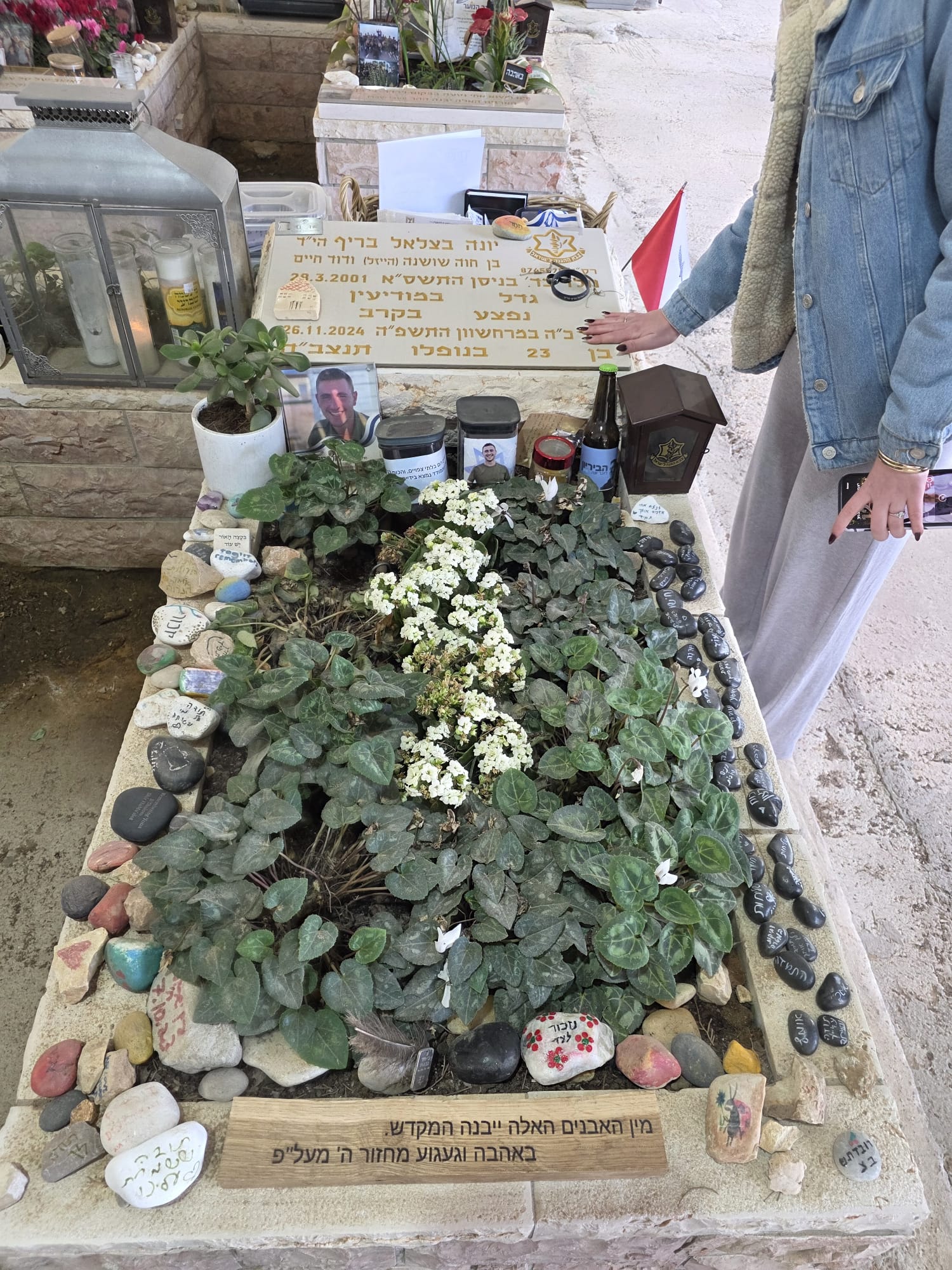
Staff Sergeant Yona Betzalel Breif, who was mortally wounded in battle and bravely fought for his life for 417 days, fell on the 25th of Cheshvan 5785, November 26, 2024. He was laid to rest in the military cemetery on Mount Herzl in Jerusalem, surrounded by his loved ones, with the skies of Israel weeping with them. He left behind heartbroken parents, three sisters and two brothers, and thousands of people whose lives were touched by his light.
His mother eulogized him with heart-wrenching tears: "My Yona, I ask for your forgiveness. I am so sorry I couldn't do more, that I couldn't find someone else somewhere in the world to give you the miracle pill that would heal all your wounds and infections, that would ease your pain and suffering. Please forgive me, I did my best... I love you, and I am so proud of you, so proud of your steadfast spirit that from now on, with God's help, will continue to heal us all... For 417 days you fought to give us just a little more – another hug, another smile, another laugh." His father David added: "Yona – you found and fulfilled your purpose in this world, and we had the honor of being with you on the journey, especially during these last 417 days. And now, Yona – you have found rest... When we think of you, we think of a man who loved peace, who pursued peace. Your smile alone brought peace to the world. We never heard of anyone who was angry with you. And apart from a few times I tried to wake you up and convince you to tidy your room – I was always proud of you. You always managed to bring peace to your family, your friends, and your team... You will continue to be with us in all our ways. Every moment you are with us – both by day and in our dreams at night."
His sister Nava wrote: "The song 'Ballad of a Medic' essentially tells the story of Yona the medic's heroism. While others dreamed of being frontline fighters... you were the one who chose to save lives. It was clear, that's who you are. For you, true heroism wasn't in the war itself, but in caring for people, in compassion, in the ability to put yourself aside to save others. You never sought glory or tried to prove you were stronger or better. You were simply there, with an infinite talent to help, to save, and to give hope to everyone around you." His brother Micha eulogized him: "Yona, you touched so many people in such a significant way in such a short time, and you were only 23!! A young man who wanted to live life. People from all over the world knew you, your story, prayed for you, and understood how great you were. Your name was carried everywhere... Now the void Yona left is so vast, and I don't know how it can be filled. A void in my soul and a void in the entire world. In the last 417 days, I felt I got to know you better than ever, and I am grateful for every day you were with us, Yona, because it was not to be taken for granted."
His sister Yasmina wrote in pain: "Yona, my beloved brother, my strong brother, my hero. Last night I thought about how cold it will be at your funeral. And how fitting this cold is for you, both because even in winter the air conditioner in your room was always set to 16 degrees Celsius, and because you spread warmth wherever you go. You are all warmth and love. There isn't a person who met you who wasn't captivated by your charm. Everything you did was with a huge smile, with a lightness and sensitivity unique to you. Yona, I will miss you so much." His sister Libby shared: "Tonight, we will light the Hanukkiah for the first time, and I can't help but think of Hanukkah last year in the ICU, when you were still in Room 4. We lit special LED candles that good people brought us, and you recited the Birkat HaGomel blessing in a chilling way. You even tasted a little sufganiyah. How excited we were by that. Afterward, you told me that on Hanukkah, you truly believed you would get out of there. I replied that I also believed. This wasn't how we imagined you would leave, this wasn't the poet's intention. So this year, lighting candles will be difficult and painful but full of light. Light will overcome darkness. Just as it was for the last 14 months and indeed your entire life. You always focused on the good, on the positive, despite the difficulty and frustration. And that's what I'm trying to do, to look at all the light you left us. I think of all your light, Yona, and your light only continues to grow. And I promise we will make sure to keep spreading your light all the time."
His brother Aviel eulogized him with unique words: "Yona, you loved World War II so much, every movie that came out – you watched it. The climax of World War II – the atomic bomb. Until it was dropped, its power was unknown – just like you. You were the atomic bomb. By the way, its codename was 'Little Boy.' You were also a cute little boy with some muscles. It turns out that was just your codename... When the atomic bomb that you were explodes – no one fails to see the immense secret that was contained within, and sadly, was just waiting to explode and reveal to everyone what the will to live and the love of life truly are. So in a few more years, we will stand here above the grave, at the 5th, 15th, 20th anniversary memorial, and talk about ourselves and how much we miss you, but in the meantime, you, like an atomic bomb, shake the entire world and fill all the space. You are not missing. Thank you for the privilege and what an honor it was to grow up by your side, in your shadow."
Yona Betzalel Breif left behind an enormous legacy of heroism, humanity, and light. At "Sheba" Hospital, where he fought for his life, groundbreaking research on blood vessels was conducted based on his unique medical case. The findings helped treat other wounded soldiers, and in this way, Yona continued to save lives even after his passing. His family, with deep pain but also with a spirit of resurgence, works tirelessly to commemorate his memory. They are working on launching a race in his memory in Modi'in, on fundraising in the United States for an innovative simulator for the medical team at "Sheba" Hospital, which will train generations of medics and doctors, and on a national blood drive, including a symbolic donation of 417 blood units at "Sheba" Hospital, matching the number of days he fought to survive and thrive from the day of his injury. In addition, an educational lesson plan telling his story has been written, so that generations of students will know Yona, his heroism, and his values. In the area of Moshav Kesalon, in the embrace of the nature he so loved, a memorial is planned in his memory, with a quiet seating area, a place where people can come and commune with his memory, drawing inspiration from his life story. Yona, the child who loved to live, the medic who saved lives, the hero who fought for every moment, continues to heal, to connect, and to illuminate the path for many, spreading his great light for all eternity. May his memory be a blessing.
Moments of a life

All photographs · 30
Videos and links
In the media
Articles
- Yona Brief chose life until the very last moment
ערוץ 7 ·
- "To give back the blood I received": The final wish of the fighter who fought for his life for 417 days
ישראל היום ·
- Remembering and commemorating: a trail named after Yona Betzalel Brief, of blessed memory, has been inaugurated
מודיעין אונליין ·
- A Mother’s Voice, episode 7: Hazel Brief
גלי צה״ל ·
- Yona Brief defying medical odds
Jerusalem Post ·
- Yona Brief’s Parents on the Fight for His Life
ישראל היום ·
Show all (13)
- Yona’s parents: 'He was a fighter & a survivor, we had many miracles'
Israel National News ·
- Sgt. Major Yona Bezalel Brief z''l
עיריית מודיעין מכבים רעות ·
- The most severely wounded patient of the war, hospitalized since October 7, has died of his wounds
N12 ·
- Fauda star sings for fallen friend Yona Betzalel Brief, who was seriously injured on Oct. 7
ynetnews
- Yona Brief, combat medic with a zest for life
Times of Israel
- Yona Bezalel Brief
גלעד מודיעין
- An Evening of Courage & Inspiration: “Choose Life” with Hazel Kassel Brief
Jewish Federation of Orange County
Podcasts
- 417 Days: Yona Brief’s Battle to Choose Life
Rabbi David Fine — Defining Moments ·
- “And This Is How I Remember You” in Memory of Sergeant First Class Yona Betzalel Brief, of Blessed Memory #84
All•in — מתוך השבר ·
Memorial projects
The family is leading a nationwide blood donation drive in his memory, following his request during his hospitalization to give back to other wounded people.
An incline in Park Hashchenut on Levi Street in Modi’in was named after him at a ceremony on November 14, 2025.
The Jewish Federation of Orange County published an invitation to a “Choose Life” evening with his mother, Hazel Brief, at Congregation Shir Ha-Ma’alot in Irvine on August 7, 2025. The invitation describes a talk and questions about Yona; it is not proof that the event took place.
Stories told about them
Brief was wounded in his legs during an operation in Tulkarm in May 2023, underwent rehabilitation and chose to return to his team even though he could have been discharged. In Kfar Aza he dragged wounded people out of the line of fire and was himself critically wounded.
Idan Amedi met Brief during his hospitalization, visited him often and grew close to him. At the thirty-day memorial ceremony, he sang in his memory and spoke about the singing and smiles they had shared in his room.
During his hospitalization, food evenings, karaoke and musical Shabbat welcome services were held in Yona’s room. His nephew Liam’s circumcision ceremony was also held at the hospital so he could attend, and he insisted on wearing a festive shirt.
Life & service
Profile
- Date of birth
- March 28, 2001
- Birthplace
- Modiin-Maccabim-Reut
- Date of death
- November 26, 2024
- Age
- 23
- Hometown
- Modiin-Maccabim-Reut
Service
- Rank
- Sergeant first class
- Unit
- Commando Brigade
- Battle Location
- Gaza Envelope
Family
- Father
- David Chaim
- Mother
- Hazel Susan
Burial
Cemetery
Mount Herzl Military Cemetery
- Area
- א
- Plot
- 18א
- Row
- 12
- Grave
- 1
Place of rest
All photographs · 1
Tributes & remembrance
תהא נשמתם צרורה בצרור החיים
תהא נשמתם צרורה בצרור החיים
זו תמונה יפה של יונה בריף המתוק ז״ל לומד תורה. משלב ספרא וסייפא. שאלתי אותו לפני כמה חודשים מה המסר שלו לעם ישראל. רציתי שיחזק אותנו. יונה חשב קצת ולבסוף אמר לי: תעזרו לאחרים, זה יעזור גם לכם. יונה היה לוחם דובדבן, אבל לפני כן למד במכינת עלי. 54 בוגרי המכינה נפלו בשירותם הצבאי, 27 מתוכם בחרבות ברזל. נדמה לי שזה מספר שראוי לציון והוקרה. אני מבקש להצדיע לתלמידי ובוגרי המכינה, ולחבק אותם ולהשתתף בצערם הכבד. יהי זכר הגיבורים ברוך
מלח הארץ
תודה לך, איש יקר.
יהי זכרו ברוך
גיבור ישראל בגוף ובנפש.
תודה על המסירות. תודה על הערכיות. תודה על ההקרבה הגדולה.
מקווה שאנחנו ראויים.
שנה לנפילתו יהי זכרו ברוך.
כל כך הרבה עצב, כאב ואובדן בשנתיים האחרונות. הייתי רוצה לזכור את כל השמות, להכיר את כולם. זכיתי ש'קפץ' אצלי פוסט על יונה ז"ל. איזה בן אדם. איזו השראה. סיפור של תקווה ואמונה גדולות כל כך, שגם אם נדמה שלא פתחו שערי שמיים, נדמה לי שהן בהחלט יצרו חרך.
תודה להייזל ודוד, שגידלו כזה ילד, נער, בחור וגבר מיוחד. תודה לאחיות ולאחים שהשפיעו על עיצוב אישיותו.
תודה לה' שנתן לכם עוד 417 ימים של יחדמן השמיים תנ
יונה. איזה בחור מדהים היית ותישאר לעד .
אני מקווה שטוב לך איפה שלא תהיה . אני לא הכרתי אותך אישית ,אבל רק לראות ולקרוא עלייך אני מבינה את גודל הפספוס של העולם הזה וכמה הלב שלך היה רחב . כמה הארת את חיי הסובבים אותך , כמה נפשות הצלת . בזכותך אנחנו כאן
תודה שהגנת ושמרת עלי ,
שרק נהיה ראויים . והלוואי ולכולנו יהיה יונה בתוכנו .
יהיה זכרך ברוך
רבני ותלמידי מוסדות 'בני דוד' כואבים את נפילתו של הגיבור יונה בצלאל בריף הי״ד, בוגר מחזור ה׳ של מכינת מעלה אפרים, שנפטר הלילה אחרי שנה של מאבק על חייו לאחר שנפצע באורח אנוש בקרב על קיבוץ כפר עזה בשבת שמחת תורה תשפ״ד, 7.10.23. שולחים תנחומים למשפחה. מן השמיים תנוחמו.
תמיד נזכור אותך
לזכר רב סמל יונה בצלאל בריף זל,
בחור צעיר עם חיוך שמאיר לבבות, שנקטף בגיל 23.
לא הכרתי אותך אישית, אך המבט שלך בתמונה מספר סיפור של טוב, של אומץ ושל אהבה לארץ.
הלכת צעיר מדי, והשארת אחריך חלל שלא ניתן למלא.
מי ייתן וזכרך ימשיך להאיר באור חזק בלב משפחתך, חבריך וכל עם ישראל.
יהי זכרך ברוך.
לפני מספר חודשים הגיע ראש הממשלה לשעבר, נפתלי בנט, לבקר את יונה בצלאל בריף ז״ל, הפצוע הקשה ביותר מהשבעה באוקטובר שהלך הבוקר לעולמו. בנט שיתף על המפגש המרגש עימו וכתב: ״יונה הוא גיבור ישראל אמיתי, לוחם דובדבן שב7/10 נפצע קשה מאד מאד. במאי 2023 יונה נפצע בקרב קשה בטולכרם והתעקש לחזור לצוות שלו ביחידה. ב-7/10 הוא ירד יחד עם הצוות לכפר עזה, הם נלחמו וחיסלו עשרות מחבלים, והצילו עשרות תושבים מהקיבוץ. לפתע, חבריו חטפו מכת אש מהצד, ונפלו פצועים לקרקע. יונה, שהוא החובש של הצוות, תחת אש כבדה, גרר את הפצועים החוצה ואז חטף צרור של 13 כדורים בכל גופו. רגליו נקטעו, וכל גופו נפגע קשה״ יהי זכרו ברוך
לזכרו
גיבור
יהי זכרך ברוך גבור ישראל
· צער עמוק פקד אותי עם היוודע דבר מותו של רב-סמל יונה בצלאל בריף. באחד מביקורי הפצועים האחרונים שקיימתי, הגעתי לחדרו שהיה מלא בתקווה ואהבה - ראיתי בעיניו את הרצון להמשיך במאבק נגד הפציעה אך גם את הקושי והכאב. באלבום שיצרה המשפחה ייחלתי להחלמתו וכתבתי את רשמיי מהשיחה המרגשת עם יונה והוריו. יונה היה דוגמא ומופת ללוחם נחוש, שחוזר לשדה הקרב למרות פציעה קשה ומסכן את נפשו לנוכח פני האויב. משתתף בצער המשפחה ומאמץ אותם אל ליבי.
תהא נשמתךצרורה בצרור החיים לעד גיבור ישראל
תודה רבה גיבור ישראל
סליחה ומחילה ממך
נוח על משכבך לשלום.
מהסיפורים היותר עצובים ששמעתי. אדם עם כוחות עצומים שמעטים האנשים שיש להם אותם גם. תשוקה אינסופית לחיים שמעוררת השראה ותקווה. אותך אני לא אשכח, לא צריך להכיר אותך אישית כדי להבין כמה מדהים וחזק אתה. תודה על הטוב הטהור שהבאת לעולם כל כך רע. הלוואי ואתה במקום טוב יותר עכשיו, בשלמות הגוף והנפש. תהיה נשמתך צרורה בצרור החיים נשמה טהורה שכמוך.
יונה האמיץ והמלאך , אתמול צפיתי בסרט שעשו לזכרך, דמעות זלגו מעיניי , איזה אומץ, איזה טוב לב, איזו נחישות, העולם הפסיד אותך מלאך אמיתי! נוח על משכבך בשלום ותהיה נשמתך צרורה בצרור החיים! ה.י.ד
איזה איש ...
איזו משפחה
יהי זכרו ברוך
גיבור ישראל לעד נזכור אותך ואת עיניך הטובות
נזכור אותך
יונה
תמיד.
נזכור אותך לנצח גיבור ישראל
יהי זכרו ברוך אני מאד סליחה והבן שלהם היו גיבור
שנזכה להמשיך את האור שלך כאן
תודה על מי שהיית ותודה על מה שנתת לנו
זוכרים אותך
תודה
לזכרך
שלום יונה המדהים תודה שנלחמת ב7.10 ותודה שנלחמת להמשיך לחיות. לא זכינו להחזיק אותך כאן איתנו.
רוצה לבקש ממך סליחה ולהגיד לך תודה.
יהי זכרו ברוך
תודה יונה.
יהיה זכרך ברוך
לעילוי נשמת יונה בן השכנים היקר.
איפה יש עוד צעירים כאלה .
יהי זכרו ברוך .
במותו ציווה לנו את החיים
Remembering Yona and his family today and every day
איזה כוחות נפש היו לך..
לא נשכח אותך ואת שאר הנופלים
יהי זכרך ברוך
גיבור ישראל
לעד בליבנו
שלום, שמי גבריאל ואני תלמיד תיכון בארצות הברית. אני מצטער מאוד על אובדנכם. בנכם היה גיבור, והוא נפל למען עם ישראל
. אמנם אנחנו רחוקים פיזית, אבל אני חושב עליכם ומתפלל שתחושו נחמה. יהי זכרו ברוך.
יונה בריף זל חבר לצוות של אחי, זכיתי להכיר אותך כאדם צנוע נעים ומלא אור, שידע לשמח, לשיר ולנגן .
ביום הקרב, כשזיהית את מפקדך וחברך לצוות פצועים ומדממים לא היססת לרגע באותו רגע , במעשה של הקרבה טהורה, ביטאת את כל מה שהיית נאמן, אוהב, נושא באחריות גם במחיר חייך
כשנאבקת בשיקום, ראיתי איך אתה ממשיך להילחם באמונה ובשקט, עם עוצמות שאי אפשר להסביר.
השארת אחרייך מורשת של גבורה
זיכרונך ישאר חקוק בליבי
רס"ל יונה בריף נקבר ביום רביעי. בן 23, חובש קרבי בדובדבן, שנלחם על חייו 417 ימים וכמעט ניצח את המוות, כנגד כל הסיכויים. הוא נכנע למחרת הפסקת האש בלבנון. הוא השאיר אחריו אינסוף לבבות שבורים ואנשים שבהם נגע בדרכו המיוחדת. בחייו, במלחמה על חייו ובמותו, יונה בריף ניפץ את כל החסמים ושבר את כל השיאים והגבהים. "סופרמן?", כתב אחד מחבריו בהספד מצמרר, "היה צמר גפן לידו. כל המדינה צריכה לדעת מי היה יונה, את מי איבדנו היום".
ביומיים האחרונים דיברתי עם חבריו, רופאיו, אנשים שליוו אותו ואת המאבק שלו. סיפרו לי על ההיאחזות המדהימה בחיים. על התקווה והאופטימיות. על הגבורה והנחישות. על המסירות וההתגייסות. ההתנפלות על כל שביב, בדל או סימן של סיכוי, על כל קרן אור מהוססת. ההגדרה "גיבור" מתגמדת ומצטנפת מבוישת אל מול הצעיר הזה. העוצמות שלו הן הסיפור שלנו.
חצי שנה לפני 7 באוקטובר, בפעילות מבצעית בטול־כרם, הוא נפצע באורח בינוני ממטען חבלה שהושלך לעבר הלוחמים. עבר הליך שיקום ארוך. בסופו, היה יכול לעבור לתפקיד עורפי ולסיים את השירות בנחת. לא, לא יונה בריף. הוא התעקש וחזר ליחידה. שבת, 7 באוקטובר, הייתה השבת הראשונה שאותה סגר בבסיס ככונן מבצעי, אחרי הפציעה. יחד עם חבריו קפץ בבוקר ישר לכפר עזה. צוות של דובדבן הגיע לשם בערך באותו זמן עם צוות של סיירת מטכ"ל. כ־20 לוחמים שלא ידעו, עדיין, לאן הם נכנסים.
דובדבן ומטכ"ל חילקו בעצם את הקיבוץ ביניהם. כל צוות "לקח" חצי קיבוץ, בלי לדעת שמאות מחבלים אורבים להם בפנים. בתוך זמן קצר הם הבינו. היה ברור להם שהסיכוי לצאת משם בחיים נמוך מאוד. זה היה קרב גבורה שנמשך שעות. שני חבריו הטובים של יונה, המפל"ג בן ברונשטיין והלוחם אמיר פישר, נפצעו באורח קשה. אמיר צעק לעזרה. יונה הגיע והחל לטפל בו. הוא משך את אמיר ואת בן לעבר מחסה, תחת אש תופת. הוא הבין שהסיכוי להצילם קלוש, אבל לא ויתר. ואז הוא נפגע. הוא חטף 13 כדורים ונפל על חברו הטוב, אמיר. אם זה מזכיר לכם את "בלדה לחובש", אתם צודקים.
יונה בריף נפגע בכל הגוף. כדור בראש, כדור בגב, כדורים בשתי הרגליים, בידיים, בכל מקום אפשרי. הוא המשיך להילחם והמשיך לטפל בחבריו. הוא שם לעצמו לפחות שני חוסמי עורקים. הוא חולץ יחד עם האחרים רק אחרי שעות. הובהל לברזילי ומשם לשיבא. לרופאים לקח מעט מאוד זמן להבין שזה פצוע שלא ישרוד. רופא שנתקל בפצוע כזה בשדה הקרב כשהפצועים מוטלים סביב, לא יטפל בו. מקרה אבוד. אי אפשר לשרוד פציעות כאלה. אבל ביונה בריף טיפלו. ועוד איך טיפלו. בחיים לא טיפלו ככה באף אחד. והוא שרד. 417 ימים ולילות הוא שרד וכמעט ניצח את המוות.
"הוא היה אמור למות תוך ימים", אומר ד"ר יורם קליין, מנהל הטראומה בשיבא, שניתח אותו באותו יום, "אבל הוא לא מת. הוא נלחם. אני בחיים לא ראיתי הרקולס כזה. הוא הפך למשפחה של כולנו. הוא היה כאן שנה וחודשיים. בהתחלה, אף אחד לא האמין שיש סיכוי. אבל המאבק שלו החדיר את התקווה גם בלבבות שלנו. הוא קיבל איזה 200 מנות דם. לפחות 20 ניתוחים. אין מומחה בעולם שלא הבאנו לכאן, שינסה לעזור להציל את הבחור הזה. קטענו את שתי רגליו. אחת מהקטיעות שלו הייתה הכי גבוהה שראיתי, כולל חלק מהאגן.
"בניתוח השתתף מומחה הקטיעות הכי מפורסם של צבא ארה"ב שהוטס לכאן במיוחד. הבאנו מומחי כבד מכל העולם, ייבאנו תרופות מיוחדות למלחמה בזיהומים פטרייתיים. תשמע, הבחור הזה לא ויתר וזה סחף את כולנו. לעיתים היה נדמה שהוא בן אל, שהוא לא בן תמותה. אף אחד לא היה שורד פציעה כזו אפילו שבועיים. והוא חי שנה וחודשיים. חלק מהזמן היה בהכרה, דיבר, עשה תרגילי כושר במיטה, אפילו שר, בלחש, עם זמרים שבאו למיטתו. אבל בסוף גם לסופרמן יש תקרת זכוכית".
מנהל שיבא, יצחק קרייס, היה מגיע בקביעות לחדר מספר 11, יושב ליד המיטה של יונה ובוכה. קרייס אמר למישהו ש"יש רפואה, ויש רפואה של יונה בריף. מה שהבחור הזה עשה כאן, פשוט לא ייאמן". קרייס היה אחד המספידים בלוויה שהתקיימה בהר הרצל. ח"כ חילי טרופר הגיע פעם אחת לביקור, ונשבה. הוא התאהב בצעיר שבור הגוף, ששכב מחובר לאינסוף מכשירים, מוניטורים, צינורות ואמצעים, והגיע כל שבוע, כל יום חמישי. נפתלי בנט בא, ונשאר. סביב המיטה של יונה בריף התפתחה קהילה שהלכה וגדלה. אנשים הגיעו ספקנים והפכו לגדולי המאמינים.
אין בספרות המקצועית דוגמה דומה למישהו במצב הזה ששרד 417 ימים בטיפול נמרץ. סביב רס"ל יונה בריף הוקמה מחלקה נפרדת לרפואה שבה נשברו כל החוקים והכללים שידועים לרפואה. הכבד שלו לא תפקד, הכליות לא עבדו, הגוף היה שבור לגמרי, ניתוח רדף ניתוח, קליע אחר קליע נשלפו מגופו, והוא המשיך לחיות. צהוב כולו, מרוסק ומיוסר, אבל חי. לאורך כל התקופה הזו הוא היה צלול כבדולח. חלק מהזמן מורדם ומונשם, חלק בהכרה מלאה. כשהיה בהכרה, דיבר. שר. עודד והתעודד. לא איבד תקווה לרגע.
הוא לקה באינספור זיהומים. לפחות עשר פעמים דלקת ריאות. בכל מקרה כזה הוא הורדם והונשם והסיכוי שלו לחזור היה קטן. אבל הוא חזר. בכל פעם מחדש. למרות הגוף השבור, הפגיעות המערכתיות, הטראומה הגופנית הכללית, גם המומחים הספקנים ביותר החלו להאמין שזה אפשרי. שהגיבור הזה יוכל לשרוד.
מספר חילי טרופר: "באתי אליו כל שבוע. רוב הזמן הוא היה בהכרה. דיברנו, צחקנו, הוא היה מבקש שאביא אומנים שאהב. הוא מאוד אהב מוזיקה. וכולם באו". מי לא היה ליד מיטתו: דודו טסה, ברי סחרוף, אביתר בנאי, עומר אדם, בניה ברבי, עידן רייכל ועוד. יהורם גאון ישב ליד המיטה של יונה ושר לו את 'בלדה לחובש'. הרי השיר הזה הוא בדיוק סיפור הפציעה של יונה. והוא ביקש שיבואו גם סטנדאפיסטים, שבאו בהמוניהם. חנוך דאום, אדיר מילר, קטורזה, גיא הוכמן ועוד רבים. הצחיקו ובכו. ליאור סושרד הגיע. דויד ברוזה נחת מחו"ל ובא ישר מהשדה. ברוזה היה האחרון שניגן ושר אצל יונה. ביום שישי שעבר הגיע אביתר בנאי, אבל יונה היה כבר מורדם ומונשם. קבעו שיבוא בשישי שאחרי. במקום זה, בנאי בא ושר בלוויה.
הוריו של יונה, דיוויד והייזל, עלו מארה"ב מטעמי ציונות. משפחה דתית־ליברלית. יונה היה הצעיר בששת ילדיהם. הצבר היחיד שנולד לאחר העלייה ארצה, בירושלים. רייצ'ל, האם, אמרה בלוויה שהבוקר למחרת מות בנה, היה הבוקר הראשון שבו ישנה במיטתה מאז 7 באוקטובר.
"הלכתי למטבח והייתי צריכה לנסות לזכור איך מפעילים את מכונת הקפה". המשפחה היפהפייה הזו הקימה לה בית בחדר מספר 11 בטיפול הנמרץ בשיבא וניהלה משם את המאבק על חייו של יונה. שם הם עקבו בעיניים דומעות אחר המדדים, מתעודדים מכל שיפור קל, מרעידים לנוכח כל החמרה. שם הם קיוו, יחד עם כה רבים אחרים, שהוא יעשה את הלא ייאמן ויחיה.
מותו ריסק גם את הצוות. פרופ' קרייס, פרופ' ערן סגל מהטיפול הנמרץ, ד"ר יעל חביב מנהלת טיפול נמרץ נשימתי, עוד רופאים ואחיות, כל מי שהיה שם ונשבה בקסמו של הלוחם הגיבור. "הם היו מרוסקים", אמר לי מישהו בשיבא, "הוא סחף אותם, הם הפכו למשפחה שלו, הוא היה משימת חייהם. בשלב מסוים למרות הנתונים כולם התחילו להאמין שזה אפשרי".
ביום העצמאות האחרון הגיע פרופ' סגל מהבית יחד עם הצוות, למבצע מיוחד. "על האש" ליונה בריף, באגם של שיבא. יחד עם המשפחה וחברים הצליחו להוציא אותו, עם המיטה וכל המכשירים וליווי רפואי מוקפד, לפיקניק עצמאות, ל"על האש" כמיטב המסורת, כדי שיונה ינשום קצת אוויר בחוץ. המאבק שלו הפך, בעיני כל המשתתפים, למאבק של המדינה.
אלון קמינר הוא פצוע שאולי אתם מכירים. מילואימניק בן 26, סגן מפקד "סנפיר" שנפצע באורח קשה במלחמה. איבד רגל, שתי ידיים ועין, פניו ספגו פגיעה קשה. קם מתוך הפציעה הזו וחזר לחיות. לאחרונה יזם קמפיין אופנה של רנואר שבו חלק מהדוגמנים היו הוא עצמו ופצועי צה"ל נוספים. גם קמינר ליווה את מאבקו לחיים של יונה בריף.
עם היוודע דבר מותו, שלח קמינר לפרופ' סגל את ההודעה הזו: "היי ערן, מצטער על השעה. חשבתי על יונה היום ואז ישר חשבתי עליך ועל הצוות, וכמה לא פשוט הייתה בטח הסיטואציה. אני יודע כמה הייתם קרובים אליו ואתה, וכמה רציתם שהוא ינצח. אני בטוח ששמעתם כבר ויודעים שאי אפשר להציל את כולם אבל זה עדיין כואב אני בטוח, עם מסירות נפש כמו שלכם איך אפשר שלא. אני רוצה בשם כל אלה שכן הצלחתם להציל להגיד תודה. תודה שלא ויתרתם עלינו, תודה שעבדתם ימים כלילות כדי שיהיה לנו את הסיכוי הכי טוב לנצח את הקרב. תודה על ההקרבה שלכם ועל כך שאני יודע שגם עם כל העצב הגדול עבורכם, אתם כרגע שם, מטפלים באדם הבא במסירות אין קץ. אני מקווה שלכולכם היה מי שיחבק אתכם היום, כי מילים הן מוגבלות לעיתים, ורוצה לשלוח חיבוק ענק ממני. בבקשה אם תוכל להעביר את זה הלאה לצוות ולכל מי שצריך אני אשמח שזה יהדהד אליהם".
"זה לא סיפור של מוות", מסכם חילי טרופר, "זה סיפור של להיאחז בחיים. לא לוותר. יונה היה גיבור בטול־כרם, גיבור בכפר עזה, גיבור 417 ימים. כל יום בו חי, ולא מת, היה יום של ניצחון".
He was on the brink of death dozens of times
Source:ישראל היום
Read the Hebrew original
הוא היה על סף מוות עשרות פעמים
If anything, we were left with more questions than when we went into the briefing.
Source:Jerusalem Post
Not just saving lives, but valuing life. That is what Yona taught us
Source:ישראל היום
Read the Hebrew original
לא רק להציל חיים, אלא להעריך את החיים. זה מה שיונה לימד אותנו
This is the fulfillment of our Zionist dream
Source:ערוץ 7
Read the Hebrew original
זו הגשמת חלום של הציונות שלנו
My Yona, I ask your forgiveness.
Source:גלעד מודיעין
Read the Hebrew original
יונה שלי, אני מבקשת את סליחתך.
Your smile alone brought peace to the world.
Source:גלעד מודיעין
Read the Hebrew original
רק החיוך שלך הביא שלום לעולם.
You were the one who chose to save lives.
Source:גלעד מודיעין
Read the Hebrew original
אתה היית זה שבחר להציל חיים.
A little boy who wanted to live life.
Source:גלעד מודיעין
Read the Hebrew original
ילד קטן שרצה לחיות את החיים.
Someone wake me from this nightmare
Source:N12
Read the Hebrew original
שמישהו יעיר אותי מהסיוט הזה
He just loved life. He lived life to the fullest all the time. He didn't waste any time.
Source:Israel National News
Remembrance Day addresses
יום הזיכרון לחללי מערכות ישראל התשפ"ה – 2025
בכל יום שעובר, אזכור יותר! אזכור, את אלו שיצאו עימי לקרב ולא שבו, ולהם אין מי ידמה ומי ישווה. אזכור, שהכאב לא יעבור לעולם, והזמן, הוא לא מרפה ולא מרפא. אזכור, את שיברון הלב הגובר ואת הבית שבוער. אזכור, את צדקת הדרך, ואשבע שוב, שמה שהיה לא יהיה יותר. אזכור, שיותר מכל דבר אחר – אני חסר! ביום הזה, אני נתקף געגוע לדמותם, לחיתוך דיבורם, לחיוכם, ומדליק נר לזיכרון דרכם ומורשתם!
משרד הביטחון
אגף משפחות, הנצחה ומורשת
יום הזיכרון לחללי מערכות ישראל התשפ"ה – 2025
בכאב, בהצדעה ובתקווה אני מתכבד להדליק נר זיכרון זה. השנה, כשאנו נלחמים במלחמה ארוכה, רב זירתית וצודקת, הזיכרון נושא משמעות עמוקה. ביום זה נעצור ונתייחד עם זכרם של טובי בנינו ובנותינו שנפלו בהגנה על המדינה. מורשתם היא המצפן שמתווה את דרכינו, והיא המעניקה לנו כוח להמשיך ולהגן על מדינת ישראל ותושביה. משפחות יקרות, אנו מרכינים ראשנו ומתחייבים שנעמוד לצידכן תמיד. יהי זכר הנופלים ברוך.
אלוף דדו בר כליפא
ראש אגף כוח האדם, צה"ל
יום הזיכרון לחללי מערכות ישראל התשפ"ה – 2025
בשעה שאנו זוכרים את גודל תרומתם ועומק מסירות נפשם של טובי בנינו ובנותינו, נופלי מערכות ישראל לדורותיהן, ממשיכים צה"ל וכוחות הביטחון במימוש המשימה למענה לחמו ועבורה נפלו: הכרעת אויבינו מדרום, מצפון, ביהודה ובשומרון, וגם בזירות רחוקות יותר. בהערכה רבה ובגאווה אדירה אנו מרכינים ראש בפני הנופלים והנופלות, מאמצים את משפחותיהם אל לבנו, וממשיכים במשימה להבטחת קיומה של ישראל לדורי דורות. יחד נעשה ונצליח.
רב אלוף אייל זמיר
הרמטכ"ל, צה"ל
יום הזיכרון לחללי מערכות ישראל התשפ"ד – 2024
כאשר דגלינו מורדים לחצי התורן וראשינו מורכנים לזכר הנופלים והנופלות במערכות ישראל, ממשיכים לוחמי צה"ל ומפקדיו בלחימה בדרום, בצפון, ביהודה ובשומרון ובזירות נוספות. על כל דור מוטלת המשימה של הגנת העם והארץ – משימה שאף פעם אינה פוסקת. נצדיע בגעגוע ובגאווה לנופלים ולנופלות, נחבק את משפחותיהם, ונמשיך ברוח הציווי שהותירו לנו. עם ישראל חי.
רב ניצב יעקב שבתאי
המפקח הכללי, משטרת ישראל
יום הזיכרון לחללי מערכות ישראל התשפ"ד – 2024
אחיי הנופלים, כל נר הוא זיכרון יחיד ומיוחד, על חיים שהיו ואינם, געגוע שנצרב עמוק בלב, עולם ומלואו. הנרות כולם הם זיכרון של אומה כי לעולם לא עוד, בשורת הציונות וקוממיות ישראל. זיכרון כי הדרך לעם חופשי בארצנו עוברת דרך מסדר הנופלים. אור הנר יזכיר לנו את מסירות נפשכם להציל חיים, להגן על הבית. הנרות מסמנים לנו נתיב גבורה ערכי מחייב שאנו מצווים ללכת לאורו. נמשיך להילחם ולהוסיף אור מתוך אמונה בנצח ישראל.
יואב גלנט
שר הביטחון
יום הזיכרון לחללי מערכות ישראל התשפ"ד – 2024
בהצדעה ובכאב, בשם צה"ל כולו, אני מדליק נר זיכרון. בעיצומה של מלחמה, הזכרון נושא משמעות יום-יומית, שעבר והווה מתלכדים בה. לאורם של הנופלים נמשיך לצעוד, חיילי הסדיר והמילואים. לאורם של הנופלים נמשיך להגן על ארצנו ועל מולדתנו, גם כשהמחיר כבד. להבת-הזכרון תבער בנו בעודנו ממשיכים להלחם ונזכור את הנופלים ואת אומץ ליבם. משפחות יקרות, צה"ל מרכין היום ראש, מצדיע לכן וכואב איתכן. יהי זכר הנופלים ברוך.
אלוף יניב עשור
ראש אגף כוח האדם, צה"ל
יום הזיכרון לחללי מערכות ישראל התשפ"ד – 2024
בהוקרה, בגאווה ובכאב שאין לו סוף, אני מתכבד להדליק נר לזכרם של הנופלים והנופלות במערכות ישראל. סיפור חייהם בארץ הזאת, מסכת שירותם, גבורתם והקרבתם – הם סיפורה של הארץ הזאת, אך גם סיפור המחיר הכבד שהיא תובעת מאוהביה. מחויבותנו לזכר הנופלים ולדרך שהותירו לנו ניצבת תמיד לנגד עינינו. את המשימה שלא זכו להשלים, משלימים כיום, וישלימו, אנשי כוחות הביטחון, הממשיכים בדרכם ולאורם. יהי זכרם של הנופלים ברוך.
משרד הביטחון
אגף משפחות, הנצחה ומורשת
יום הזיכרון לחללי מערכות ישראל התשפ"ד – 2024
בחרדת קודש אני מתכבד להדליק נר לזכרם של חללי מערכות ישראל, חברנו שנפלו, מראשית היציאה מהחומות ולאורך כל שנות עצמאותנו המדינית והציונית, מהווים תמרור זיכרון לדרך חיינו ולמחוייבות הלאומית להנצחת זכרם. דרכם נותרה דרכנו ומורשתם נר להמשך עשייתנו. יהי זכרם ברוך!
בני גנץ
שר הביטחון
יום הזיכרון לחללי מערכות ישראל
נזכור אותם, כולנו יחד. כל אחד ואחת מהם, מדי יום ביומו, והיום ביתר שאת, כך – לנצח. "כי מדי דברי בו זכור אזכרנו עוד"
משרד הביטחון
אגף משפחות, הנצחה ומורשת