
The story
The air in Jerusalem in July 2003 was thick with the Israeli summer heat, the sun already high in the sky even before late morning, but inside the delivery room, enveloped in anticipation and joy mixed with exhaustion, new life was born. Yonatan Aharon Greenblatt entered the world on the third day of Tammuz, sharing the first moment of his existence with his twin brother, Erel. Their parents, Israela and Aviya, were already experienced parents to Hillel, Maayan, and Yinon, and now, with the arrival of the twins, the family expanded, painting their home in Jerusalem's Har Nof neighborhood with additional shades of laughter, commotion, and love. The house, always full of life, now became a beating heart of seven souls—a warm nest where every corner breathed presence and every wall absorbed the stories of daily life, the small childhood arguments and quick reconciliations, the smells of cooking rising from the kitchen, and the sounds of their father's learning, from which the children absorbed the foundations of their world. Yonatan, affectionately nicknamed "Yoni," was a quieter baby than his twin brother, his large eyes examining the world with calm curiosity, as if even then he was trying to understand the inner rhythms of what was happening around him.
When the twins were still small, the family moved to Beit Shemesh, a city that combined the charm of the Judean Hills with the rapid growth of new communities. In Beit Shemesh, among paths adorned with prickly pear bushes and gleaming limestone, Yoni grew up. He learned the Hebrew alphabet at "Talmud Torah Moriah," an educational institution where the teachers instilled in him the initial foundations of good manners and respect for those around him. He remembered the smell of old books in the library, the stack of Talmudic pages in his hands, the deep voice of the rabbi telling stories of sages, and the feeling of a group of small children huddled together around a table, trying to decipher the secrets of the ancient Hebrew language. From there, he continued his studies at the "Sha'alei Torah" high school yeshiva, also in Beit Shemesh, where his interests began to solidify, deepening his connection to the spiritual world, but also allowing him space to express his unique personality as it developed. He was a smiling young man, but not with an explosive smile; rather, one that spread slowly across his face, accompanied by a sincere and pleasant gaze, indicative of a broad, embracing, and sensitive heart. He was not one to shout or draw attention, but rather one of the quiet ones, whose presence was felt even without many words, as humility and modesty were his calling cards.
This modesty was not passive; it was active, expressed in a rare ability to listen. Yoni was very attentive to his surroundings, always with an ear open for a friend struggling with difficulty, for help that was needed, for advice that needed to be given gently. He was the first to rush to help, especially those considered weaker, those whose voices were not always heard. If someone struggled with a test, he would sit with them patiently until the material was understood; if someone needed help carrying equipment or organizing something, Yoni was already there, without questions, with outstretched hands. His friends from the high school yeshiva repeatedly testified to his "quiet leadership"—not one that shouted orders or demanded attention, but one whose calming and responsible presence would, as they put it, "make them get it together." When they needed to complete a complicated task or face a group challenge, Yoni's quiet gaze, his commitment, and his personal example were enough to rally everyone and bring the task to its most successful conclusion. And always, always, he had some small surprise in his pocket, something sweet—chocolate, a snack, a candy—which he would pull out at the right moment, when energy dipped or when a little comfort was needed, small daily gestures that warmed the heart and testified to endless care.
His ties with his family were especially strong, and he found unwavering comfort and support within the family nest. The bond with Erel, his twin brother, was unique. Twins, by their nature, share an inner world that only they can truly understand, and Yoni and Erel were no different. Although their mother, Israela, testified to the marked differences in their personalities—Yoni the quieter and more introverted, Erel perhaps a bit more extroverted and boisterous—they were good friends, inseparable. They shared secrets, laughed together, and sometimes even argued, as brothers do, but always found their way back to each other's arms, strengthened by the bond of blood and soul. Yoni loved visiting his grandparents, moments of quiet and wisdom from previous generations. On these trips, which were sometimes long and involved crowded bus rides or family cars, he would sit and listen to his grandparents' stories, about a distant past, about other days, about values that shaped their family. He gave them his full attention, cherishing every moment of their time together, absorbing the warmth and experience they radiated, and finding in them an anchor of stability and love.
Beyond the world of study and family, Yoni found refuge and joy in nature. He loved the sea, the feel of cold water on his feet on a hot day, the sound of waves crashing on the shore, the saltiness of the air that filled his lungs. He loved to hike, to wander the paths of the land, discovering hidden corners of green or arid desert. A trip on the paths of the Galilee, with green landscapes stretching to the horizon, or in the Judean Desert, with its infinite silence and the brown-red colors that painted the mountains, were for him moments of exaltation and deep connection to the earth. On those trips, after a day of strenuous walking or a long drive, he loved to drink a cold beer, facing a breathtaking view, whether it was a sunset over the sea or twinkling stars above a solitary tree in the heart of the desert. The bitter-sweet taste of the beer, along with the quiet and the open spaces, was for him a symbol of freedom and tranquility. He loved listening to music, and his taste was varied, reflecting his openness to different worlds. On one hand, he enjoyed the poignant lyrics and melancholic melodies of Aviv Geffen, speaking to a sensitive and contemplative soul. On the other hand, he found joy in the more popular rhythms and tunes of Peer Tasi, which managed to lift his spirits and connect him to simplicity and zest for life. Music was for him a soundtrack to life, accompanying him in moments of introspection and moments of shared joy.
Upon completing his high school studies, when the time came to choose his next path, Yoni chose to join the "Nave Dekalim" Hesder Yeshiva in Ashdod. This was a natural choice for him, as it combined his love for Torah and study with the desire to serve the country. He studied there for about two years, a period during which he deepened his knowledge of the world of Torah even further. The daily schedule at the yeshiva was challenging, a combination of long study hours with preparation for military service. Yoni found himself immersed in halachic issues and the Talmud, analyzing ancient texts, participating in lively discussions in the study hall, trying to understand the depth of things, connecting them to the modern world, and finding personal meaning in them. He was a true man of Torah, not just in the sense of obedience but in the sense of a deep love for learning. He loved to research, to understand the nuances, to dive into the depths of things. But not only study was important to him; also the spiritual and communal aspect. He used to bless the yeshiva students with the "Priestly Blessing," an ancient ritual in which the Kohanim bless the people. For Yoni, this was not just a commandment, but an experience of exaltation and a great privilege. To stand before the congregation, raise his hands, and utter the ancient words of blessing, was a moment when he felt a deep connection to tradition, to the people, and to his ability to bestow good and blessing upon those around him. This was his way of expressing his love for people and his faith.
At some point, his yeshiva studies gave way to preparation for the next stage of his life—military service. On Tuesday, November 2022, Yoni left the study bench and enlisted in the IDF. He did not seek the easy path, but volunteered to serve as a combat soldier in the "Givati" Brigade, an elite infantry brigade known for its professional and tough fighters. This was a decision that reflected his character: always striving for excellence, contributing as much as possible, facing challenges. The path in the Givati Brigade was arduous, requiring immense physical and mental strength. Yoni found himself dealing with long training hours, exhausting marches with heavy equipment, intense shooting, and learning complex combat tactics. He did not complain, even when his body ached and fatigue threatened to overwhelm him. He excelled in all his missions, demonstrating professionalism and endless dedication. His commanders, who quickly recognized his potential, testified that they trusted him implicitly. He was an excellent, precise, responsible fighter, and always volunteered to help, whether it was to carry heavier equipment, replace a tired friend on guard duty, or stay last in the field to ensure all tasks were completed. His friends, who became a second family during training, described him as "the heart of the platoon." He was their emotional pillar, the one who calmed, the one who supported, the one who found the right word at the right moment. His determination and strength, even in the most difficult moments, were an inspiration to all. He did not give up on himself, and always pushed himself and his surroundings forward, without losing his quiet smile or his good nature.
And then, on the morning of Simchat Torah, the 22nd of Tishrei 5784, Saturday, October 7, 2023, life in the State of Israel, and Yoni's life too, changed irrevocably. At six-thirty in the morning, while most residents of the south were still sleeping peacefully, the Hamas terrorist organization launched a brutal and unprecedented surprise attack. Heavy barrages of rockets were fired in all directions, and under their cover, thousands of terrorists—by land, sea, and air—infiltrated the Gaza Envelope communities and deep into Israeli territory, embarking on a murderous rampage. Peaceful kibbutzim became battlegrounds, southern cities like Sderot, Ofakim, and Netivot were attacked, a nature party near Kibbutz Re'im and Nir Am turned into a bloodbath. The terrorists brutally murdered some eight hundred civilians in their homes and cars, kidnapped hundreds of Israelis to the Gaza Strip, and destroyed, looted, and set fire to homes and property. Hundreds of soldiers, police officers, security forces personnel, and members of local standby squads fell in battle, in a desperate attempt to defend Israeli citizens. On that black morning, a war began. When the war broke out, Yonatan was still in the final stages of his training as a Givati combat soldier. The news of the attack hit him and his friends like a punch to the gut. The shock was immense, the confusion great, but quickly gave way to determination and a clear sense that they had to act, to defend, to fight back.
The intensive training of Yoni and his friends took on a new, urgent meaning. Within a few days, as the entire country mobilized for the war effort, the IDF entered the Gaza Strip, and the start of the ground maneuver in late October 2023 marked the next phase. Yonatan and his friends were at the forefront. They entered the Strip, into a dense and dangerous urban environment, and began intensive fighting that lasted for many months. The Strip, which until then had been a foreign and threatening place, became their daily battleground. Amidst fierce battles in narrow alleys, among ruined buildings and incessant threats, Yonatan received his purple beret, a symbol of completing his training. The beret ceremony, normally held in a festive and moving event, this time took place in the heart of the battlefield, under fire, charged with even deeper meaning. It was not just the end of training, but an expression of absolute trust in a fighter who was already actively fighting, proving his abilities and determination at every moment.
Yoni participated in fierce battles in almost all sectors where the Givati Brigade operated in the Strip. He was there in the northern Strip, in Beit Lahia and Beit Hanoun, areas where heavy fighting took place amidst dense vegetation and crowded residential neighborhoods. He fought in Shuja'iyya, one of the main terrorist strongholds, where every step was fraught with immediate danger, and every corner could hide a trap. From there, he continued to the heart of Gaza City, to the central camps, and to the southern Strip, in the areas of Khan Yunis and Rafah, all the way to the Philadelphi Corridor, the Egyptian border. At all times, and in every sector, he demonstrated great courage. He was not content with doing the minimum required; he always sought ways to contribute more, to volunteer, to be at the forefront. This was evidenced by the fact that he had no less than five "Pakalim" – an acronym for "Personal Combat Equipment Items," meaning personal equipment adapted for specific roles (marksman, grenadier, medic, commander, etc.). While most soldiers have one or two Pakalim, five Pakalim were tangible proof of his strong desire not to be an "excuse" for not being put into combat. He wanted to be relevant in every role, in every situation, always ready and prepared for any mission.
One of the stories that most testifies to his uncompromising character and dedication to the mission came from his parents. On the eve of the entry into Rafah, one of the most complex and dangerous operations in the war, Yoni's beloved grandfather passed away. This was a severe blow for him, a painful personal loss, but Yoni chose not to tell his commanders about it. He knew very well that if he told them about his grandfather's passing, he might be sent home, for the funeral, to his family, thereby preventing him from joining the fighting force. He was not willing to give up his place in battle, his role in defending his friends and the country. He absorbed the pain internally and moved forward, with the heavy burden on his heart, focused on the goal. His friends spoke of him with appreciation and admiration: "Even during shifts, he always insisted on being inside." He didn't seek to evade, didn't try to find a quiet corner to rest. He wanted to be where the action was, where he was needed. In the last eight months of his life, Yoni spent seven net months in the Gaza Strip—a statistic not many soldiers reached, a testament to his incessant fighting and supreme dedication. "He excelled in everything he did," his friends concluded, and this sentence was repeated again and again by both his commanders and his friends.
His willingness to help his friends knew no bounds. For example, on one occasion, when a ground operation was delayed by one day, and there was a need to guard vehicles left in an open area, Yoni volunteered for the mission. While others sought the little rest that was possible, he chose to remain alert and vigilant, guarding the equipment, without finding it any bother. On another occasion, after thirty-five days of intense fighting in Rafah, when exhaustion peaked and everyone retired to rest, Yoni again gave up his longed-for rest. He saw that there was a need for help in organizing the large amount of equipment that had accumulated, and immediately came to help those assigned to the task, as if his inexhaustible strength and commitment knew no fatigue. This was his way—always to see the need of the collective, and to place it before his personal needs. His commanders also recounted that he asked to go on a grenadier course, seeing immense value and importance in it for assisting in combat. He was not content with the role of a regular combat soldier, but sought to expand his capabilities, learn additional techniques, become a more effective tool on the battlefield, out of a deep understanding of the importance of every detail in battle. The grenadier, which was a weapon with stronger and more lethal firepower, was seen by him as a tool that could help his friends, protect them, and improve the fighting capability of the entire force.
On Saturday, the 14th of Tammuz 5784, July 20, 2024, another sunny day of Israeli summer, Yoni's life tragically changed course. He was in one of the buildings in Rafah in the southern Gaza Strip, as part of ongoing operational activity. Suddenly, without warning, an anti-tank missile struck the building. A few moments of deafening noise, a powerful explosion, and the building's wall was breached with immense force. Yonatan was severely wounded. The commotion was immediate. Other soldiers in the vicinity rushed to evacuate the wounded, under fire and pressure. Military medical teams arrived quickly, began life-saving first aid, and he was evacuated by helicopter to "Soroka" Hospital in Be'er Sheva. There, in the trauma room, a tenacious struggle for his life began. For a week, Yonatan fought for his life, connected to machines and surrounded by doctors and nurses doing everything in their power. His family, his parents, brothers and sisters, his friends from the army and the yeshiva, came to the hospital. They did not leave his bedside, held his hand, talked to him, sang to him, prayed, hoped for a miracle. The entire country watched with concern and prayed for the well-being of the young soldier. But despite all efforts, and despite Yoni's strong desire to live, his body succumbed to his severe injuries. On the 21st of Tammuz 5784, July 26, 2024, Yonatan Aharon Greenblatt died of his wounds. He was only twenty-one years old at the time of his death.
The bitter news struck his family and friends like a thunderclap, leaving an enormous void and indescribable pain. Sergeant Yonatan Aharon Greenblatt fell in battle and was laid to rest in the military cemetery on Mount Herzl in Jerusalem, alongside Israel's heroes throughout generations. Thousands accompanied him on his final journey, commanders and friends, family members and acquaintances, and public representatives. The heavy silence that enveloped the mountain only emphasized the magnitude of the loss. He left behind grieving parents, Israela and Aviya, and five siblings—Hillel, Maayan, Yinon, Erel, and Shilat—who had to cope with an unbearable reality of life without him. After his fall, Yonatan was posthumously promoted from Corporal to Sergeant, further recognition of his bravery and dedication.
At the funeral procession, amidst the pain and brokenness, his relatives and friends tried to find words of comfort and farewell. His mother, Israela, eulogized him with heartbreaking words that touched the deepest chords of the soul: "Righteous are You, Lord, for all that has come upon us. You took my child from me. My heart is broken. A whole nation prayed for you for an entire week. We held your hand and sang you songs. You were very special, you had simplicity and quiet. Friends loved you. We had a special connection, we could talk about everything. We will have to move on. I can't believe it's you and us. You continue to walk with us. We are not leaving you. You will always be our child. I love you very much." In her words, deep sorrow was heard, but also infinite love and a sense of eternal connection. The head of the "Nave Dekalim" Hesder Yeshiva where he studied also eulogized him, outlining his character: "Yoni, you did an amazing job. At the beginning, you struggled to discover the spiritual strength hidden within you, and then you began to break through and advance. A shy smile full of innocence, courage, and humility. Inner and outer strength that was revealed in the entries into Gaza. We know how much you wanted to return to the yeshiva and the spiritual world. Thank you, parents, for raising such a hero." His words emphasized his journey of growth, from the quiet young man who sought his path, to a brave fighter who discovered his full potential, while maintaining humility and simplicity.
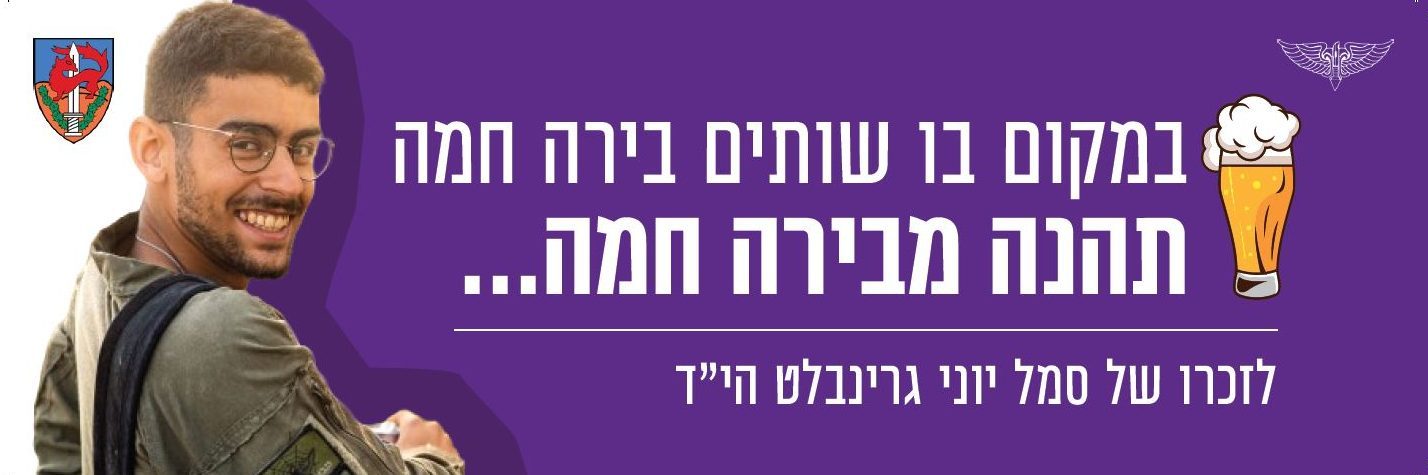
The memory of Yonatan Aharon Greenblatt does not remain only in words and pain. His friends, who loved him so much, found a creative and authentic way to commemorate his unique spirit. The idea for an original memorial project came from Yonatan himself, in such an everyday and simple situation, that it reflected the essence of his character. During one of his few exits from Gaza, a brief moment of respite from the fighting, he went to the sea with his twin brother Erel. The scorching Israeli summer sun had done its work, and the beers they had brought with them quickly warmed up. When Erel turned to him with a disappointed look, Yonatan, with his characteristic simplicity, replied: "In a place where you drink warm beer – enjoy warm beer." This sentence, which teaches about his positive and accepting nature, about the ability to find the good in every situation, became his memorial slogan. His friends took the idea and turned it into reality: they created a special edition of beer, with a recipe they specifically created for him, and printed this slogan on stickers distributed in his memory. Thus, even in death, Yoni's life continues to spread a light of optimism, acceptance, and joy of life.
Yonatan's memory is preserved in a variety of other ways, testifying to the immense impact he had on his surroundings. He is commemorated on the remember.bio memorial site, where his picture and the words written in his memory can be found, a testament to a wide community of people whose lives he touched. A special memorial page was also established in his memory on the website of the Beit Shemesh Municipality, his hometown, ensuring that future generations will also know his story. On YouTube, moving videos edited by his loved ones can be found, short clips showing moments from his life, accompanied by music he loved, commemorating his smile and spirit. Yonatan is also commemorated at "Yoav Fortress" – the Givati Brigade's home, near the Nahora Junction, a place where his name is carved in stone and appears alongside the names of other soldiers who fell in Israel's wars, as part of the glorious legacy of the purple brigade. Through all these, the life story of Yonatan Aharon Greenblatt continues to resonate. A story of a quiet young man with a big heart, a man of Torah who loved to learn, a brave and uncompromising fighter, and a loyal son, brother, and friend. His heroism was not loud, but quiet, everyday, so human, and it stemmed from his choices, from his willingness to sacrifice himself for the collective, from the simplicity with which he accepted reality and tried to make it better. He is a symbol of the Israeli spirit of renewal, of the young generation fighting for its homeland, and his legacy will continue to accompany us, strengthening our hearts and reminding us of the dear price of freedom and the values of love for humanity, dedication, and giving, which he embodied in his short and so meaningful life.
In the media
Articles
- Fallen soldier Yonatan Greenblatt and I have more in common than our name
The Times of Israel Blogs ·
- “Yonatan Aharon’s mother was sitting shiva; he did not leave Gaza because he feared he would not be allowed to return”
כיכר השבת ·
- Cleared for publication: Sergeant Yonatan Aharon Greenblatt, wounded in Gaza, has died of his wounds
וואלה ·
- Yoni leaves behind a twin brother: “When Erel entered the hospital room, his pulse rose from 30 to 110”
ynet ·
- From a child to a hero of Israel — SSgt Yonatan Aharon Greenblatt is laid to rest
Israel National News ·
- BDE: Sergeant Yonatan Aharon Greenblatt, z’l
ShemeshPhone ·
Songs
- The Great Love — Yoni Genut, Lavi Genut and the Yeshiva LaTze'irim choir
יוני גנוט / ערוץ 7 ·
Memorial sites
- Sgt. Yonatan Aharon Greenblatt, of blessed memory
remember.bio
- Izkor - Sergeant Yonatan-Aharon Greenblatt
משרד הביטחון - יזכור
Memorial projects
The music video “The Great Love,” by Yoni Genut, his son Lavi, and the Yeshiva L’Tzeirim choir, was released in his memory. The family participated in the production and supported the work; the music was produced by Shmulik Daniel and the video directed by Ohad Elimelech.
At the funeral, stickers for prayer books were distributed encouraging people to refrain from talking during prayers, for the elevation of his soul.
His friends produced a special-recipe beer edition and a memorial sticker inspired by something he said to his brother Arel during a visit to the beach.
His story was included in a book about fallen soldiers from hesder yeshivas. The article also tells of a bakery employee who pledged to regularly donate refreshments for a Torah class held for the elevation of his soul.
Stories told about them
His grandfather said that Yonatan did not ask for leave to attend his other grandfather's funeral or the shiva, fearing he would not be able to return to the fighting. He said Yonatan made sure to speak with his mother in his free time to reassure her.
His aunt Gilat described Yonatan’s responses to his twin brother Arel during his hospitalization, including an increased heart rate when Arel entered and sang to him. These are family accounts in the article, without independent medical verification.
After his grandfather died, Yonatan undertook to refrain from talking during prayer. At his funeral, stickers for prayer books were distributed, encouraging this commitment in his memory.
“In a place where people drink warm beer, enjoy a warm beer…”
Life & service
Profile
- Date of birth
- July 3, 2003
- Birthplace
- Beit Shemesh
- Date of death
- July 27, 2024
- Age
- 21
- Hometown
- Beit Shemesh
Service
- Rank
- Sergeant
- Unit
- Givati Brigade
- Honours
- Posthumously Promoted
- Battle Location
- Southern Gaza Strip
Family
- Father
- Aviya
- Mother
- Yisraela
Burial
Tributes & remembrance
רוצים להיות ראויים לך ולשכמותך.
יהי זכרך ברוך
ישראלה אביה וכל המשפחה המקסימה,
באהבה, תמי כספי
תמיד נזכור
יהי זכרו ברוך לעד.
יהי זכרו של גיבור ישראל ברוך.הי"ד אמן .ישראלה והמשפחה, תנוחמו משמים.חושבים עליכם ומחבקים אתכם בכאבכם.
יהי זכרו ברוך גיבור ישראל
יהי זכרו לנצח ברוך ותהא נשמתו צרורה בצרור החיים. גיבור ישראל.
יהי זכרו ברוך הי״ד
יוני, אוהבים ומתגעגעים
נזכור תמיד
לכבוד משפחת גרינבלט המדהימה מלאת העוצמה והאמונה
יהי זכרו ברוך, שנהיה ראויים.
We will continue to be a happy family, united.
Source:Israel National News
You are a good and heroic brother.
Source:Israel National News
Yoni, our heroic boy.
Source:Israel National News
Yoni, a boy of light and strength, a student at the hesder yeshiva in Ashdod.
Source:וואלה
Read the Hebrew original
יוני, ילד של אור ועוצמה, תלמיד ישיבת ההסדר באשדוד.
He kept going into Gaza.
Source:ynet
Read the Hebrew original
הוא כל הזמן נכנס לעזה.
I saw determination and strength in him
Source:ynet
Read the Hebrew original
ראיתי אצלו נחישות וחוזק
You were my favorite brother
Source:ynet
Read the Hebrew original
היית האח האהוב עליי
I love you and will not forget you
Source:ynet
Read the Hebrew original
אני אוהב אותך ולא אשכח אותך
A person with happiness in his eyes.
Source:ynet
Read the Hebrew original
בן אדם עם אושר בעיניים.
From early childhood, Yonatan was a mischievous and gentle boy; he did everything gently and quietly.
Source:כיכר השבת
Read the Hebrew original
יונתן מקטנותו היה ילד שובב ועדין, הכל נעשה אצלו בעדינות ובשקט.
The heart breaks, the grief is immense and inconceivable.
Source:כיכר השבת
Read the Hebrew original
הלב נשבר היגון עצום ובלתי נתפס.
They were here for a week and brought so much light to the department
Source:מקור ראשון
Read the Hebrew original
הם היו פה שבוע והוסיפו הרבה אור במחלקה
I pray that God will comfort his parents and siblings among the mourners of Zion.
Source:The Times of Israel Blogs
You were very special; there was simplicity and quiet in you.
Source:יזכור
Read the Hebrew original
היית מיוחד מאוד, הייתה בך פשטות ושקט.
A shy smile full of sincerity, courage and humility.
Source:יזכור
Read the Hebrew original
חיוך ביישני מלא תום לב, עוז וענווה.
He excelled at everything he did
Source:יזכור
Read the Hebrew original
הוא הצטיין בכל מה שעשה
Remembrance Day addresses
יום הזיכרון לחללי מערכות ישראל התשפ"ה – 2025
בכל יום שעובר, אזכור יותר! אזכור, את אלו שיצאו עימי לקרב ולא שבו, ולהם אין מי ידמה ומי ישווה. אזכור, שהכאב לא יעבור לעולם, והזמן, הוא לא מרפה ולא מרפא. אזכור, את שיברון הלב הגובר ואת הבית שבוער. אזכור, את צדקת הדרך, ואשבע שוב, שמה שהיה לא יהיה יותר. אזכור, שיותר מכל דבר אחר – אני חסר! ביום הזה, אני נתקף געגוע לדמותם, לחיתוך דיבורם, לחיוכם, ומדליק נר לזיכרון דרכם ומורשתם!
משרד הביטחון
אגף משפחות, הנצחה ומורשת
יום הזיכרון לחללי מערכות ישראל התשפ"ה – 2025
בכאב, בהצדעה ובתקווה אני מתכבד להדליק נר זיכרון זה. השנה, כשאנו נלחמים במלחמה ארוכה, רב זירתית וצודקת, הזיכרון נושא משמעות עמוקה. ביום זה נעצור ונתייחד עם זכרם של טובי בנינו ובנותינו שנפלו בהגנה על המדינה. מורשתם היא המצפן שמתווה את דרכינו, והיא המעניקה לנו כוח להמשיך ולהגן על מדינת ישראל ותושביה. משפחות יקרות, אנו מרכינים ראשנו ומתחייבים שנעמוד לצידכן תמיד. יהי זכר הנופלים ברוך.
אלוף דדו בר כליפא
ראש אגף כוח האדם, צה"ל
יום הזיכרון לחללי מערכות ישראל התשפ"ה – 2025
בשעה שאנו זוכרים את גודל תרומתם ועומק מסירות נפשם של טובי בנינו ובנותינו, נופלי מערכות ישראל לדורותיהן, ממשיכים צה"ל וכוחות הביטחון במימוש המשימה למענה לחמו ועבורה נפלו: הכרעת אויבינו מדרום, מצפון, ביהודה ובשומרון, וגם בזירות רחוקות יותר. בהערכה רבה ובגאווה אדירה אנו מרכינים ראש בפני הנופלים והנופלות, מאמצים את משפחותיהם אל לבנו, וממשיכים במשימה להבטחת קיומה של ישראל לדורי דורות. יחד נעשה ונצליח.
רב אלוף אייל זמיר
הרמטכ"ל, צה"ל
יום הזיכרון לחללי מערכות ישראל התשפ"ד – 2024
כאשר דגלינו מורדים לחצי התורן וראשינו מורכנים לזכר הנופלים והנופלות במערכות ישראל, ממשיכים לוחמי צה"ל ומפקדיו בלחימה בדרום, בצפון, ביהודה ובשומרון ובזירות נוספות. על כל דור מוטלת המשימה של הגנת העם והארץ – משימה שאף פעם אינה פוסקת. נצדיע בגעגוע ובגאווה לנופלים ולנופלות, נחבק את משפחותיהם, ונמשיך ברוח הציווי שהותירו לנו. עם ישראל חי.
רב ניצב יעקב שבתאי
המפקח הכללי, משטרת ישראל
יום הזיכרון לחללי מערכות ישראל התשפ"ד – 2024
אחיי הנופלים, כל נר הוא זיכרון יחיד ומיוחד, על חיים שהיו ואינם, געגוע שנצרב עמוק בלב, עולם ומלואו. הנרות כולם הם זיכרון של אומה כי לעולם לא עוד, בשורת הציונות וקוממיות ישראל. זיכרון כי הדרך לעם חופשי בארצנו עוברת דרך מסדר הנופלים. אור הנר יזכיר לנו את מסירות נפשכם להציל חיים, להגן על הבית. הנרות מסמנים לנו נתיב גבורה ערכי מחייב שאנו מצווים ללכת לאורו. נמשיך להילחם ולהוסיף אור מתוך אמונה בנצח ישראל.
יואב גלנט
שר הביטחון
יום הזיכרון לחללי מערכות ישראל התשפ"ד – 2024
בהצדעה ובכאב, בשם צה"ל כולו, אני מדליק נר זיכרון. בעיצומה של מלחמה, הזכרון נושא משמעות יום-יומית, שעבר והווה מתלכדים בה. לאורם של הנופלים נמשיך לצעוד, חיילי הסדיר והמילואים. לאורם של הנופלים נמשיך להגן על ארצנו ועל מולדתנו, גם כשהמחיר כבד. להבת-הזכרון תבער בנו בעודנו ממשיכים להלחם ונזכור את הנופלים ואת אומץ ליבם. משפחות יקרות, צה"ל מרכין היום ראש, מצדיע לכן וכואב איתכן. יהי זכר הנופלים ברוך.
אלוף יניב עשור
ראש אגף כוח האדם, צה"ל
יום הזיכרון לחללי מערכות ישראל התשפ"ד – 2024
בהוקרה, בגאווה ובכאב שאין לו סוף, אני מתכבד להדליק נר לזכרם של הנופלים והנופלות במערכות ישראל. סיפור חייהם בארץ הזאת, מסכת שירותם, גבורתם והקרבתם – הם סיפורה של הארץ הזאת, אך גם סיפור המחיר הכבד שהיא תובעת מאוהביה. מחויבותנו לזכר הנופלים ולדרך שהותירו לנו ניצבת תמיד לנגד עינינו. את המשימה שלא זכו להשלים, משלימים כיום, וישלימו, אנשי כוחות הביטחון, הממשיכים בדרכם ולאורם. יהי זכרם של הנופלים ברוך.
משרד הביטחון
אגף משפחות, הנצחה ומורשת
יום הזיכרון לחללי מערכות ישראל התשפ"ד – 2024
בחרדת קודש אני מתכבד להדליק נר לזכרם של חללי מערכות ישראל, חברנו שנפלו, מראשית היציאה מהחומות ולאורך כל שנות עצמאותנו המדינית והציונית, מהווים תמרור זיכרון לדרך חיינו ולמחוייבות הלאומית להנצחת זכרם. דרכם נותרה דרכנו ומורשתם נר להמשך עשייתנו. יהי זכרם ברוך!
בני גנץ
שר הביטחון
יום הזיכרון לחללי מערכות ישראל
נזכור אותם, כולנו יחד. כל אחד ואחת מהם, מדי יום ביומו, והיום ביתר שאת, כך – לנצח. "כי מדי דברי בו זכור אזכרנו עוד"
משרד הביטחון
אגף משפחות, הנצחה ומורשת