
The story
In the green hills, between natural woodlands and vineyards, lies Kibbutz Migdal Oz, a carefully tended patch of landscape in the heart of Gush Etzion. There, on the tenth day of Tishrei in the year 2002, on Yom Kippur when the angels themselves seemed to fall silent, Yakir Yedidya was born into the Shinkolovsky family. The youngest son of Gittel Tova Malka and Ariel Shalom, he was a little brother to Yehuda, Aviraz, Efer, and Renana. Their home, a warm and open kibbutz house, was always filled with the laughter of children, the smells of home-cooked meals, and the sounds of Torah study blending seamlessly with everyday conversations about kibbutz affairs and the wider world. Yakir grew up inside this fabric, inside a community that lived its principles—the connection to the land and the love of people—in simplicity and humility. He was a smiling baby who won hearts instantly. His large, curious eyes already hinted at a rich inner world, and his sweet smile was contagious, melting everyone around him.
Yakir’s childhood was woven into the paths of the kibbutz, into the scent of wet earth after the first rain, and into the sounds of cowbells ringing from the nearby dairy barn at dawn. He learned to walk on stone-paved paths, ran barefoot across the grass in the public garden, and played hide-and-seek among the ancient olive trees. The surroundings of Migdal Oz, which combined wild nature with communal life, shaped his sensitive and open soul. At the regional state-religious school in Gush Etzion, where he began his studies, he stood out not only for his constant smile but also for a quiet intelligence. He was not the loudest child in class, but when he spoke, his words were precise, sometimes surprisingly deep, and he absorbed material with exceptional ease. His memory was phenomenal, and from a young age he showed an enormous curiosity about every subject, from Torah stories to the smallest details of the natural world around him. He loved wandering through the groves near the kibbutz, collecting leaves and flowers, observing insects, and asking questions about everything he saw—questions that revealed a contemplative and thoughtful mind. His parents and siblings remembered the boy who could sit quietly for hours with a book or gaze for a long time at a small flower, as if deciphering its secrets.
As he grew older, his unique personality only strengthened. Yakir was never afraid of hard work and was always willing to get dirty for the sake of the task. Even as a child, when others avoided less pleasant chores, he approached them with joy and a smile. If there was work to be done in the dairy barn, for example, he was the first to volunteer. He didn’t mind the strong smell or the mud; what mattered to him was the contribution and the act itself. He treated every task, small or large, with seriousness and responsibility beyond his years. He learned to see the beauty in labor, the satisfaction in creation, and he understood that no work is “beneath” anyone if it is done with good will. At home too, he was always the first to offer help, to lift heavy things, to clean up after everyone, all without complaint, out of an inner understanding of what needed to be done. He was a creator of quiet. His presence calmed those around him, and he influenced others not through many words but through personal example, kindness, and a winning smile that expressed the goodness of his heart.
In his teenage years, Yakir went to study at the Bnei Akiva–Orot Yehuda yeshiva high school in Efrat, where he continued to develop both his spiritual and intellectual world. In the yeshiva, he was not only diligent in his studies but also revealed himself as a natural, quiet leader. He served as a counselor in the Bnei Akiva youth movement, leading groups of younger children, teaching them about love of the land, values, and the meaning of community. He was a young field counselor—for nation and society—and led hikes and journeys, sharing with his charges the vast knowledge he had accumulated about nature and history, but above all, his deep love for the land. His campers adored him. He knew how to speak to them at eye level, to listen to their dilemmas, and to inspire them. He never shouted or preached; instead he showed them the way through his own actions, through his willingness to go first, to open paths, and to face physical and mental challenges. The trips he organized were always planned down to the smallest detail, and he took care of each and every camper, making sure everyone felt safe and included.
After finishing yeshiva high school, Yakir chose to continue his spiritual and intellectual path at the hesder yeshiva in Yerucham. The choice of Yerucham, a remote desert town, was not accidental. It reflected his deep desire to distance himself from the centers of noise and to focus on serious study and meaningful action. In the study hall of Yerucham, Yakir flourished. He displayed great perseverance and diligence, spending hour after hour immersed in the pages of the Talmud and other books, delving into complex topics and seeking to understand their depths. The head of the yeshiva, Rabbi Uriel Eitam, remembered him as someone who “made his Torah fixed,” anchoring his place in the study hall with devotion. He was one who “says little and does much”—studying quietly, delving deeply, but when action was needed, he was the first to rise and carry it out. His friends in the yeshiva appreciated his wisdom and his ability to analyze topics in an original way, but more than anything, they valued his pleasant and modest character. He was a true friend, knew how to listen patiently, to support others in times of need, and his shy, pleasant smile was his trademark, accompanying every meeting and every conversation, creating a feeling of acceptance and warmth.
Yet alongside his spiritual world, another passion burned in Yakir—an old, familiar dream: to become a tank soldier. From a young age, the roaring diesel engines of tanks, the massive steel armor, and the uncompromising power of the machine had captured his imagination. He saw the tank not merely as a weapon of war but as a symbol of defense, strength, and the ability to stand firm against any threat. He spoke about it with his friends in the yeshiva with genuine excitement and shining eyes, and even managed to convince some of them to enlist with him in the armored corps. The preparations for enlistment were exciting, but then came the bitter news: an orthopedic problem that was discovered prevented him from serving as a combat soldier. For Yakir, this was a shattering blow. His life’s dream was in danger. But he was not a man who gave up easily. When he was told the problem might be solved with physical therapy, he made a bold decision: to postpone his enlistment and devote himself fully to treatment. It was an exhausting period filled with physical and mental pain—hours of exercises, relentless effort, coping with frustration—all for one purpose: to fulfill his dream. Thanks to his uncompromising determination, hard work, and dedicated treatment, he managed to overcome the limitation. He proved to himself and to those around him that with strong will and faith, any barrier can be broken.
On November 11, 2021, Yakir enlisted in the IDF, proudly putting on the olive-green uniform and joining the armored corps. It was a moment of immense personal victory. He loved military service with all his being—the discipline, the challenging basic training, the social bonding, and the sense of mission. He strove to be a good comrade and a good soldier in every sense of the word, investing his entire self in every task. One of his basic training friends remembered Yakir as someone who should have been chosen as outstanding trainee and tried to console him when it didn’t happen. Yakir, with his calm smile and characteristic modesty, replied that what really mattered was to act “quietly and humbly,” not out of pursuit of honor or recognition, but from an inner belief in the path. And indeed, that spirit guided him throughout his training. In the end, although he did not seek the spotlight, his talent and dedication did not escape the eyes of his commanders, and he completed the course as an outstanding platoon soldier—an impressive achievement that reflected his high abilities and his uncompromising commitment. After finishing his training, Yakir was assigned as a loader in an M-60 tank (company commander’s tank) in Company C, Battalion 53, of the 188th Brigade—the legendary “Barak” Brigade.
Even as a soldier, Yakir never shied away from any job. He was always the first to volunteer for every task and carried it out with diligence and responsibility, going above and beyond what was required. He did not see “black” jobs as a burden but as an opportunity to contribute and be useful. One commander remembered an incident in which there was a stubborn clog in the base showers—a disgusting, foul-smelling problem that no one wanted to deal with. The soldiers avoided it and the commanders were at a loss. Suddenly, without anyone asking him, Yakir simply walked into the showers alone. He dismantled the entire clogged piping, cleaned it thoroughly, and put everything back in place. When he came out, soaked and filthy, he flashed a wide, almost shy smile, as if he had done the most natural and simple thing in the world. That was his essence: a man of action, quiet, gentle, and pleasant to everyone around him, who always acted out of brotherhood and respect for others, and who earned the appreciation and love of everyone who knew him. He was a kind of “social glue,” with a rare ability to draw people to him and to connect people to one another. Even during his military service, when he and his new friends arrived at the company for training, he was the one who created the natural and warm connection between them and the veteran fighters, dispelling fears and creating a real sense of belonging. He knew how to see the person behind the uniform, to speak to each person in his own language, and to find what they had in common.
The same direct and respectful connection he knew how to create with people his own age and with older adults, Yakir also created with children. His nieces and nephews loved him fiercely and adored their young, smiling uncle. For them, he was the perfect uncle—the kind who knew how to listen to their imaginary stories, to play endless role-playing games with them, to roll around with them on the grass, and to tell them fascinating tales. He did not treat them as “little children” but as complete personalities with rich inner worlds. He would get down to their eye level, give himself fully to the game, and laugh with them in rolling laughter. When he came home on leave from the army, they would run to him, hang on his neck, and refuse to let go for long minutes. For his part, he would hug them warmly, stroke their heads, and feel the pure happiness in that innocent connection. He also formed a special bond with the children of his rabbis in the yeshiva who would come to the study hall. He knew how to listen to them patiently, to play educational games with them, and to answer their innocent questions with complete seriousness. He became a significant figure for them too, like an older brother or a reliable grown-up friend they could trust and tell their secrets to. He remembered their names, their hobbies, and always showed genuine interest in them.
And then came the most terrible morning of all. On Saturday, the twenty-second of Tishrei, Simchat Torah 5784—October 7, 2023—as an Israeli autumn sun rose slowly over the horizon and the people of Israel were still immersed in Simchat Torah celebrations, a cruel and unprecedented surprise attack was launched. At six-thirty in the morning, massive explosions shattered the quiet as thousands of rockets and missiles were fired without pause from the Gaza Strip toward wide areas across the country. Under the cover of the rocket fire, thousands of Hamas terrorists infiltrated by land, sea, and air and began a murderous assault on the communities of the Gaza envelope, on Sderot, Ofakim, and Netivot, on the Nova music festival site near Kibbutzim Re’im and Nir Oz, on IDF bases, and on people traveling the roads in the area. Long minutes of uncertainty turned into hours of unimaginable horror. The terrorists murdered some eight hundred civilians in cold blood in their homes and cars, after committing unspeakable atrocities against them. They abducted hundreds of Israelis—babies, children, women, men, and the elderly—into the Gaza Strip, destroying, looting, and burning homes and property. Hundreds of soldiers, police officers, security personnel, and members of local civilian security teams fell in battle while defending the state’s citizens with their bodies. On that grim morning, the “Iron Swords” war began—a war that changed the face of the country.
Yakir, who was then in active service, was immediately called up. The phone vibrated, WhatsApp messages flooded in nonstop, and the morning quiet gave way to the commotion of emergency mobilization. He did not hesitate for a moment. The land on which he had grown up, the home that had shaped his character, the people he loved—all were in danger. He packed his bag quickly, said a hurried goodbye to his family, and set out into the unknown, into a war the likes of which had never been seen. He and his tank crew, as part of the Golani Brigade’s evacuation platoon, quickly entered the disaster-stricken areas. Their role was critical: to evacuate the wounded, the dead, and civilians trapped under fire. They moved through the terrain under constant threat, witnessing before their eyes the terrible destruction, the smoke rising from burned houses, and the signs of horror left by the terrorists. Yakir and his team formed a special bond with the Golani fighters on the ground. They were there for them at all times, ready to assist, extract, and protect. They served as the eyes and ears of the infantry soldiers, arriving quickly at every call, under heavy fire, out of a deep sense of responsibility. Yet despite the immense importance they saw in this role, in them—and especially in Yakir—burned the desire to return to their own company and join the fighting at the spearhead. They felt they could contribute more by fighting the enemy directly rather than merely clearing up the results of its actions.
On Wednesday, November 29, 2023, about a month and a half after the outbreak of the war, Yakir’s family was able to visit him at the assembly area in Arad Park. The meeting was emotional and filled with mixed feelings. On one hand, there was enormous relief at seeing him healthy and whole, his familiar smile once again on his face. On the other, there was deep concern about what lay ahead and the missions still before him. Yakir, with shining eyes and great pride, told them that the next time he and his friends entered Gaza, they would already be taking part in the actual fighting. He spoke about it with enthusiasm, not out of recklessness but from a deep sense of mission, faith in the justice of the path, and a fierce desire to protect his home. Tova, his mother, later recounted how her heart had calmed and how happy she was to see him looking so good, so at peace with himself and with his path. He radiated inner strength and serenity despite the tense situation. He strengthened the family and promised he would take care of himself. They hugged him in a long embrace—an embrace of parting and of hope, an embrace meant to store strength for the moments to come.
Five days later, on Monday, December 4, 2023, Yakir’s tank entered the Gaza Strip at the head of the battalion into the Shuja’iyya neighborhood. Shuja’iyya, a known terrorist stronghold, was a complex and dangerous target, riddled with tunnels, explosives, and ambushes. The battle was expected to be difficult and brutal. Yakir’s tank, serving as the company commander’s tank, led the force, breaking through under fire while protecting the troops advancing behind it. The tension in the air was palpable; every movement was weighed carefully, every turn might be the last. When they reached the outskirts of the neighborhood, in a crowded and dense area, a lethal anti-tank missile was fired at them. Everything happened with dizzying speed. The missile struck the tank with tremendous force; a powerful explosion shook the ground. Yakir and two other members of the tank crew—beloved and devoted fighters—were killed on the spot. Only the tank driver survived, wounded and in shock. Staff Sergeant Yakir Yedidya Shinkolovsky fell in battle at the age of twenty-one, defending his people and his land with his body. He was laid to rest in the military section of the cemetery in Kfar Etzion, beneath the skies of the kibbutz where he had grown up. After his death, he was posthumously promoted to the rank of Sergeant in recognition of his dedication and bravery. He left behind heartbroken parents, three brothers and a sister, and an entire community that felt an immense loss.
The mourning was deep and painful, but alongside it rose a sense of pride in the way Yakir had lived and in the sacrifice he had made. Tova, his mother, eulogized him with a trembling voice but eyes that radiated strength: “My dear Yakir, that’s what we always called you—my dear Yakir, in every sense of the word, a gift we were privileged to have for twenty-one years. How much we learned from you. A special child with inner strength even in periods that were challenging for you. From the moment you left for yeshiva and then the army, you grew and developed so much. There was depth and sensitivity in you. Last Wednesday we were privileged to come see you and you looked so good, and I calmed down and was happy… Yakir believed in what we too believe and in what we raised our children to believe: that we have a right to be here in this land even if it means fighting for it. May we learn to fight for the important things together and not let disagreements divide us.” His mother’s moving words highlighted Yakir’s deep faith and the message of unity he sought to convey.
His brother Aviraz eulogized him with warmth and longing: “Yakir my beloved brother, the sweetest uncle my children loved most to play with… As your name, so you were—a precious person and a true friend. You had a rich inner world and a rare sensitivity to those around you. Every station you conquered in your short life you achieved through hard work. You worked hard and with humility, and you kept your optimism and big smile on your face. It was so moving to see you chosen as outstanding trainee at the end of your course, so loved and respected by your friends. You fell for the people, the state, and the land. We will do everything so that it will not be in vain. We will continue, we will build, we will plant, we will grow, we will develop, and we will unite as a people, because that was your way.” Aviraz’s words painted a portrait of Yakir as a beloved, dedicated figure of exceptional determination who left a deep mark on everyone who knew him.
Another brother, Efer, struggled to contain the loss: “There was in you a captivating innocence connected to profound simplicity. You believed in something and you did it, without asking questions and without doubting, simply because you thought it was the right thing… You arrived at the hesder yeshiva in Yerucham, you flourished, and it was a joy to watch you from the side as you grew and developed. Then you came to the army and you really blossomed. You would come home and speak with shining eyes about the army; at a moment’s notice you were the first to be ready.” Efer described Yakir as a man of action and faith who gave himself completely to his path and saw the army not merely as a place of service but as the fulfillment of a destiny.
Renana, his younger sister, expressed the enormous sense of absence and missed opportunity: “Not long ago we talked about love,” she eulogized. “You said that falling in love seemed scary to you—scary to open up and give yourself to someone else like that. For someone like you it really was scary. You love deeply and you love strongly, and when you love something it’s all the way to the end… You were supposed to find someone to love like that, you were supposed to love and get married and have children and love them even more. You were supposed to learn the history of everything in the world and quote me paragraphs from books that I barely remember reading. I don’t know how to summarize you now. We were supposed to have more time for everything.” Renana’s words revealed the depth of Yakir’s soul, his ability to love without limits, and the many dreams that were cut short, leaving behind a huge void of “what could have been.”
Even Yakir’s rabbis, who knew his spiritual and intellectual world, struggled to absorb his departure. The head of the Yerucham hesder yeshiva, Rabbi Uriel Eitam, eulogized him: “In your life you did everything quietly. And all your wonderful qualities were hidden behind that quiet… There are people who are privileged that a mishnah describes their personality in such a precise sketch: ‘Make your Torah fixed, say little and do much’… First of all, in the simple sense, you fixed your place in the study hall… You were truly one who ‘says little,’ but when someone was needed to do—you did. And with a pleasant countenance: you were always with that pleasant, simple, slightly shy smile. To everyone. A smile with which you were pleasant to people, beloved by all. You were wise, curious, you read a variety of things, you absorbed, you remembered, you were original.” Rabbi Eitam described Yakir as a rare figure who combined humility and quiet with deep wisdom and infinite willingness to act—a man who was all truth and simplicity.
Rabbi Uri Samet, the rabbi of Kibbutz Migdal Oz, who had watched Yakir grow and develop, remembered him from childhood: “Who doesn’t remember little Yakir, lighting up the face of everyone he met, arousing a smile and a sweetness that is hard to describe. In classes too you showed a wonderful memory and a desire to learn, and already at your bar mitzvah you completed a tractate of Talmud… That’s how you were. Showing dedication in everything you did, loving God and walking with dedication, perseverance, and integrity.” Rabbi Samet’s words emphasized Yakir’s deep roots in the kibbutz and in tradition, and his uncompromising dedication to the values that had guided him from the day he was born.
Yakir Yedidya Shinkolovsky of blessed memory left behind a legacy of love of people, humility, action, and deep faith. His family, carrying the pain of loss, asked that his memory become a beacon of unity: “We ask that the stamp of brotherhood that Yakir left through his actions accompany all of Israeli society. Even if there are disagreements among us, we must always remember that first and foremost we are brothers, and from that recognition we must conduct our disagreements. This is the legacy that Yakir and his friends left us, and we will walk in its light.” The story of Yakir Yedidya, the smiling kibbutz boy who became a brave armored fighter, is a story of choosing a life of meaning, of overcoming obstacles, and of giving without limit. He is a symbol of an entire generation of young Israelis who grow up on the values of love of the land and of people, and who are willing to sacrifice what is most precious for the security of the state and its future. The memory of Yakir, with his eternal smile and his captivating humility, will remain engraved deeply in hearts and will serve as an inspiration to all of us to walk in his path—the path of brotherhood, action, and faith. May his memory be blessed.
In the media
Articles
- Weiser v. Iran — Complaint, Schenkolewski family, paragraphs 519–532
Osen LLC / U.S. District Court filing ·
- IDF announces officer, 2 soldiers from tank brigade killed fighting in Gaza
The Times of Israel ·
- An officer and soldiers were killed by an anti-tank missile on the outskirts of Shejaiya: “Three from Eitan’s tank”
ynet
- Hundreds accompanied Yakir to his final resting place: “A gift we were blessed with for 21 years” — Kol Rega
www.kore.co.il
- “Deep sorrow and a broken heart”: Sergeant Yakir Yedidya Shinkolevsky was killed in Gaza | Israel National News
ערוץ 7
Social posts
- Daniel Amram Uncensored - Remembering Three Tank Soldiers
דניאל עמרם ללא צנזורה / Telegram ·
Stories told about them
Yakir was killed with Eitan Fish and Tuval Tzanani by anti-tank fire on the outskirts of Shuja’iyya. The hesder yeshiva in Yeruham announced that he would be buried beside his friend Eitan Rosenzweig.
His mother said she felt reassured when she saw him on the last Wednesday before he fell. Aviraz described the achievements he had worked hard for and his anticipation of joining the fighting.
His grandmother Sarah Goodman described three eulogists from the army, the yeshiva and the kibbutz who emphasized his devotion to Torah, the IDF and the kibbutz. She explicitly corrected the website to state that he was survived by a sister and three brothers, not four brothers.
Yakir regularly participated in Mishnah study before the evening prayer at the yeshiva. After his friends enlisted, while his own enlistment was delayed by a medical issue, he continued and taught the class himself.
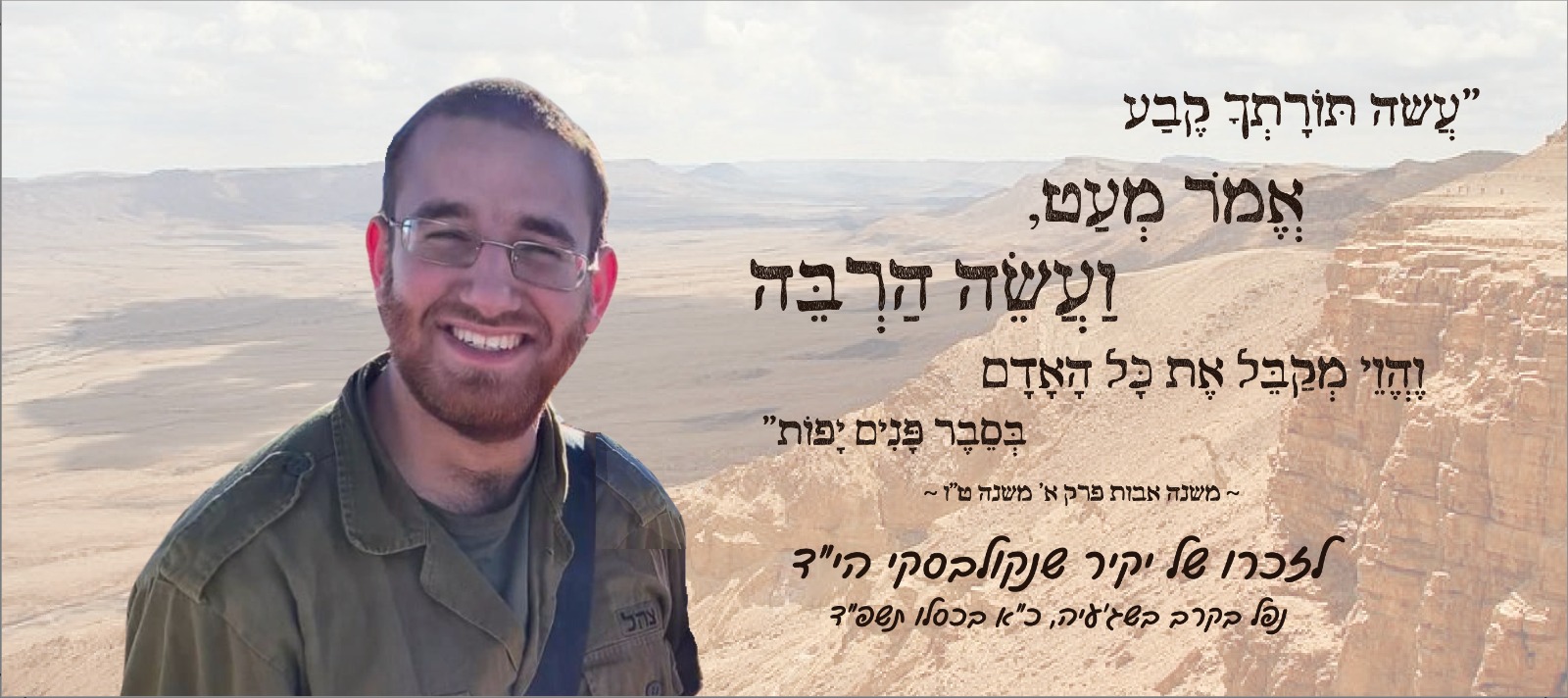
“Make your study of the Torah a fixed practice; speak little, but do much; and receive all men with a pleasant countenance. Pirkei Avot 1:17”
Life & service
Profile
Service
- Rank
- Sergeant
- Honours
- Posthumously Promoted
- Battle Location
- Gaza Strip
Family
- Father
- Ariel Shalom
- Mother
- Gitel Tova Malka
Burial
Tributes & remembrance
לטובה היקרה ולכל המשפחה,
יהי זכרו של יקיר ברוך ושלצד העצב הנורא , הזכרונות החמים ממנו וממי שהיה ילוו אתכם באהבה.
לא הכרתי אותך אישית לצערי הרב אבל אני כן זוכר אותך בטירונות בשיזפון תמיד עם חיוך על הפנים אפשר לראות טוב על בן אדם גם בלי להכיר אותו אתה היית כזה אני בטוח יהי זכרך ברוך גיבור
לזכר תלמידי האהוב!
לא נשכח אותך לעולם גיבור ישראך
סמל יקיר ידידיה שנקולבסקי ז"ל
מלאך שנקטף
נזכור אותך לעד
הפסד גדול. משתתפים בצער המשפחה
כשמך היית בכל מקום, איש יקר.
צנוע בהליכותיו, אמת בפיו ובמעשיו.
חיוך שמשקף את תנועות הנפש המבקשות להוסיף אור וטוב.
תודה שהגנת עלינו, זיכרונך בליבנו תמיד
תמיד בליבנו
לנצח תלמידי,
אזכור אותך תמיד.
המורה טליה
נזכור ולא נשכח לעולם
יקיר ידידיה היקר,
תודה לך שהגנת עלינו במסירות נפש,
במובן הכי מוחשי והכי נורא של הביטוי.
תנחומים מלב כואב לכל יקיריך .
יהא זכרך ברוך,גיבור ישראל
יהי זכרו ברוך
לוחם אמיץ שרק ניהיה ראויים לך
גיבור יקר, לא הכרתיך אישית אבל החותם שהשארת מורגש בפלוגה עד היום.
אח יקר והאהוב, לוחם גיבור בעל משמעת עצמית, מסירות עבודה ולב ענק,
תודה על אישיות מדהימה שתלווה אותי כל החיים,
הטען הכי טוב שהכרתי, זכיתי להיות התותחן שלך בצמפ. אוהב אותך, לא נפלת! התעלת!! אתה נמצא במקום הכי טוב בעולם! זכית לקנות עולמך בשעה אחת
טובה אהובה וכל המשפחה. מחבקת את צערכם ואת הזכרונות מיקיר ידידיה. יהי זכרו של יקיר ברוך
יהי זכרך ברוך גיבור ישראל
תודה ששמרת עלינו
השם ינקום דמך
אדם מדהים ומסור
למדתי המון מהשקט שלך ומהעשייה שלך
מתגעגע מאוד
אוהב תורה, אוהב אדם, אוהב עבודה.
פעל בהשקט ובצנעה
גדוד סופה זוכר את גיבוריו ופועל לאור מורשתם, יהי זכרם ברוך.
גדוד סופה זוכר את גיבוריו ופועל לאור מורשתם, יהי זכרם ברוך
Yedidya was a beloved and well-known boy in our kibbutz, one of our finest sons
Source:ערוץ 7
Read the Hebrew original
ידידיה היה ילד אהוב ומוכר בקיבוץ שלנו, מטובי בנינו
With deep sorrow and broken hearts, we learned that our dear and beloved student had fallen in Gaza.
Source:ערוץ 7
Read the Hebrew original
בצער עמוק ובלב קרוע התבשרנו על נפילתו של תלמידינו היקר והאהוב בעזה.
Yakir believed that we have a right to be here in this country.
Source:www.kore.co.il
Read the Hebrew original
יקיר האמין שיש לנו זכות להיות כאן בארץ.
You had a rich inner world.
Source:www.kore.co.il
Read the Hebrew original
היה לך עולם פנימי עשיר.
Your pain is also the national pain of the entire community.
Source:ynet
Read the Hebrew original
כאבכם הוא גם כאב לאומי של הקהילה כולה.
Remembrance Day addresses
יום הזיכרון לחללי מערכות ישראל התשפ"ה – 2025
בכל יום שעובר, אזכור יותר! אזכור, את אלו שיצאו עימי לקרב ולא שבו, ולהם אין מי ידמה ומי ישווה. אזכור, שהכאב לא יעבור לעולם, והזמן, הוא לא מרפה ולא מרפא. אזכור, את שיברון הלב הגובר ואת הבית שבוער. אזכור, את צדקת הדרך, ואשבע שוב, שמה שהיה לא יהיה יותר. אזכור, שיותר מכל דבר אחר – אני חסר! ביום הזה, אני נתקף געגוע לדמותם, לחיתוך דיבורם, לחיוכם, ומדליק נר לזיכרון דרכם ומורשתם!
משרד הביטחון
אגף משפחות, הנצחה ומורשת
יום הזיכרון לחללי מערכות ישראל התשפ"ה – 2025
בכאב, בהצדעה ובתקווה אני מתכבד להדליק נר זיכרון זה. השנה, כשאנו נלחמים במלחמה ארוכה, רב זירתית וצודקת, הזיכרון נושא משמעות עמוקה. ביום זה נעצור ונתייחד עם זכרם של טובי בנינו ובנותינו שנפלו בהגנה על המדינה. מורשתם היא המצפן שמתווה את דרכינו, והיא המעניקה לנו כוח להמשיך ולהגן על מדינת ישראל ותושביה. משפחות יקרות, אנו מרכינים ראשנו ומתחייבים שנעמוד לצידכן תמיד. יהי זכר הנופלים ברוך.
אלוף דדו בר כליפא
ראש אגף כוח האדם, צה"ל
יום הזיכרון לחללי מערכות ישראל התשפ"ה – 2025
בשעה שאנו זוכרים את גודל תרומתם ועומק מסירות נפשם של טובי בנינו ובנותינו, נופלי מערכות ישראל לדורותיהן, ממשיכים צה"ל וכוחות הביטחון במימוש המשימה למענה לחמו ועבורה נפלו: הכרעת אויבינו מדרום, מצפון, ביהודה ובשומרון, וגם בזירות רחוקות יותר. בהערכה רבה ובגאווה אדירה אנו מרכינים ראש בפני הנופלים והנופלות, מאמצים את משפחותיהם אל לבנו, וממשיכים במשימה להבטחת קיומה של ישראל לדורי דורות. יחד נעשה ונצליח.
רב אלוף אייל זמיר
הרמטכ"ל, צה"ל
יום הזיכרון לחללי מערכות ישראל התשפ"ד – 2024
כאשר דגלינו מורדים לחצי התורן וראשינו מורכנים לזכר הנופלים והנופלות במערכות ישראל, ממשיכים לוחמי צה"ל ומפקדיו בלחימה בדרום, בצפון, ביהודה ובשומרון ובזירות נוספות. על כל דור מוטלת המשימה של הגנת העם והארץ – משימה שאף פעם אינה פוסקת. נצדיע בגעגוע ובגאווה לנופלים ולנופלות, נחבק את משפחותיהם, ונמשיך ברוח הציווי שהותירו לנו. עם ישראל חי.
רב ניצב יעקב שבתאי
המפקח הכללי, משטרת ישראל
יום הזיכרון לחללי מערכות ישראל התשפ"ד – 2024
אחיי הנופלים, כל נר הוא זיכרון יחיד ומיוחד, על חיים שהיו ואינם, געגוע שנצרב עמוק בלב, עולם ומלואו. הנרות כולם הם זיכרון של אומה כי לעולם לא עוד, בשורת הציונות וקוממיות ישראל. זיכרון כי הדרך לעם חופשי בארצנו עוברת דרך מסדר הנופלים. אור הנר יזכיר לנו את מסירות נפשכם להציל חיים, להגן על הבית. הנרות מסמנים לנו נתיב גבורה ערכי מחייב שאנו מצווים ללכת לאורו. נמשיך להילחם ולהוסיף אור מתוך אמונה בנצח ישראל.
יואב גלנט
שר הביטחון
יום הזיכרון לחללי מערכות ישראל התשפ"ד – 2024
בהצדעה ובכאב, בשם צה"ל כולו, אני מדליק נר זיכרון. בעיצומה של מלחמה, הזכרון נושא משמעות יום-יומית, שעבר והווה מתלכדים בה. לאורם של הנופלים נמשיך לצעוד, חיילי הסדיר והמילואים. לאורם של הנופלים נמשיך להגן על ארצנו ועל מולדתנו, גם כשהמחיר כבד. להבת-הזכרון תבער בנו בעודנו ממשיכים להלחם ונזכור את הנופלים ואת אומץ ליבם. משפחות יקרות, צה"ל מרכין היום ראש, מצדיע לכן וכואב איתכן. יהי זכר הנופלים ברוך.
אלוף יניב עשור
ראש אגף כוח האדם, צה"ל
יום הזיכרון לחללי מערכות ישראל התשפ"ד – 2024
בהוקרה, בגאווה ובכאב שאין לו סוף, אני מתכבד להדליק נר לזכרם של הנופלים והנופלות במערכות ישראל. סיפור חייהם בארץ הזאת, מסכת שירותם, גבורתם והקרבתם – הם סיפורה של הארץ הזאת, אך גם סיפור המחיר הכבד שהיא תובעת מאוהביה. מחויבותנו לזכר הנופלים ולדרך שהותירו לנו ניצבת תמיד לנגד עינינו. את המשימה שלא זכו להשלים, משלימים כיום, וישלימו, אנשי כוחות הביטחון, הממשיכים בדרכם ולאורם. יהי זכרם של הנופלים ברוך.
משרד הביטחון
אגף משפחות, הנצחה ומורשת
יום הזיכרון לחללי מערכות ישראל התשפ"ד – 2024
בחרדת קודש אני מתכבד להדליק נר לזכרם של חללי מערכות ישראל, חברנו שנפלו, מראשית היציאה מהחומות ולאורך כל שנות עצמאותנו המדינית והציונית, מהווים תמרור זיכרון לדרך חיינו ולמחוייבות הלאומית להנצחת זכרם. דרכם נותרה דרכנו ומורשתם נר להמשך עשייתנו. יהי זכרם ברוך!
בני גנץ
שר הביטחון
יום הזיכרון לחללי מערכות ישראל
נזכור אותם, כולנו יחד. כל אחד ואחת מהם, מדי יום ביומו, והיום ביתר שאת, כך – לנצח. "כי מדי דברי בו זכור אזכרנו עוד"
משרד הביטחון
אגף משפחות, הנצחה ומורשת