
The story
In the heart of the Negev Highlands, a small, tranquil community settlement called Midreshet Ben-Gurion, where the desert’s edge meets the community’s pathways, Uri Bar Or first drew breath on a cool winter morning, the 19th of December, 2002. He was the eldest son of Noa and Yaakov, known to all as Kobi, and in time, he would become a big brother, a role model, and a guiding figure to his two younger brothers, Yiftach and Itamar. Their home, set against the primeval landscape of acacia trees and bare stone hills, was a warm nest of creativity and quiet. Here, the desert’s sounds—whispers of wind, the chirping of birds—intermingled with the sounds of life, a love for music, and a deep affection for humanity. Uri grew up immersed in this landscape, watching the sun rise over the Edom Mountains, heralding a new day, or setting on the horizon, painting orange and purple arcs at the world’s edge. He absorbed the simplicity and power of the place. As the eldest, he possessed something special from the very beginning, a gentle yet determined spirit, an endless curiosity, and a genuine desire to understand the world and its people. He was the one who helped his mother clear the dishes after dinner, who read stories to his younger brothers before bed, and who always made sure no one was left alone during the kibbutz yard games.
Uri’s early childhood years were filled with the desert sun and the vibrant bustle of a lively home. Whether playing with Yiftach and Itamar in the yard, among the young olive trees his parents had planted, or running with friends along the Midrasha’s paths, he always had a special spark—a readiness to give, a sincere desire to make a positive impact on his surroundings. His father, Kobi, noticed these traits even then, seeing in him a child with a "soft heart, full of love, and an immense will to influence." He wasn't a child who pushed himself to the forefront but rather one who worked quietly, behind the scenes, to ensure everyone felt comfortable, that everyone found their place. When he played soccer with his friends in the midday sun, his face flushed and sweat dripping from his forehead, he wasn't the one who fiercely chased every ball. Instead, he was the one who made sure to pass, to share, to ensure that even the weaker players on the team got a chance to shoot at the goal. He loved the sense of teamwork, of cooperation, and was always there to calm small arguments or mediate between friends. His childhood in Midreshet Ben-Gurion, with its open desert expanses serving as endless playgrounds and its small, close-knit community where everyone knew everyone, instilled in him a deep sense of belonging and the understanding that everyone is part of a larger tapestry.
Uri spent his elementary school years at the local "Tzin" school, where he proved to be an inquisitive and thoughtful student, though modest, never seeking undue attention. He loved to learn, not just to excel, but from a genuine desire to understand things deeply. He would immerse himself in books, trying to break down complex ideas, yet he always had time for a friend who needed help with homework or a younger child seeking a listening ear. At home, returning from school, he would tell his parents about the new things he had learned, the classroom discussions, and the ideas swirling in his head. He always shared his experiences with Yiftach and Itamar, trying to include them in his life even when they were too young to understand everything. He wasn't a boisterous child; rather, an inner quiet enveloped him, a stillness that allowed him to focus, create, and think. When he was ten, he discovered the world of music in a way that transformed his life. It wasn't just about listening to favorite songs, but about a deep understanding of structure, harmony, and rhythm. He began to play, first on simple keyboards, then on other instruments, trying to grasp how sounds combine to create emotion, how silence turns into noise, and how a single note can become an entire melody.
When he transitioned to the "Environmental High School," Uri's choice of the music major was natural, almost inevitable. There, within the classroom walls and rehearsal rooms, his talent blossomed in full force. He was not just a musician, but a composer. His teachers, led by the head of the music department and his mentor, Professor Michael Wolpe, recognized in him an "extraordinary talent, one in a generation." Professor Wolpe later eulogized him with pain, saying, "I waited 20 years for a student like this," a powerful testament to Uri's musical genius. The music rooms at the high school became his personal sanctuary. There, surrounded by sheet music, instruments, and blank pages, he would sit for long hours, his fingers hovering over the keys, his eyes focused on the evolving score on the screen. He composed complex musical pieces, ones that combined many instruments, combinations that sometimes sounded almost impossible, yet in Uri's hands, they merged into perfect harmony. He wasn't content with the familiar; he constantly sought the new, the challenging, the way to express deep emotions through sounds. The woody scent of the piano, the tuning sounds of violins, the echoing keyboard in the space—all these were an inseparable part of his world. He published his works on his own YouTube channel, "Uri Bar Or," sharing his inner world with the outside, with his characteristic modesty and humility. He didn't seek fame, but rather wanted his music to reach as many ears as possible, to touch as many hearts as possible.
The pinnacle of his creative work came with his final project: the composition "Rhythm of the Heart." This was a complex score, written for twelve different instruments, each with its unique voice, all together creating a moving and profound symphony. The climax of the piece was its impressive performance at the "Sounds in the Desert" festival, a well-known cultural event held in his home region. On his eighteenth birthday, a symbolic and meaningful date, no fewer than fifty-one musicians from the Israel Chamber Orchestra took to the stage and breathed life into the notes Uri had created. He sat in the audience, next to his parents and brothers, his heart beating to its own rhythm, watching with sparkling eyes and a mixture of excitement and humble pride. To see his creation, the fruit of his spirit and hands, brought to life by such a large and professional orchestra, was a defining moment for him. The sounds of the violins merging with the voices of the cello, bassoon, and flute, together created a rich sonic tapestry that swept through the hall and touched everyone present. The music was powerful, full of emotion, and reflected Uri's delicate and unique soul. It was not just a concert; it was a profound artistic expression that left its mark on everyone there, and on Uri himself, who experienced the culmination of a chapter in his life. The enthusiasm he received from the audience, the smiles and hugs from teachers and musicians, affirmed his feeling that his path was one of creation and influence through art.
Upon completing high school, instead of immediately enlisting in the IDF, Uri made a decision characteristic of his nature: to defer his military service for a year to dedicate a service year in Jerusalem. He wanted to continue to influence, to give, to contribute, and this framework allowed him to do just that. The transition from the desert quiet of Midreshet Ben-Gurion to the hustle and holiness of Jerusalem was a sharp change, but Uri quickly found his place. He mentored teenagers, and quickly "captured their hearts," as his relatives recounted. He possessed a rare ability to see each boy and girl as they were, to understand their world, their difficulties, and their aspirations, and to give them a sense that they were seen, heard, and loved. He was not an instructor who gave orders, but a companion, a friend, a listening ear. One of the most moving stories from that period is about a mentee, a ninth-grade student, whom he taught composition software. He sat with her for long hours, with endless patience and genuine empathy, explaining, demonstrating, gently correcting, and encouraging her not to give up even when things seemed complicated. He saw a spark in her and invested his whole self. Years later, that mentee was assigned the role of composer for the IDF Orchestra—a tangible testament to the power of Uri's giving, belief, and quiet influence. He sowed seeds of creativity and self-belief in her, and they sprouted and ripened into magnificent fruits.
Alongside his service year in Jerusalem, Uri joined the Nahal core group service track, another framework that strengthened his sense of belonging and community. His core group friends and instructors testified that he was "the glue of the group," an expression that more than anything attested to his central role. He always ensured the group's unity, that everyone felt good and welcome, and that no one was left alone or ostracized. In those days of shared living, community work, and preparation for meaningful service, there were moments of tension, fatigue, and disagreements—but Uri was always there to calm things down, mediate, and connect. He was the one who organized spontaneous team-building activities, who listened to everyone's dilemmas, and who spread optimism and joy even in difficult moments. He was not a loud or dominant leader, but a quiet leader who led by personal example, out of genuine care. When they all sat together in the evenings, around the burning bonfire, or in the simple dining hall, Uri was the one who made sure every voice was heard, every emotion acknowledged. He knew how to connect people, to see the common ground, and to build bridges over divides.
On December 12, 2022, ten days before his twenty-first birthday, Uri enlisted in the IDF. He was assigned to serve as a combat soldier in the 50th Battalion of the Nahal Brigade, a natural choice for someone who came from a Nahal core group and wanted to serve in a meaningful combat role. The transition from the desert quiet of Midreshet Ben-Gurion, through the sacred urbanity of Jerusalem, to the world of uniforms, discipline, and the field, was complex. He underwent various training courses, intense basic training, and grueling exercises, which demanded great physical and mental strength. The cold mornings, the long marches with heavy equipment on his back, the long hours of guard duty in the dark—all these presented a significant challenge for his gentle and sensitive soul. But Uri, with his quiet determination, met every task. He did not complain, but rather coped, and most importantly—formed deep social connections with those around him. He continued to characterize his surroundings with a "relaxed and positive atmosphere," something so necessary in the tough military environment. Even under pressure and demands, Uri maintained his good heart, his sense of humor, and his ability to see the person behind the uniform. He was the shoulder to lean on, the friend who always had a kind word, or a small joke that diffused the tension. At the end of his training, he was assigned the role of attack NCO in the company commander's forward command post (FCP)—a position requiring precision, great responsibility, navigation and terrain reading skills, and above all—deep tactical understanding. He was "highly valued by his commander," further testament to his diverse abilities and dedication. In this role, he was the eyes and ears of the company commander, responsible for coordinating forces in the field, reporting on the situation, and providing an accurate real-time picture.
On Saturday, October 7, 2023, at 6:30 AM, the first siren sounded in Israel. It was a siren unlike any we had known, a sound that heralded not merely a barrage of rockets from Gaza, but the opening of an inferno. Uri, like all of Israel, awoke to a morning as black as night, a morning that turned reality upside down. The Hamas terrorist organization launched a brutal surprise attack, unprecedented in its scope and cruelty. Under a hail of rockets and missiles, thousands of terrorists infiltrated—by land, sea, and air—and began a murderous rampage in the Gaza envelope communities, in Sderot, Ofakim, Netivot, and at innocent nature parties. Homes were destroyed, property looted, families brutally murdered in unspeakable ways, and hundreds of civilians kidnapped into the Gaza Strip. Hundreds of soldiers, police officers, and security forces fell in battle. The entire country plunged into shock, deep fear, but also a tremendous sense of mobilization. Uri, who was then serving at his base, felt the urgency and the deep pain of the moment. WhatsApp messages flew through unit groups, phones rang incessantly, and every combatant knew: this was the moment of truth. Calls of "scramble" echoed in the corridors, and everyone knew they had to pack their gear, check their weapons, and prepare for a battle whose scale no one could have imagined. The shock and horror of the atrocities ignited an unwavering determination to defend home, people, and country. On this morning, a war began, Israel's War of Revival.
About two weeks after the war began, the IDF launched a ground maneuver in the Gaza Strip, a maneuver aimed at dismantling Hamas rule and restoring security to the south. Uri and his unit, the 50th Nahal Battalion, were at the forefront of the forces that entered the northern Strip. They fought fierce, face-to-face battles against dozens of terrorists hiding in tunnels, homes, and civilian structures. Every day was a series of ambushes, exchanges of fire, searches, and clearings. His role as an attack NCO in the company commander's FCP became even more critical. He was the one who helped his commander make split-second decisions, navigating forces in the field, identifying targets, and coordinating fire. He witnessed the harsh realities of war, the destruction, the faces of the terrorists, but also the heroism of his comrades-in-arms, their unity and determination to continue. They eliminated many terror cells, exposed underground infrastructure, and operated bravely under fire. The nights were cold and tense, the days long and exhausting, and the smell of gunpowder, sweat, and wet earth permeated every pore of their skin. Conversations with his friends during the rare moments of short rest were often about home, family, the life that was, and the hope for the life to come.
On November 29, 2023, after almost two months of intense fighting in the northern Strip, Uri took a short break from the combat. A few precious moments, more valuable than gold, of returning home, to the embrace of his family, to the relative quiet of Midreshet Ben-Gurion. His mother, Noa, who missed him intensely and worried about him every single moment, posted a short and moving message on Facebook: "Finally, after almost two months, you came home for a few hours. Take care of yourself, my child." These words, simple and sincere, expressed the depth of a mother's love and concern. Uri arrived home, and at the threshold of the house where he grew up, a strong, enveloping hug from his mother awaited him, absorbing all her anxieties and prayers. He saw his father, Kobi, whose face was etched with worry but also pride, and his younger brothers, Yiftach and Itamar, who jumped on him with excitement and a desire to soak up every moment of closeness. The smell of home-cooked food, the feel of clean sheets, the quiet conversations over a cup of coffee—all these were like rainwater in the heart of the desert, refreshing and restoring the soul. He told them a little, carefully, about what he had been through, but mostly tried to convey a sense of calm, to show that he was okay, strong. But above all, there was the quiet connection, the looks full of understanding, the knowledge that even when deep in enemy territory, he had an anchor at home, a family waiting for him. The few hours passed at lightning speed, and the farewells were difficult, heavy. A last hug, a long look into his mother's eyes, a promise to return. On the way back to the Strip, the sights and sounds of home accompanied him, giving him strength to continue, to fight, to know there was someone to protect.
After eight months of intensive fighting across all sectors of Gaza, months during which Uri’s unit moved from the north to the center of the Strip, and from there to its south, in May 2024, the battalion transitioned to combat in the Rafah area. Rafah, the southernmost city in the Strip, was a strategic target, considered the last stronghold of Hamas and a place where, according to intelligence assessments, many hostages were held. The mission was particularly complex and dangerous: to search homes, locate tunnels, find intelligence materials, and clues about the hostages’ whereabouts. The soldiers were already exhausted, but their determination was stronger than ever. The weight of the hostages, and the need to bring them home, propelled them forward. The summer sun of May was already beginning to scorch, the heat was heavy, and the overall atmosphere was one of peak tension. Uri, in his role as attack NCO in the company commander’s FCP, was involved in the planning and execution of every operation, understanding the risks and the importance of every detail. He helped map the area, analyze intelligence, and plan entry and exit routes. Every step in Rafah was calculated, every turn was dangerous, and every structure could hold deadly surprises.
On Tuesday, May 28, 2024, Uri’s company was assigned a critical mission: a raid on a UNRWA clinic in the city of Rafah. UNRWA clinics, belonging to the UN aid organization for Palestinian refugees, had often been used as cover for Hamas terrorist activities, and there was suspicion that weapons or valuable intelligence were hidden in this particular building. The raid was meticulously planned, with commanders and soldiers aware of the many risks involved in entering buildings in hostile areas. "The raid was carried out slowly, with great thought and careful attention to all anticipated risks," it was later written. Four soldiers from the lead company, who were the first to enter and clear the area, and four soldiers from the company commander’s FCP, including Uri, cautiously entered the building. Step by step, they scanned the rooms, their senses alert to every rustle, every suspicious sign. The tension was immense; every breath sounded too loud, every step was heavy. The silence in the building was deafening, a silence that portended ill. And then, in one moment, the moment they always feared, the worst happened. Inside the building, hidden in a sophisticated manner, a powerful explosive device was planted. Suddenly, without any prior warning, the device detonated with immense force. The explosion shook the entire building, scattering dust and stones everywhere, turning the tense silence into a chaos of noise and panic. Thick smoke filled the space, cries of pain were heard amidst the commotion. In one moment, lives were cut short.
Sergeant Uri Bar Or, twenty-one and a half years old when he fell, was killed instantly, along with two of his comrades-in-arms: Staff Sergeant Amir Galilov and Staff Sergeant Ido Appel. Four other soldiers were severely wounded. The explosion turned the complex mission into a grave tragedy, leaving an immense void in the hearts of the company, the battalion, and the families. The battle for Rafah, which was so crucial, exacted an unbearable price. Uri’s friends, those who remained in the field, desperately tried to extract the wounded and the dead, operating under fire and in combat shock. Medical teams were quickly summoned, but for Uri and his two friends, it was too late. The bitter news quickly reached his family in Midreshet Ben-Gurion. The words "notification was delivered to his family" sound so simple, yet they carry an entire world of pain, of collapse, of whole lives stopped in an instant. His parents, Noa and Kobi, and his brothers, Yiftach and Itamar, received the hardest news of all, news that changed their world forever. Their eldest son, their big brother, the gifted composer, the man of giving, the brave warrior—fell in battle. A sharp, incomprehensible pain descended upon the home, the community, upon everyone who knew and loved Uri. After his fall, Uri was promoted to Staff Sergeant, an honor recognizing his dedication and contribution. He was laid to rest in the cemetery of Midreshet Ben-Gurion, in the landscape where he was born and raised, with the street of the home where he grew up visible to the head of the Ramat Negev Regional Council, Eran Doron.
Uri’s parents, Noa and Kobi, heartbroken yet full of pride, wrote words about him that reflected his essence: "Uri was kind-hearted, intelligent, handsome, talented, caring, sensitive, a gifted composer, a true friend." Every word was pure truth, every trait an inseparable part of who he was. Eran Doron, head of the Ramat Negev Regional Council, eulogized him with touching words that painted his character accurately and movingly: "Uri, you knew how to spread goodness to your surroundings through strings and sounds. You knew how to connect notes to words of music that brought upliftment and joy to those who heard you. You knew how to express pain and love through sounds. You knew how to educate with respect and, as a great educator, you did so with respect: you did it in the movement and during your service year, in your age group and in the community, always setting a personal example. You did not give up on yourself, you explored and learned what you loved." Doron continued to describe Uri’s deep connection to the place where he grew up: "From here, from the cemetery, we see the street of the home where you grew up; from here, we see the anchors of your life: the Midrasha paths, the desert’s edge, Tzin school, the Environmental High School, the movement. In each of them, you left your mark. A young and gentle man, what a full life, what a meaningful life, what a life of creation, what a life that will no longer be." These words, spoken over his fresh grave, echoed in the desert air, accompanying Uri on his final journey, leaving behind immense pain, but also a deep understanding of the greatness of the person he was.
Uri’s legacy, interwoven with threads of music, giving, and love for humanity, continues to live on even after his fall. His mother, Noa, a veteran folk dance instructor, found a moving and unique way to commemorate his memory. She choreographed a line dance based on a dance Uri himself created in tenth grade for his peers—a dance that reflected his spirit, his rhythm, and his joy of life. This dance, performed in his memory at many dance gatherings across the country, has become a living, breathing expression of remembrance. When hundreds of dancers connect together, forming a human circle of movement and sound, they are not just dancing a dance, but connecting to Uri’s spirit, to the music that pulsed within him. Through dance, he continues to "spread goodness" and "connect notes to words of music," as the head of the council eulogized him. In addition, Noa choreographed another original dance, based on the moving song "The Door Will Be Open" by the Shalva band. This dance is dedicated to her son and tells how "Uri’s door was open to anyone who was a little different or special." It reflects his immense empathy, his ability to embrace every person, and the broad heart with which he welcomed everyone. His mother also disseminates this dance at various gatherings, and it has become a symbol of accepting others, of unconditional love—qualities that Uri Bar Or, of blessed memory, embodied in his short and profoundly meaningful life. Through music, through dance, through memories and stories, Uri’s spirit continues to pulsate, to influence, and to inspire, as an anchor of Israeli hope and pride. He fell as a hero, but lives on and will remain in the memories of many as a creator, an educator, and a person whose entire life was one grand creation of goodness and love.
In the media
Articles
- Haifa to host Mu/Zi chamber music festival led by Braunstein and Plesser
The Jerusalem Post ·
- Three Nahal Brigade soldiers fell in battle in Gaza
Israel National News ·
- Three servicemen were killed in fighting in the southern Gaza Strip
Dom.co.il / NEWSru ·
Podcasts
Social posts
- #imthatjew | Eitan Chitayat
LinkedIn
Memorial sites
- Uri Bar Or
עמותת הנח״ל
- Clouds of Memory – Mentions and Commemoration
אתר ההנצחה לאורי בר-אור
Memorial projects
According to an announcement published on October 19, 2026, a concert called Uri’s Seasons featuring his works and a conversation with his family is planned for November 27, 2026, at the Mu/Zi festival in Haifa. This is a future event at the time of the research.
A program of music, dance and stories by his mother Noa in his memory was announced at the Beth Yeshurun community in Houston, as part of a visit planned for August 2025; the article was published before the visit and does not confirm that the event took place.
JHV reports that Noa created a dance called The Door Will Be Open in Uri’s memory, set to a song performed by a choir of people with special needs and incorporating sign language. This is an additional item beyond the Houston performance program already documented.
The Continuing Uri’s Melody campaign promotes a lookout point above Nahal Zin, a music room, and scholarships for young musicians; it cannot be concluded that all the goals have been completed.
Stories told about them
His commander Huji said that Ori insisted on practicing fire support even when the unit was operating in Judea and Samaria without available artillery. He spent hours learning from the fire support officer and returned with ideas for training; the commander described trusting his professionalism in directing fire during the war.
In high school, Ori wrote “Ketzev HaLev” for his final project, a piece for twelve types of instruments. The piece was performed at the Sounds in the Desert festival on his eighteenth birthday by musicians from the Israel Chamber Orchestra. During his year of service, he taught a girl in his care to compose on a computer, and she was later assigned as a composer in the IDF Orchestra.
Eitan Hitiat describes stopping at a memorial site in the desert where, at the press of a button, he heard remembrance remarks and recordings of Ori’s music. He later recognized the Bar-Or family home along the way, knocked on the door and spoke with Noa, promising to publish a tribute to her son.
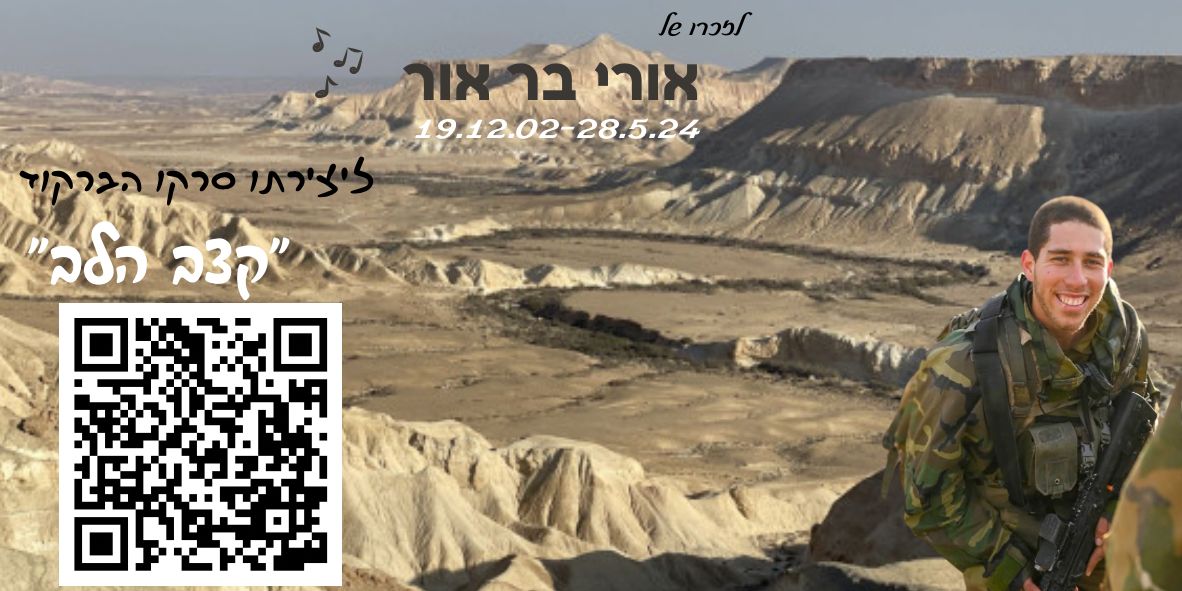
“In memory of Uri Bar Or Scan the barcode for his work: "Heartbeat"”
Life & service
Profile
- Date of birth
- December 19, 2002
- Birthplace
- Midreshet Ben-Gurion
- Date of death
- May 28, 2024
- Age
- 21
- Hometown
- Midreshet Ben-Gurion
Service
- Rank
- Staff sergeant
- Unit
- Nahal Brigade
- Honours
- Posthumously Promoted
- Battle Location
- Southern Gaza Strip
Family
- Father
- Yaakov
- Mother
- Noa
Burial
Cemetery
Midreshet Ben Gurion
Tributes & remembrance
בכל מקום שרק אוכל אזכיר אותך ואת החיוך הענק שלך
שמעתי בגל״צ את ההורים המדהימים שלך והייתי חייבת לקרוא על האיש הצעיר שנפל בשביל החיים שלנו כאן. נשתדל להיות ראויים
תודה לך,אורי היקר
על האור שהפצת בעולמנו.
תודה לך על שנלחמת למעננו במחיר ההקרבה הנורא מכל !
תנחומים מלב כואב לכל אהוביך.
יהא זכרך ברוך,גיבור ישראל .
לא יצא לי להכיר אותך בצורה טובה אבל אנחנו קרובי משפחה ורק רציתי לומר, שכב על משכבך בשלום
מוסיקה, אור, חיוך....
ופה נשאר חור בלב....
יהי זכרך ברוך
כ באייר.
לימוד הדף היומי היום מוקדש לזכרו.
אורי יקר , בן למשפחה אמיצה , לסבים שהיו גאים בך על מי שאתה. היוצר, היוזם . נער שחבריו ראו בו סמן דרך. העתיד שלך באומנות, כתיבה וציור ריקוד וכל מה שרק רצית היה פתוח לפניך . איך נפלת ובאחת נגדע הכל.
הלב עם המשפחה. הייתם בראשי לאורך כל יום הזיכרון. אני יכולה רק לדמיין את הכאב והצער שנפערים בנשמה.
מי ייתן ותדעו רק טוב מעתה. רק נשימה ואהבה.
יהיה זכרו ברוך
אורי הריקוד שהמצאת הוא מדהים
קראתי עליך ולא הספקתי להתפעל מהאדם שאתה,
הלוואי שהייתי זוכה להכיר אותך
תודה שהארת את העולם באור שלך ובשמש שאתה.
כל כך הרבה לבבות שזכו בך
תודה שהיית שמש לעולם
תודה שבזכותך אנחנו חיים ונושמים בבית משלנו במדינה הזו
אזכור אותך תמיד מלאך
אורי בר אור
כמה אור בחיוך שלך
יהיה זכרך ברוך
זוכרים אותך אורי. אור נצחי שאתה.
לזכר אורי, שהפיץ אור. כואב הלב על האובדן הגדול.
סיפור חיים מעניין אני משתתף בצערכם
כמה עצוב . אורי בר אור. נולדת להפיץ אור ונגדעת בטרם עת.
שנהיה ראויים לכם יהי זכרו ברוך
אמן
שנהיה ראויים לכם אמן
את הניגון שלך את הריקוד שלך לא נפסיק
כולכם הייתם גיבורים כל מי שנפל בעיקר אתה גיבורים שהגנתה על כולם ו על המשפחה שלך אתה הייתה מאוד אמיץ תודה לכולם שהגנתם אלינו
נם של נועה וקובי בראור.
אם רק היית יודע כמה ההורים שלך כואבים אך מנציחים אותך בדרך כלכך מיוחדת
אם רק היית יודע כמה ההורים שלל כואבים אבל ממשיכים את דרכך ומנציחים אותך בדרך מיוחדת כלכך
הכרתי את אורי בשתי דרכים אחת בתנועה ואחת בבריכה בה הוא עבד לא משנה מתי או איך תמיד שדיברתי איתו הוא חייך היה מלא בסבלנות ותמיד זה היה נראה שהוא מתעניין במה שאני אומר גם אם זה לא היה מעניין. אני לא אשכח את החיוך שלו והאכפתיות שלו לסביבה
יהי זכרו ברוך
אורי היקר אנחנו מתגעגעים אליך שיהיה זכרך ברוך אמן בעזרת השם מתגעגעים אליך כל הירושלמים ומקווים לפגוש אותך במקום יותר טוב
השם יקום דמך! מצדיעה לך!
יהי זכרך ברוך אורי היקר
יהי זכרו ברוך
ת.נ.צ.ב.ה.
אורי, קשה בלעדיך
עוד שלושה ימים תעבור בדיוק שנה מהפעם האחרונה שנפגשנו וקשה לחשוב על זה שהזמן ממשיך והעולם לא עצר,
אבל בכל דבר שממשיך בעולם משהו ממך ממשיך להתקיים והשתקפויות של דברים ממך כל הזמן מלוות ועושות אפקט חיובי בעולם.
אתה חסר
תודה רבה על הכול
We have known Uri since he was an infant; I saw him grow, step by step.
Source:103FM
Read the Hebrew original
את אורי אנו מכירים ממש מינקותו, ראיתי אותו גדל שלב אחרי שלב.
Uri left light. Uri left music.
Source:LinkedIn
An extraordinary talent, one in a generation
Source:עמותת הנח״ל
Read the Hebrew original
כישרון יוצא דופן, אחד בדור
Remembrance Day addresses
יום הזיכרון לחללי מערכות ישראל התשפ"ה – 2025
בכל יום שעובר, אזכור יותר! אזכור, את אלו שיצאו עימי לקרב ולא שבו, ולהם אין מי ידמה ומי ישווה. אזכור, שהכאב לא יעבור לעולם, והזמן, הוא לא מרפה ולא מרפא. אזכור, את שיברון הלב הגובר ואת הבית שבוער. אזכור, את צדקת הדרך, ואשבע שוב, שמה שהיה לא יהיה יותר. אזכור, שיותר מכל דבר אחר – אני חסר! ביום הזה, אני נתקף געגוע לדמותם, לחיתוך דיבורם, לחיוכם, ומדליק נר לזיכרון דרכם ומורשתם!
משרד הביטחון
אגף משפחות, הנצחה ומורשת
יום הזיכרון לחללי מערכות ישראל התשפ"ה – 2025
בכאב, בהצדעה ובתקווה אני מתכבד להדליק נר זיכרון זה. השנה, כשאנו נלחמים במלחמה ארוכה, רב זירתית וצודקת, הזיכרון נושא משמעות עמוקה. ביום זה נעצור ונתייחד עם זכרם של טובי בנינו ובנותינו שנפלו בהגנה על המדינה. מורשתם היא המצפן שמתווה את דרכינו, והיא המעניקה לנו כוח להמשיך ולהגן על מדינת ישראל ותושביה. משפחות יקרות, אנו מרכינים ראשנו ומתחייבים שנעמוד לצידכן תמיד. יהי זכר הנופלים ברוך.
אלוף דדו בר כליפא
ראש אגף כוח האדם, צה"ל
יום הזיכרון לחללי מערכות ישראל התשפ"ה – 2025
בשעה שאנו זוכרים את גודל תרומתם ועומק מסירות נפשם של טובי בנינו ובנותינו, נופלי מערכות ישראל לדורותיהן, ממשיכים צה"ל וכוחות הביטחון במימוש המשימה למענה לחמו ועבורה נפלו: הכרעת אויבינו מדרום, מצפון, ביהודה ובשומרון, וגם בזירות רחוקות יותר. בהערכה רבה ובגאווה אדירה אנו מרכינים ראש בפני הנופלים והנופלות, מאמצים את משפחותיהם אל לבנו, וממשיכים במשימה להבטחת קיומה של ישראל לדורי דורות. יחד נעשה ונצליח.
רב אלוף אייל זמיר
הרמטכ"ל, צה"ל
יום הזיכרון לחללי מערכות ישראל התשפ"ד – 2024
כאשר דגלינו מורדים לחצי התורן וראשינו מורכנים לזכר הנופלים והנופלות במערכות ישראל, ממשיכים לוחמי צה"ל ומפקדיו בלחימה בדרום, בצפון, ביהודה ובשומרון ובזירות נוספות. על כל דור מוטלת המשימה של הגנת העם והארץ – משימה שאף פעם אינה פוסקת. נצדיע בגעגוע ובגאווה לנופלים ולנופלות, נחבק את משפחותיהם, ונמשיך ברוח הציווי שהותירו לנו. עם ישראל חי.
רב ניצב יעקב שבתאי
המפקח הכללי, משטרת ישראל
יום הזיכרון לחללי מערכות ישראל התשפ"ד – 2024
אחיי הנופלים, כל נר הוא זיכרון יחיד ומיוחד, על חיים שהיו ואינם, געגוע שנצרב עמוק בלב, עולם ומלואו. הנרות כולם הם זיכרון של אומה כי לעולם לא עוד, בשורת הציונות וקוממיות ישראל. זיכרון כי הדרך לעם חופשי בארצנו עוברת דרך מסדר הנופלים. אור הנר יזכיר לנו את מסירות נפשכם להציל חיים, להגן על הבית. הנרות מסמנים לנו נתיב גבורה ערכי מחייב שאנו מצווים ללכת לאורו. נמשיך להילחם ולהוסיף אור מתוך אמונה בנצח ישראל.
יואב גלנט
שר הביטחון
יום הזיכרון לחללי מערכות ישראל התשפ"ד – 2024
בהצדעה ובכאב, בשם צה"ל כולו, אני מדליק נר זיכרון. בעיצומה של מלחמה, הזכרון נושא משמעות יום-יומית, שעבר והווה מתלכדים בה. לאורם של הנופלים נמשיך לצעוד, חיילי הסדיר והמילואים. לאורם של הנופלים נמשיך להגן על ארצנו ועל מולדתנו, גם כשהמחיר כבד. להבת-הזכרון תבער בנו בעודנו ממשיכים להלחם ונזכור את הנופלים ואת אומץ ליבם. משפחות יקרות, צה"ל מרכין היום ראש, מצדיע לכן וכואב איתכן. יהי זכר הנופלים ברוך.
אלוף יניב עשור
ראש אגף כוח האדם, צה"ל
יום הזיכרון לחללי מערכות ישראל התשפ"ד – 2024
בהוקרה, בגאווה ובכאב שאין לו סוף, אני מתכבד להדליק נר לזכרם של הנופלים והנופלות במערכות ישראל. סיפור חייהם בארץ הזאת, מסכת שירותם, גבורתם והקרבתם – הם סיפורה של הארץ הזאת, אך גם סיפור המחיר הכבד שהיא תובעת מאוהביה. מחויבותנו לזכר הנופלים ולדרך שהותירו לנו ניצבת תמיד לנגד עינינו. את המשימה שלא זכו להשלים, משלימים כיום, וישלימו, אנשי כוחות הביטחון, הממשיכים בדרכם ולאורם. יהי זכרם של הנופלים ברוך.
משרד הביטחון
אגף משפחות, הנצחה ומורשת
יום הזיכרון לחללי מערכות ישראל התשפ"ד – 2024
בחרדת קודש אני מתכבד להדליק נר לזכרם של חללי מערכות ישראל, חברנו שנפלו, מראשית היציאה מהחומות ולאורך כל שנות עצמאותנו המדינית והציונית, מהווים תמרור זיכרון לדרך חיינו ולמחוייבות הלאומית להנצחת זכרם. דרכם נותרה דרכנו ומורשתם נר להמשך עשייתנו. יהי זכרם ברוך!
בני גנץ
שר הביטחון
יום הזיכרון לחללי מערכות ישראל
נזכור אותם, כולנו יחד. כל אחד ואחת מהם, מדי יום ביומו, והיום ביתר שאת, כך – לנצח. "כי מדי דברי בו זכור אזכרנו עוד"
משרד הביטחון
אגף משפחות, הנצחה ומורשת