
The story
In the city of Partizansk, so far from the shores of the Mediterranean Sea, Roman Bronstein drew his first breaths on a warm summer day, the 7th of Av, 5737, which was July 22, 1977. His parents, Galina and Boris, enveloped him in an embrace of love and hope; a father who was a combat officer in the Red Army and a grandfather who trod similar paths, they bequeathed to him from birth genes of determination and devotion. In their small home, where the scent of Ukrainian stew sometimes mingled with the aroma of old paper books, Roman grew up alongside his sister, Ina, a boy with intelligent eyes that already burned with an intense curiosity to know and explore. They didn't know then, in the heart of the crumbling Soviet Union, how far this journey would take him, and how deeply new roots, a different soil, another language, would embed themselves within him, yet the pioneering spirit within them, the unextinguished Jewish spirit, already foretold his future.
Roman spent his early school years in the city of Storozhynets, Ukraine. He was a child who stood out—not only for his sharp intellect and his ability to grasp material with astonishing speed, but also for his captivating personality. Teachers would tell his parents about the quiet yet present boy who sat in the front row, his blue eyes absorbing every word, every idea. He wasn't a child who struggled; he was simply a child who loved to learn, to discover, to unravel the world's riddles. Academic material stuck to him with an unbelievable ease, and he excelled in every subject, in mathematics as in literature, in physics as in history. But beyond his grades, Roman was a child with a big heart, one who knew how to see others, offer help, and share the few sweets he had. He was the center of his group of friends, not because of assertiveness or dominance, but because of the personal charm that radiated from him, his ability to make people laugh, tell stories, and make everyone feel welcome. Even then, in those formative years, he developed the trait that became his hallmark: a rare combination of intellectual sharpness, uncompromising determination, and deep human sensitivity.
Among all the textbooks and adventures he read, one book held a special place in young Roman's heart: "Two Captains" by Veniamin Kaverin. The story of Sanya Grigoryev, the young orphan who embarks on a life journey to uncover the truth about a lost polar expedition, was seared into his consciousness. The characters of Sanya, who vowed to discover the truth at all costs, and his loyal wife Katya, who waited for him, left a profound impression. Sanya, willing to sacrifice everything for a geographical discovery, ignited in young Roman the spirit of adventure, the desire to set impossible goals for himself and achieve them. The immortal line from the book, "To fight and to search, to find and not to yield," became a personal motto, a moral and emotional compass that would guide him throughout his life. He didn't know that these very principles he would one day need to apply, not in the snowy plains of Siberia, but on much warmer soil, in the name of values he didn't yet know.
Within the home, beyond lessons and books, the presence of a distant land—Israel—always hovered. His parents, Boris and Galina, spoke of Zionism not in terms of dry ideology, but with a deep longing for home, for roots. Roman absorbed this through their evening conversations, through their glances when they heard news about the Middle East, through the quiet hope they nurtured in their hearts. By the time he was sixteen, in 1993, it was clear that there was no real future for young Jews like him in the former Soviet Union. The underlying antisemitism, the lack of prospects, and the desire for a fuller life under brighter skies, pushed the Bronstein family to make a fateful decision. Roman, an outstanding student who had completed nine years of schooling with honors, received the opportunity to immigrate to Israel as part of the Na’aleh program—Youth Aliyah before parents. This was a courageous decision for such a young boy, to detach himself from the familiar, from his family, and to embark alone to a foreign country, with no relatives or acquaintances waiting for him. On the eve of his aliyah, sitting across from his parents in their small kitchen, he promised them with sparkling eyes that he would do everything to succeed, that he would excel in his studies and go to university—a promise he made with the gravitas of an adult, though he was still a teenager. He knew this was his way to fulfill their dream, and his own.
Landing in Israel was like jumping into cold water, but Roman, with his characteristic determination, plunged in with full vigor. He arrived at Hadassah Neurim Youth Village in Emek Hefer, an institution designed to absorb immigrant youth and integrate them into Israeli society. The youth village was an entirely new world for him: the Hebrew language, its initially strange sounds, the different accents of his friends from all corners of the globe, the food, the local customs. He didn't waste a moment. While his roommates would fall asleep from exhaustion or go out, Roman would sit at the small table in their room, under a dim lamp, and continue to study. For long hours into the night, when darkness had already covered the fields of Emek Hefer and frogs croaked in the nearby swamps, he was absorbed in his textbooks. He learned Hebrew diligently, read every book placed before him, closed gaps, and excelled in every subject. His friends always remembered him as a "bookworm," but also as a loyal friend who, despite all his seriousness, also knew how to laugh and relax. He was part of the first cohort of the Na’aleh program, a group of young pioneers, and felt the weight of responsibility to be an example, to be the one who succeeded. During this period, in the absence of a mother and father, the youth village became his new family, and his friends like brothers and sisters. Among them, his love for Israel always stood out, not just as a refuge, but as a true homeland, to which he felt a deep and unwavering connection.
When he graduated high school with honors, the thought of military service filled his heart with excitement and a sense of mission. His parents, still in the Soviet Union, expected him to pursue academic studies as he had promised, but Roman knew his path had to go through the army. He called them, his voice resolute but full of respect: "Father, Mother," he said, "I have to serve in a combat unit. I feel it's my place to defend our new home." Boris, the former combat officer, understood his son. He knew Roman wouldn't back down, and that this passion to defend, this devotion to the homeland, he had inherited from him and his father. He gave his blessing; Galina wiped a quiet tear, knowing this was the next step in her son's journey to become a complete person in the new land.
In 1995, upon completing high school, Roman enlisted in the IDF. He didn't hesitate for a moment, knowing exactly where he wanted to go: a combat soldier in the "Tzabar" Battalion of the "Givati" Brigade. His feet first touched the base's soil, in new uniforms that still smelled of fabric and the excitement of a new beginning. The training was tough, physically and mentally. Long hours of marches, crawls, shooting, and again and again—all under the scorching Negev sun. But Roman never complained. He was the first to run, the last to give up, and always with a small, mischievous smile on his lips. He advocated for excellence, not just for himself but for those around him. When he saw a friend fall, he would offer a hand and help him up, not with grand words but with a quiet act. He remembered the legacy of his father and grandfather, the officers in the Red Army, and knew he too was destined for command. He saw the path forward, the need to lead, to set a personal example, and to serve as a pillar for his friends. After a short time, when his commanders recognized his potential, his composure under pressure, and his natural leadership abilities, they sent him to officer's course.
Officer's course was intense and challenging, but Roman excelled. He emerged with the rank of First Lieutenant on his shoulders, a sense of pride and heavy responsibility. He returned to the "Tzabar" Battalion as a platoon commander in training, a role that required not only command knowledge but also sensitivity and care towards the young soldiers who had just arrived from home. He remembered himself as an immigrant youth, sometimes lonely, and knew how important support and human leadership were. He was a tough commander, uncompromising on discipline and performance, but always with a heart of gold. His soldiers remembered him as a commander who pushed them to their limits, but also one who sat with them in the field, listened to their problems, and cared for them as if they were family. He didn't give them breaks, but always ensured they received the best, that they were ready for any challenge. He served in additional command roles, leaving his mark on everyone he met, and leaving a deep impression of a professional, determined, yet also human and warm individual. When he was discharged from the IDF with the rank of First Lieutenant, he left behind a trail of appreciation and respect among both his soldiers and commanders.
After his mandatory service, Roman returned to the promise he had made to his parents back in Partizansk, far away. He enrolled in a Bachelor's degree in Computer Science at Bar-Ilan University, dedicating all his energy to his studies, as he always did. The numbers, codes, and complex logic of the computer world drew him in, and he immersed himself with passion. He successfully completed his degree, and as expected, quickly found his way into Israel's booming high-tech industry. He worked as a programmer in various companies, valued for his sharp intellect, his ability to solve complex problems, and his technical talent. He built a successful career for himself and felt great satisfaction from the intellectual challenges the field presented. He earned an honest living, worked hard, and saw the fruits of his labor.
Several years later, the exciting moment arrived when his parents, Galina and Boris, also immigrated to Israel and reunited with him. It was a full circle moment for Roman, to finally see his parents on the land he had defended and worked so hard for. His father, Boris, who had been a lawyer in the Soviet Union, decided to open a law firm in Israel as well. Roman, who loved new challenges, immediately volunteered to help his father prepare for the grueling bar exams. He sat with him for long hours, reviewing legal material, discussing constitutional and civil issues. During this assistance, Roman discovered a new, surprising, yet deep interest in the legal field. He realized that the legal world, with its logic, its need for in-depth analysis, and its ability to impact people's lives, appealed to him far more than high-tech. He decided to change professions, a brave decision for someone who had already built a successful career, and enrolled in a Bachelor's degree in Law at the Academic Center for Law and Business in Ramat Gan.
At the Academic Center for Law and Business, Roman once again stood out. He was an excellent and beloved student, a familiar figure in the college hallways. Faculty members spoke of him with great appreciation: "He was one of the first students we had the privilege of mentoring," they said, "and although thousands of students have passed through since, we remember him for the great intelligence he displayed, his kindness, and his desire to dedicate his work to helping others." Roman didn't study law just to succeed in a career; he studied it out of a sense of mission, a genuine desire to positively impact people's lives, especially new immigrants, as he himself had been. He saw the complexity of Israeli bureaucracy, the difficulties immigrants faced in their first steps in the country, and knew he could help them. He successfully passed the bar exams, joined his father's office, and became a successful and respected lawyer, who worked extensively for the immigrant community, with a deep understanding of their needs.
Amidst all this activity, in his student and professional life, Roman found the love of his life—Natalia. The two built their home in Bat Yam, a vibrant coastal city, and established a wonderful family. Daniel, the eldest, arrived first, and then, about two years later, the twins, Helen and David, were born, bringing new light and incessant playfulness into their lives. Roman was a family man through and through. He loved Natalia deeply and was a devoted and present father to his children. He knew how to balance a demanding career and his many pursuits with the precious time he dedicated to his family. He was present in his children's lives, playing with them, reading them stories, and being there for them at every moment, big or small. The home in Bat Yam was filled with laughter, conversations, and family warmth. Roman was a stable anchor for everyone—a true friend, a man of his word, who knew how to give of himself without limits. Not just to his soldiers or friends, but also to his family members, whether those who had immigrated to Israel after him, or those who remained in Ukraine, whom he cared for and supported from afar.
But above all his pursuits, above career and family, a fierce love for the State of Israel and an uncompromising commitment to defend it always hovered in his soul. Roman was not content with significant mandatory service; he continued to serve with great devotion in the reserves for many years, rising through the ranks to the level of Major. He saw reserve duty not just as an obligation but as a right, a way to express his deep sense of belonging to the land. In his last reserve role, he served as an instruction officer in Battalion 8111 of Brigade 5, a position that required him to sharpen his command and professional skills and pass them on to future generations of fighters. He always used to say that a homeland is not necessarily the country you are born in, but the place you choose to belong to, the place you are willing to fight for. "My homeland is Israel," he would say with gleaming blue eyes, and everyone who heard him knew that this was not just a statement, but pure truth that came from his heart. His reserve comrades, who had accumulated decades of service with him, knew they could always count on him. "You were the salt of the earth," they would say of him, "always laughing and making others laugh, a crazy fighter, a tough commander with a heart of gold, cared for his soldiers and family and achieved success in life through sheer determination."
On Saturday, the 22nd of Tishrei, 5784, October 7, 2023, the day Israel celebrated Simchat Torah, the country awoke to a morning of unimaginable horror. At 6:30 AM, while most residents of the south were still asleep, and across the country people were preparing for the holiday, the Hamas terrorist organization launched a murderous surprise attack. Thousands of missiles and rockets were fired from the Gaza Strip towards communities and wide areas of the country, and under the cover of this inferno, thousands of terrorists infiltrated—by land, sea, and air. They streamed into the Gaza envelope communities, into Sderot, Ofakim, and Netivot, massacred innocent party-goers at nature parties near Kibbutzim Re'im and Nir Oz, attacked IDF bases, and harmed innocent civilians on the roads. The scenes were unfathomable: fire, destruction, civilians brutally murdered in their homes and cars, hundreds of Israelis abducted into the Gaza Strip. Hundreds of soldiers, police officers, and security forces fell in the heroic battle to defend the homeland. This terrible morning marked the beginning of a war that changed the face of the nation.
Roman Bronstein didn't think twice. Even though he was already exempt from reserve duty, even though he could have stayed home in Bat Yam, safe with his family, he was unwilling to let his friends fight without him. "How can I stay home when my friends are there?" he must have thought to himself, watching the unfolding news and the horrifying reports. He surely remembered his promise to himself—"To fight and to search, to find and not to yield." At 10:00 AM that morning, just four and a half hours after the attack began, he was already in his private car, driving rapidly towards the assembly point, joining his battalion. He arrived into the chaos, into the confusion, into the uncertainty, but within him burned a clear and certain feeling: he had to be there. He had to defend.
Initially, the forces were stationed in the assembly areas in the Gaza envelope. There, among the quiet fields and kibbutzim that had not yet recovered from the inferno, they began to train, organize, and carry out various operational activities, awaiting the order to enter. Days and nights passed in tents, in tactical discussions, in intensive preparation for the unknown campaign. Roman, as an instruction officer, was a pillar for his soldiers. He conducted briefings, set a personal example, and instilled a sense of calm and confidence in the tense situation. He made sure to tell them every morning, in his familiar voice, a blend of authority and warmth: "We are here, on this land right now, so that what happened on October 7th will never happen again." Simple words, yet loaded with meaning, that penetrated the hearts of the soldiers, giving them an anchor and a purpose.
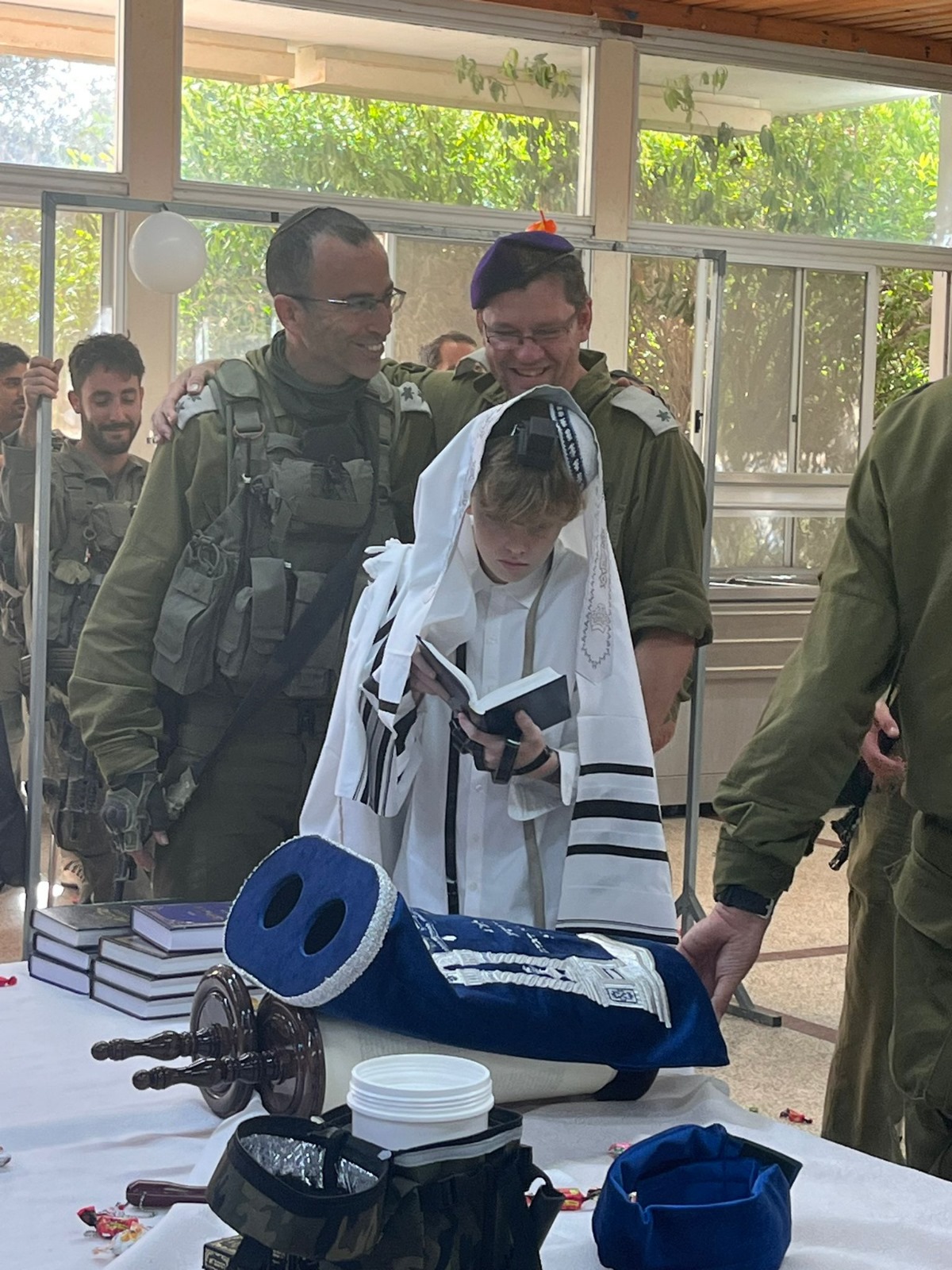
In November, after several weeks of intensive reserve duty, the date for Daniel's Bar Mitzvah, Roman's eldest son, arrived. The thought of Daniel celebrating his Bar Mitzvah at home, without him, while he was serving in the field, was unbearable. But Roman was not alone. The entire battalion, his second family, mobilized to allow the family to celebrate together, even under the clouds of war. The Torah reading ceremony was held in Kibbutz Re'im, right where the battalion was stationed for its defense mission. It was a surreal and tear-jerking event. Natalia arrived with the children, young Daniel, Helen, and David, into the military hustle, into the wounded kibbutz. Among uniformed soldiers, military vehicles, and the winds of war blowing, the Torah reading took place. Daniel, excited and enveloped in the love of his father and his friends, was called to the Torah. Roman, a tough and usually reserved officer, stood there, his blue eyes sparkling, his voice slightly breaking with emotion. He held onto his son, hugging him tightly, as the soldiers stood around, some with weapons, some with tears in their eyes. "I've been in this battalion for twenty-three years," Roman said with a choked voice, "and what moves me most is that my son's Bar Mitzvah is being held here... I thank you all and I love you, this is a great battalion, this is family." He looked at Daniel, and then at the smaller of the twins, David, and said with a pained smile: "I'm sure David, he's two years younger, in two years he'll say: 'Where's my war, I also want a Bar Mitzvah.' So may there be no more wars and we'll celebrate David's Bar Mitzvah too in a moving event, but today is your day, Daniel." His words echoed in the space, a combination of hope for a better future, deep gratitude, and pain over the complex reality. At that moment, in the heart of the chaos, Roman and his family, together with the battalion family, managed to create a moment of grace, of life, of normalcy.
Shortly thereafter, the order came. Roman's battalion entered the Gaza Strip. Roman told no one close to him. He knew that unnecessary worry would only burden them, and he wanted to protect them, even from afar, from the fears that accompany entering enemy territory. He went in with his soldiers, into the complex and dangerous reality of the Gaza Strip. In the field, the traits that had shaped Roman his entire life—his sharp intellect, his determination, his composure under pressure, and his big heart—were fully evident. "He had the field instincts of a supreme commander," one of the soldiers who fought with him in Gaza recounted, his voice trembling as he remembered. "He was a person entirely focused on those behind him. That's why he was also a crazy officer, sharp in the field, many people are walking on two feet today only because of him." Roman was not just a commander who gave orders; he was a protector, a pillar, someone you could rely on with your eyes closed. He would lead the force, checking every step, looking for signs of threat, planning the safest route. "He always gave us one saying, every morning, to remember that we are here, on this land right now, so that what happened on October 7th will never happen again," another soldier recalled, almost quoting Roman. This was not just a tactical statement, but a reminder of the deep purpose for which they were fighting, of the essence buried beneath all the noise and dust. "He gave us all that embrace of 'I'm here, I'm with you, I'm taking care of you, I'm hugging you'," the soldier added, "He saved us, he really saved us." Another officer who fought alongside him summarized it in simple, powerful words: "He gave us sanity in an insane place." In the reality of Khan Yunis, amidst the ruins of homes, in the narrow alleys, amidst the incessant threat, Roman was a beacon of light, an anchor of logic, of humanity, of true leadership. He was the captain, in the deepest sense of the word, navigating his soldiers' ship in a stormy sea, always remembering the slogan: "To fight and to search, to find and not to yield."
On the 27th of Kislev, 5784, December 10, 2023, amidst the dangerous complexity of operational activity in the Khan Yunis area, the worst happened. Roman's force encountered an explosive device. The powerful blast tore through the tense silence, the absolute concentration, the disrupted routine of the war. Roman, a Major in the reserves, an instruction officer in Battalion 8111, Brigade 5, only forty-six years old, was killed on the spot. The world collapsed for a moment. The difficult news reached his family in Bat Yam, Natalia, Daniel, Helen and David, his parents Galina and Boris, and his sister Ina. Hearts were broken. The hero, the captain, the father, the husband, the son, the brother and the friend—fell in battle, defending his homeland, true to his promise until his last breath.
Roman Bronstein was laid to rest in the military cemetery in Holon. The funeral procession was painful, quiet, and powerful. Thousands came to pay their last respects—his family, his friends from the army and studies, his professional colleagues, soldiers he had saved, old friends from Na'aleh, and many others whose lives he had touched. Each of them carried a memory, a moment, a word, that defined Roman.
Vital, Roman's close friend, stood by the fresh grave, his voice choked with tears, but his words came out with a fighter's determination. "Roman, brother, I can't process this," he said. "Twenty-six years together, what haven't we been through together? From mandatory service, platoon commander in the 'Tzabar' battalion, through permanent service, and up to twenty-two years together in the reserves. In Lebanon, at Rotem outpost, I always knew I could count on you to extract me from ambushes and open routes. We survived gunfire and mortar shells more than once, I was calm when you were with me in the force. A super-fighter, eternally dedicated. At the shooting range, when an entire company was firing, you'd come to the machine gunner, replace him in firing, and just by hearing the machine gun sing, I knew it was you pulling the trigger." Vital described Roman as a legendary fighter, belonging to the "generation of giants," a generation of commanders who never gave up on themselves or others. "Your laugh still echoes in my head," Vital continued painfully. "Who will sit with us now at 'Dixie' every quarter, at our usual table, with our usual dishes and a glass of beer in hand? Roman, dear and beloved brother, I have no doubt that there is no one in the world who would have stopped you from entering the Strip and fighting. You were a super-soldier at twenty just as you fell a super-hero at forty-six. Hero, may your memory be blessed."
Ben, his team member, also stood, agitated and in pain. "Just now we celebrated his oldest son's Bar Mitzvah in the army. It was crazy, the most Zionist thing ever, just like Roman," he recounted. "For him, the army was sacred. We served together for many years and this was the first year he volunteered for reserves. This was supposed to be our last war. He's a super-gun, a golden person everyone loved. Like a North Star everyone looks up to. Very smart. We talked before he went into Gaza, he told me to call his wife and children and asked me to take care of them." These words, the request to care for his family, reflected Roman entirely—an uncompromising fighter on the battlefield, yet a loving and devoted family man who cared for his loved ones until the last moment.
Larisa, not a relative but someone who knew Roman deeply, wrote about "your personal charm, the depth you could dive into conversations within seconds, your reliability and willingness to back us up whenever needed, those incredibly smart blue eyes, the deep talks about the army, the worry about the big war that would one day be here. You were right about everything!" She added with pain: "On October 7, 2023, in the first hours of the war, Roman enlisted in the reserves, did everything required in the army and even managed to come home for his children's and Natasha's birthdays, to be with his father at doctor's appointments. And when we were informed on December 10 that you and your force had hit an explosive device, our world was shattered and the hearts of so many people broke. Dear Romka, we will remember you always." In Larisa's words, Roman's character shone through as a complete man who knew how to combine deep commitment to his country and army with endless devotion to his family.
Even more distant acquaintances felt the void left behind. One of them wrote: "Dear Roma, beloved by all... You always had a smile on your face, always humble and surrounded by friends. We talked a lot about the kids, trips, army, studies, and I always felt as if we had been the closest friends for many years. I and everyone will miss you, I will always remember you young, smiling, and caring for everyone—a hero of the family and of all the people of Israel!" And Eldar, another friend, summed up the essence of his character in poignant words: "The eternal youth, with an innocent and mischievous smile all at once. The most dedicated, the most combat-ready, the most infantryman. Missing you."
Roman Bronstein was a hero not because of lofty words, but because of his actions, his choices, and the truth by which he lived. He was an immigrant child who became a fighter, a commander, a lawyer, a family man, the salt of the earth, and his entire life was a symbol of determination, devotion, and love for humanity. He fulfilled his promises—to his parents, to his homeland, to himself. He lived by the slogan of Sanya Grigoryev, his childhood hero, "To fight and to search, to find and not to yield," and in his death, he fought until the last moment, found his place in the history of the people of Israel, and did not give up on the future of his children, on the security of his homeland.
The void Roman left behind is immense, but his legacy lives and breathes. At the Yitzhak Sadeh School in Bat Yam, the city where he built his home, a basketball tournament was held in his memory, a way to commemorate his character through sport and unity. A memorial site was established in his name, "Roman Bronstein Memorial Site," featuring his life story, photographs, and links to articles published about him, testifying to the public resonance his death left. A page in his memory was also set up on the "My Life Story" website, containing stories, videos, and photos from different stages of his life, a living and breathing documentation of a man who was so much. Roman Bronstein was not born in Israel, but he breathed, lived, and fought for it, becoming an inseparable part of its story of revival. He leaves behind a grieving but proud family, friends who remember his laughter and courage, and an entire nation that remembers his sacrifice and heroism. His life story is not just a personal story, but the story of an entire generation, of immigrants who became pioneers, of civilians who became fighters, of people who chose to defend their home at all costs. May his memory be blessed.
Moments of a life
All photographs · 43
Videos and links
In the media
Articles
Memorial sites
Memorial projects
LA Wellness Club in Bat Yam announced a training day in his memory on 28 April 2025, including an evening workout with the family taking part. This is an announcement ahead of the event, without verification that it took place.
His friends established "Roman’s Wings" to support his children and continue to stand by the family.
A basketball tournament in his memory at Yitzhak Sadeh School in Bat Yam.
Stories told about them
His father Boris answered legal questions from IsraelInfo readers, and Roman later joined him. After his fall, his father returned to answering readers; the article also describes the family firm where his wife worked.
His friends say the battalion organized a bar mitzvah for his son Daniel during the war so that he would not miss the event. The company sergeant major enlisted the battalion commander and the battalion sergeant major for this purpose.
Life & service
Profile
Service
- Rank
- Major (res.)
- Service Type
- Reserve Forces
- Battle Location
- Gaza Strip
Family
- Father
- Boris
- Mother
- Galina
Burial
Tributes & remembrance
תהא נשמתם צרורה בצרור החיים
תודה על המסירות וההקרבה הגדולה. מקווה שאנחנו ראויים. יהי זכרו ברוך.
רומן,
היית גיבור בחייך. קצין למופת. אדם מדהים. אוהב ומגן ישראל.
לוחם בכל רמח אבריך.
אני אסיר תודה שזכיתי להכיר אותך.
אני בטוח שאתה שומר עלינו מלמעלה כמו ששמרת מלמטה.
יהי זכרו ברוך
גיבור ואיש מלחמה. אני זוכר את רוח השליחות המיוחדת, שפיעמה בך תמיד בכל עת שנקראת לשירות. נוח בשלום על משכבך עם שאר צדיקי עליון, ייקום השם דמך ותעמוד לגורלך לקץ הימין
בתפילת הבוקר קראנו את שמך,רומן אור ונשמה.
מתפללים שאוהבך ומשפחתך ימצאו נחמה.
שנהיה כולנו ראויים להקרבתך.
שלח ברכות משמים עלנו.
(מניין הבוקר.פארק סינגוג.קליבלנד.אוהיו.
לא אשכח אותך לעולם, חבר יקר..
תודה רבה, רומן יקר לך ולכל הגיבורי ישראל שיצאתם להילחם, להגן עלינו....
נזכור תמיד, נשמור את הזכרון ונשתדל להיות טובים יותר.
אתם דוגמה לגבורה, ערכים ואהבה ללא תנאי למולדת....
חיבוק חזק למשפחה...
אבא יקר תמיד נזכור אותך
אני חבר של דניאל, משתתף בצערם ותנוח על משכבך בשלום
נחשפתי אתמול לסיפורך האישי ונפעמתי מכוח הרצון, מתחושת השליחות ומטוב הלב.
שמור עלינו גם מלמעלה.
רומן ז"ל גיבור ישראל, שנהיה ראויים לך.
חיזוק וחיבוק גדול למשפחה
פלוגה מ8111
תודה, רומקה, על מה שהיית ועשית בשבילנו
יהי זכרו ברוך אמן
לימדת אותנו מה זה להיות חיילים, אנשים, חברים, גברים, מה זה כבוד למדים, לסגול ולחברים
קרן ביליה, אחותי מספרת רק דברים טובים על רומן. על כמה שהוא,דאג לילדיו, עזר להם בלימודים ובכל דבר שהיו צריכים. הוא היה בולט בפעילותיו בוועד והיה מהמובילים.
אדם טוב ויקר. יהי זיכרו ברוך.
מפקד מצדיע לך
ת.נ.צ.ב.ה
יהיה זכרו ברוך
יהיה זכרו ברוך.
מפקד מעולה ואיש שיחה טוב , הינו ביחד במילואים 5 שנים עד שהחלטתי לעבור יחידה , זוכר את השיחות שלנו כאילו היו אתמול ,מתגעגע , לא נשכח ולא נסלח
יהיה זכרו ברך
יהי זכרו ברוך גיבור
מתגעגעים אליך
תמיד נזכור אותך
מתגעגעת אליך מאוד
שמעתי עליך עכשיו ברדיו 103, דיבר עליך חבר ששירת איתך בסדיר.
הרגשתי צורך להיכנס ולהדליק נר זיכרון עבורך. מלח הארץ. תודה לך!
יהי זכרו ברוך
משתתף בצער המשפחה
מתגעגע אליך אחי היקר
רומן יקר, חושבים עליך הרבה. אין לי מילים אחרות.
כל יום אנחנו מגלים איזה אדם רבגוני היית.
כמה אנשים אוהבים אותך
יום הזכרון השני מ 10 לדצמבר 2023 לומדים לחיות בלעדיך
רומקה, עד היום מתקשה להפנים ולעכל את נפילתך, וזה אולי בגלל שהרוח שלך תמיד איתנו. עד יומנו האחרון תהיה בליבנו ובמחשבתנו. נוח על משכבך בשלום, גיבור ישראל.
רומן בשבילי היה המדריך האולטימטיבי. אתה רוצה להבין איך פועלים דברים? דבר עם רומן. אתה רוצה להתמקצע בתחום מסוים? דבר עם רומן.
בכל דבר השאלה הראשונה הייתה איך לא החייל הכי טוב עושה את זה אלא איך החייל הסביר והרגיל יצליח במשימה. ההדרכה לא למצויינים אלא דווקא ללוחמים הרגילים ואם צריך לתרגל שוב ושוב אז נתרגל שוב ושוב.
זה כוחה של הדרכה שפועלת על האדם הרגיל ולא דווקא לאיש הקצה. ורומן היה מכוון כל הזמן ללוחמים שצריכים עוד אימון ועוד מאמץ.
חלק מהיותו אחראי על ההדרכה הייתה היצירתיות שלו למצוא פתרונות, יש הרבה בעיות ומתחילת המלחמה היו הרבה בעיות טכניות של אימון והכנה לקראת מה שאנחנו הולכים לפגוש - בכל מקום שאפשר להתמקם ולהתאמן העיקר שנצליח לעשות את הבסיס ומשם לצאת להלחם.
הגעתי לאימון הסבה לתבור ורומן אומר לי אתה איתנו באוהל. ככה הצטרפתי למחלקת ההדרכה באותו אימון ועוד אימונים אחר כך בצורה לא רשמית.
משם התחילו סיפורי רומן. סיפורים שמי שמכיר את טרומפלדור שומע אותו הולך בתוך הסיפור של רומן. עליה לארץ מתוך הכרות רגעית. עליה לבד בלי אף אחד לארץ ישראל.
בכל סיפור עלתה וזרחה דמותו המופלאה של נער צעיר שהחליט לקשור את עצמו לעם ישראל, לקשור את עצמו לארץ ישראל, לקשור את עצמו למסורת של עם ישראל במשך דורות על גבי דורות.
וכך הביטוי ״והגדת לבנך״ קם ועמד מול עינינו, היה חשוב לרומן לספר את סיפור חייו, כי שם התחילה מסורת של יהודי ששב הביתה מהגלות, יהודי שמצטרף למלחמה על העם והארץ.
רומן היה מספר על הכניסה לצבא הרבה, איך היה לו לא פשוט בכלל בתור עולה חדש. אבל את הכל הוא לוקח ברוח טובה. ולא רק ברוח טובה אלא בכל מקום שיש מישהו שצריך עזרה הוא יאמר לו - אני איתך. צריך להחליף עמדה רומן יחליף, צריך להשיב אש כשחיזבאללה יורים? רומן ישיב באש. חייל חטף הלם קרב - רומן יתפוס את מקומו במוצב וילחם.
את כל הסיפורים רומן מספר לא בשביל שנרגיש שהוא גיבור על - אלא כי כל אחד מאיתנו היה עושה בדיוק את אותו דבר, זה פשוט לו שככה צריך לנהוג ושכל אחד היה עושה את אותו דבר.
כולם היו עונים ״הנני״ לכל קריאה וצורך שיש. אז מה הסיפור? אין סיפור זה רק שיתוף חוויות בין לוחמים.
רומן ידע שהמלחמה גובה מחיר, יחד עם המחיר הוא היה מוכן לשלם את המחיר הזה, מדוע? כי הוא הרגיש שיש כאן משהו גדול ממנו ומכולנו ביחד.
דמותו הייתה בשבילי כמו יוסף טרומפלדור שאמר ״מוטב למות בעד ארצנו״ היה אפשר לחוש איך מתוך ספרי ההיסטוריה יוצא טרומפלדור וההשתקפות שלו נמצאת ברומן.
כך כתב טרומפלדור -
לאחיו -
״ואם אפול בקרב, מאושר אהיה, יודע לשם מה אני נופל...״
ולהוריו כתב -
״אם אמות, הרי מותי בעד העם העברי, בעד משא נפשנו...״
ולחבר כתב -
״אם אני הולך למות, הרי אני הולך בשמחה, בלב קל, מפני שזה לשם הדבר הכי יקר לי. האם לא שמחה היא למות מתוך הכרה, שבמחיר זה יקבל עמי דבר - מה במולדתי היקרה, ארץ ישראל?״
הדברים יפים לטרומפלדור ומי שהכיר את רומן יודע שדברים אלה היו חלק בלתי נפרד מהאש הפנימית שהניעה אותו.
ויש את רומן שמדבר על המשפחה ואיך בבת אחת מלוחם עז פנים הוא הופך לרגיש ועדין כל כך.
בדאגה כל כך מסורה להורים, לנטשה ולילדים. דאגה שבאה מאהבת אמת.
ויש את רומן של האירוע שמוסר את הנפש שלו עבור האחרים. וזה משקף את כל חייו שהיו עבור האחרים. היכן הוא יכול לומר הנני עבור אחרים.
כמה געגוע לאח היקר.
A hero is something a little beyond human, and Roman was very human. And he was simply a good friend
Source:ynet
Read the Hebrew original
גיבור זה משהו קצת לא אנושי, ורומן היה מאוד אנושי. ופשוט היה חבר טוב
Your laughter still echoes in my head.
Source:יזכור
Read the Hebrew original
הצחוק שלך עדיין מהדהד לי בראש.
Like a North Star that everyone looks to.
Source:יזכור
Read the Hebrew original
כמו כוכב צפון שכולם מסתכלים עליו.
You were right about everything!
Source:יזכור
Read the Hebrew original
צדקת בהכול!
You always had a smile on your face
Source:יזכור
Read the Hebrew original
תמיד היית עם חיוך על הפנים
Forever young
Source:יזכור
Read the Hebrew original
הצעיר הנצחי
Remembrance Day addresses
יום הזיכרון לחללי מערכות ישראל התשפ"ה – 2025
בכל יום שעובר, אזכור יותר! אזכור, את אלו שיצאו עימי לקרב ולא שבו, ולהם אין מי ידמה ומי ישווה. אזכור, שהכאב לא יעבור לעולם, והזמן, הוא לא מרפה ולא מרפא. אזכור, את שיברון הלב הגובר ואת הבית שבוער. אזכור, את צדקת הדרך, ואשבע שוב, שמה שהיה לא יהיה יותר. אזכור, שיותר מכל דבר אחר – אני חסר! ביום הזה, אני נתקף געגוע לדמותם, לחיתוך דיבורם, לחיוכם, ומדליק נר לזיכרון דרכם ומורשתם!
משרד הביטחון
אגף משפחות, הנצחה ומורשת
יום הזיכרון לחללי מערכות ישראל התשפ"ה – 2025
בכאב, בהצדעה ובתקווה אני מתכבד להדליק נר זיכרון זה. השנה, כשאנו נלחמים במלחמה ארוכה, רב זירתית וצודקת, הזיכרון נושא משמעות עמוקה. ביום זה נעצור ונתייחד עם זכרם של טובי בנינו ובנותינו שנפלו בהגנה על המדינה. מורשתם היא המצפן שמתווה את דרכינו, והיא המעניקה לנו כוח להמשיך ולהגן על מדינת ישראל ותושביה. משפחות יקרות, אנו מרכינים ראשנו ומתחייבים שנעמוד לצידכן תמיד. יהי זכר הנופלים ברוך.
אלוף דדו בר כליפא
ראש אגף כוח האדם, צה"ל
יום הזיכרון לחללי מערכות ישראל התשפ"ה – 2025
בשעה שאנו זוכרים את גודל תרומתם ועומק מסירות נפשם של טובי בנינו ובנותינו, נופלי מערכות ישראל לדורותיהן, ממשיכים צה"ל וכוחות הביטחון במימוש המשימה למענה לחמו ועבורה נפלו: הכרעת אויבינו מדרום, מצפון, ביהודה ובשומרון, וגם בזירות רחוקות יותר. בהערכה רבה ובגאווה אדירה אנו מרכינים ראש בפני הנופלים והנופלות, מאמצים את משפחותיהם אל לבנו, וממשיכים במשימה להבטחת קיומה של ישראל לדורי דורות. יחד נעשה ונצליח.
רב אלוף אייל זמיר
הרמטכ"ל, צה"ל
יום הזיכרון לחללי מערכות ישראל התשפ"ד – 2024
כאשר דגלינו מורדים לחצי התורן וראשינו מורכנים לזכר הנופלים והנופלות במערכות ישראל, ממשיכים לוחמי צה"ל ומפקדיו בלחימה בדרום, בצפון, ביהודה ובשומרון ובזירות נוספות. על כל דור מוטלת המשימה של הגנת העם והארץ – משימה שאף פעם אינה פוסקת. נצדיע בגעגוע ובגאווה לנופלים ולנופלות, נחבק את משפחותיהם, ונמשיך ברוח הציווי שהותירו לנו. עם ישראל חי.
רב ניצב יעקב שבתאי
המפקח הכללי, משטרת ישראל
יום הזיכרון לחללי מערכות ישראל התשפ"ד – 2024
אחיי הנופלים, כל נר הוא זיכרון יחיד ומיוחד, על חיים שהיו ואינם, געגוע שנצרב עמוק בלב, עולם ומלואו. הנרות כולם הם זיכרון של אומה כי לעולם לא עוד, בשורת הציונות וקוממיות ישראל. זיכרון כי הדרך לעם חופשי בארצנו עוברת דרך מסדר הנופלים. אור הנר יזכיר לנו את מסירות נפשכם להציל חיים, להגן על הבית. הנרות מסמנים לנו נתיב גבורה ערכי מחייב שאנו מצווים ללכת לאורו. נמשיך להילחם ולהוסיף אור מתוך אמונה בנצח ישראל.
יואב גלנט
שר הביטחון
יום הזיכרון לחללי מערכות ישראל התשפ"ד – 2024
בהצדעה ובכאב, בשם צה"ל כולו, אני מדליק נר זיכרון. בעיצומה של מלחמה, הזכרון נושא משמעות יום-יומית, שעבר והווה מתלכדים בה. לאורם של הנופלים נמשיך לצעוד, חיילי הסדיר והמילואים. לאורם של הנופלים נמשיך להגן על ארצנו ועל מולדתנו, גם כשהמחיר כבד. להבת-הזכרון תבער בנו בעודנו ממשיכים להלחם ונזכור את הנופלים ואת אומץ ליבם. משפחות יקרות, צה"ל מרכין היום ראש, מצדיע לכן וכואב איתכן. יהי זכר הנופלים ברוך.
אלוף יניב עשור
ראש אגף כוח האדם, צה"ל
יום הזיכרון לחללי מערכות ישראל התשפ"ד – 2024
בהוקרה, בגאווה ובכאב שאין לו סוף, אני מתכבד להדליק נר לזכרם של הנופלים והנופלות במערכות ישראל. סיפור חייהם בארץ הזאת, מסכת שירותם, גבורתם והקרבתם – הם סיפורה של הארץ הזאת, אך גם סיפור המחיר הכבד שהיא תובעת מאוהביה. מחויבותנו לזכר הנופלים ולדרך שהותירו לנו ניצבת תמיד לנגד עינינו. את המשימה שלא זכו להשלים, משלימים כיום, וישלימו, אנשי כוחות הביטחון, הממשיכים בדרכם ולאורם. יהי זכרם של הנופלים ברוך.
משרד הביטחון
אגף משפחות, הנצחה ומורשת
יום הזיכרון לחללי מערכות ישראל התשפ"ד – 2024
בחרדת קודש אני מתכבד להדליק נר לזכרם של חללי מערכות ישראל, חברנו שנפלו, מראשית היציאה מהחומות ולאורך כל שנות עצמאותנו המדינית והציונית, מהווים תמרור זיכרון לדרך חיינו ולמחוייבות הלאומית להנצחת זכרם. דרכם נותרה דרכנו ומורשתם נר להמשך עשייתנו. יהי זכרם ברוך!
בני גנץ
שר הביטחון
יום הזיכרון לחללי מערכות ישראל
נזכור אותם, כולנו יחד. כל אחד ואחת מהם, מדי יום ביומו, והיום ביתר שאת, כך – לנצח. "כי מדי דברי בו זכור אזכרנו עוד"
משרד הביטחון
אגף משפחות, הנצחה ומורשת