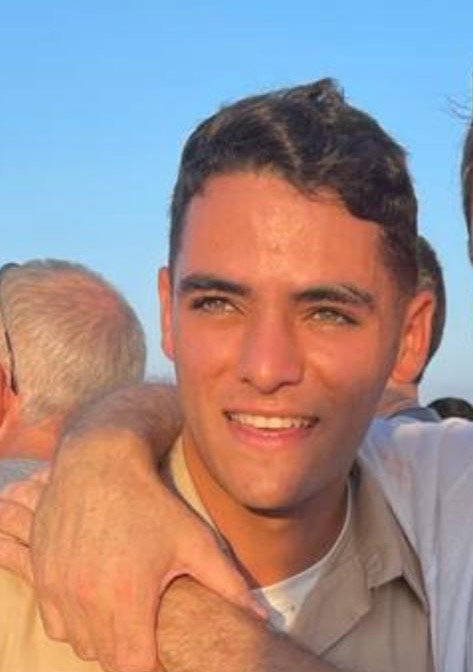
The story
Romi was born on a bright spring morning, Wednesday, May 6, 2003, in Givatayim, the firstborn son of Rachli and Sa’ar Hecht. He arrived with curious, kind green eyes, a small smile that already hinted at the quiet charm he would spread around him, and a heart that seemed unusually large and ready to love. The house on the quiet street in the small green town filled with new light. Soon his younger siblings, Noa and Uri, joined the family and became his entire world.
He grew up in a warm home where the door was always open, where the smell of home-cooked meals mingled with children’s laughter and long evening conversations around the dinner table. His parents, Rachli and Sa’ar, gave him solid foundations of love, respect, and responsibility—values that seeped into him from an early age and became his inner compass. As a baby his small hands already reached out to support, his green eyes already scanned the room looking for anyone who might need help, and that captivating smile was his first way of communicating with the world, of bringing calm and peace to those around him.
Even before he turned five, when kindergarten became his first meaningful framework outside the house, Romi stood out for his natural giving and his exceptional empathy. In pre-school, as a gentle child, he noticed the boy who struggled to fit in, the one who seemed to move at his own rhythm and needed extra patience and a softer touch. Romi didn’t wait for the teacher’s instruction or a parent’s request; he simply went over. He sat beside Uri, who often withdrew into his inner world, and offered him a colorful Lego block, showing him gently how to connect it to another. Slowly, with endless patience, he built a crooked, wobbly tower with him—one that kept collapsing. But Romi never gave up. He smiled, encouraged him with an understanding look, and every time the tower fell he helped Uri gather the pieces and start again, until Uri himself began to smile a small, almost invisible smile. Romi became his mentor, walking with him through the play corners, extending a small hand when he stumbled, handing him the right colors at the art station. He didn’t talk much, but his quiet, supportive presence created a bubble of safety around Uri that allowed him to open up, just a little, to the world. That was the moment his parents and teachers understood that this child carried a rare depth—the ability to truly see the other and act on his behalf without expecting anything in return.
His elementary school years at the Borochov School in Givatayim only strengthened these qualities. Romi was never the loud kid in class, the one who shouted to get attention. He was quiet, yet his presence was felt in every corner. He was the one his friends turned to when they needed honest advice, when an argument needed to be settled fairly, or when a class project had to be lifted. Teachers spoke of a boy with “exceptional modesty,” who, even when he excelled in wisdom and skill, remained grounded, always ready to listen and contain. He was part of a young leadership group established at the school and immediately stood out as an influential figure—not through commands or declarations, but through his actions. When the initiative arose to travel to a special-education school in Beit She’an to volunteer, Romi was among the first to sign up. He didn’t just join; he saw the bigger picture. There was a need for physical help, for carrying equipment, for organization. Without thinking twice he turned to his father, Sa’ar, and asked if he could come along to assist. Sa’ar, who knew his son well, was not surprised. He saw that spark in Romi’s eyes, the desire to contribute, and he gladly joined. Father and son together organized equipment, helped set up activity corners, and above all gave the children in Beit She’an a sense of caring and connection. Romi played ball with them, drew with them, listened to their small stories, and brought along his calming smile that managed to open hearts. It was a formative experience that planted even deeper within him the understanding that the power of giving lies in the act itself and in the human connection it creates.
At home, Romi was the pillar for his brother and sister. As the eldest, he was the protector, the one who was always there. His connection with Noa and Uri was warm and close, soaked in unconditional love and support. In the evenings, after the sun had set and lights came on in the neighboring houses, they would gather in the living room to play board games or simply talk. Romi was the one who told the corny jokes, who found creative solutions to every little fight over a toy, who hugged Noa when she was afraid of the dark. He was Uri’s compass—showing him how to ride a bike for the first time, encouraging him as he practiced soccer in the yard. When they needed help with homework, Romi was there, patiently explaining complicated math rules or grammar. He didn’t lecture; he sat with them, one on one, until they understood. He had a quiet voice, but when he spoke, everyone listened. Sa’ar and Rachli watched him with pride, seeing how he grew into a young man with enormous responsibility, a big heart, and the ability to hold the world of those closest to him. Their home in Givatayim was his fortress, the place where he learned his values, where he felt loved, and from which he set out into the world equipped with a deep faith in the good in people.
When he reached “Kla’i” high school, Romi entered the excellence class, where his sharp intellect blossomed and his natural leadership skills were honed. He was never a “star child” in the arrogant sense of the word, but a star that radiated light around him, drawing people in with his kindness and his captivating smile. Teachers described him as a smart, beloved boy who aspired to contribute and go far, yet always did so with humility. He was an inseparable part of the social core of his grade—the one who organized gatherings, made sure no one was left out, and always found the right words to lift everyone’s spirits. His sense of humor was developed and sharp, and he knew exactly how much to use it to ease tense moments or simply make everyone smile. A constant smile rested on his face, almost his personal signature, leaving a mark on the heart of everyone who met him. He was surrounded by friends, “someone you don’t forget,” as his loved ones described him, because with his charming personality and genuine care he touched the hearts of all those around him.
But the majority of his energy and time Romi devoted to the “Working and Studying Youth” movement. He began as an enthusiastic member, sitting around the campfire at summer camps, listening intently to the counselors, absorbing the values of friendship, action, and love of the land. Very quickly he became a counselor himself, and at the Borochov branch in Givatayim he became an admired figure. He was not the counselor who gave orders, but the one who instilled values through personal example. He taught his members what respecting others really meant, how determination could move mountains, and how love of the land was not a slogan but a way of life expressed in daily actions. He organized activities, led discussions, and above all created a safe space where every member felt they belonged and were valued. Under his leadership the Borochov branch became a vibrant center, a place where teenagers could express themselves, learn, and grow. As branch coordinator, Romi dedicated long hours—sometimes at the expense of his own free time—to ensure every event ran perfectly, that every member received the attention they deserved, and that the spirit of the movement continued to beat strongly. He saw “Working and Studying Youth” not merely as a framework but as a second home, a place that shaped his identity and gave him the tools to become a true leader—one who acted quietly, with humility, yet with deep and lasting influence.
As his enlistment date approached, one dream burned inside him with special intensity: to serve in Unit 669, the Israeli Air Force’s tactical rescue unit. It was not a random choice but the natural expression of the scale of values that had guided him all his life—giving, helping others, saving lives. He saw in this unit the pinnacle of meaningful service, the place where he could fulfill his purpose most completely. He enlisted on December 6, 2021, and began the long, grueling training course. The preparation demanded exceptional physical and cognitive abilities, highly developed social skills, and perfect teamwork. Romi entered it with uncompromising determination. He ran long distances with heavy weight on his back, swam in rough seas, climbed steep cliffs, and solved complex navigation exercises under enormous time pressure. There were moments of total exhaustion, muscle pain, and loneliness, but Romi never gave up. He pushed himself to the very edge of his ability and beyond, always remembering why he was doing it: to be there for anyone who found themselves in trouble.
During training and later as a full-fledged fighter, Romi stood out for his professionalism, his quiet leadership, and his unwavering dedication. His commanders deeply respected him and called him “a man of action.” He was not one to talk much in team briefings, but when a mission was required he carried it out in the best possible way, with precision and responsibility. He always put the good of his comrades before his own and looked out for their safety and well-being. With his unique ability, quietly and modestly, he united the team around him and gave them a sense of security. The fighters beside him, his brothers in arms, described him as “a brother”—someone you could trust with your eyes closed, who would never despair or give up, and who would always be there to help, even in the most dangerous situations. He was caring, responsible, and brave; all these qualities came together in him to form an elite warrior ready for any challenge. Unit 669, with its motto, became a second family for him, a place where the values he absorbed at home and in the youth movement received tangible, daily expression. He lived that motto with every fiber of his being and was prepared to pay any price to save lives.
Then came the morning of Saturday, the 22nd of Tishrei, Simchat Torah 5784—October 7, 2023. It was six-thirty in the morning when the quiet of Shabbat was shattered by piercing sirens that tore through the sky. Romi, who was at home in Givatayim, woke in alarm. The first messages began flooding his phone—reports of heavy rocket fire, terrorist infiltrations, unimaginable events in the Gaza envelope. His heart knew immediately: this was not another round of fighting; this was war. He hurried to gather his gear, understanding he had to leave for the unit at once. His brother Uri stood at the doorway, worried, as Romi told him in a quiet but resolute voice, “I’m going to defend my country.” No more words were needed. Uri understood the magnitude of the moment, the lack of choice, the burning sense of mission in Romi’s eyes. Romi left the house into the chaos that had begun outside, into roads that quickly filled with speeding cars carrying soldiers and security personnel, all rushing to assembly points, to battle.
The first days and weeks of the war were an ongoing nightmare. Romi and his unit in 669 were at the forefront, participating in dozens of rescue missions, some under heavy fire, extracting wounded from hell, evacuating civilians caught in the fighting, and providing first aid in places where death lurked in every corner. He saw unbearable sights, met people who had lost their entire world, and witnessed extraordinary human bravery alongside unimaginable horrors. Every time he went out on a mission he knew he was there to bring hope, to save lives, to be a small light in the great darkness. He acted with endless devotion, employing all his training, all his skills, and all his heart. Tired, exhausted, yet determined, he continued onward, mission after mission, focused on a single goal: to save. He returned with short stories, fragments of experiences, that testified to the scale of the task and the price it exacted. His family followed him with deep concern but also with enormous pride, knowing that Romi, their son and brother, was doing what he knew how to do better than anything: protect the other.
On December 12, 2023, about two months after the outbreak of the war, Romi and his unit operated in the Shejaiya area in northern Gaza, a focal point of fierce and intense fighting. In the afternoon hours a dramatic message arrived: a force of four fighters had been hit and needed immediate extraction. Romi, serving as radioman, and his commander, Major Ben Shali, did not hesitate for a second. They knew every second was critical and that the lives of the wounded fighters depended on the speed of their response. They rushed to the location, pushing forward under heavy enemy fire, aware of the danger yet driven by a fierce urge to save. The battle was difficult, the complexity on the ground enormous, and the fire directed at them relentless. In the midst of the inferno, inside the deafening noise of shooting and explosions, Romi and Ben operated with professionalism and extraordinary courage, trying to reach the wounded fighters. But fate was cruel. In that same rescue operation, both were killed by terrorist fire. Nine fighters fell in that harsh incident. Romi Hecht, twenty years old when he fell, was killed in battle while doing what he believed in with all his heart: trying to save lives, trying to protect his comrades, defending his country.
The news of Romi’s death struck his family, his friends, and everyone who knew him with profound shock. The house in Givatayim, which had always been filled with laughter and warmth, fell silent. An immense, incomprehensible pain descended on everyone. Sa’ar and Rachli, his parents, Noa and Uri, his siblings, felt as if a part of their soul had been torn away. Romi was laid to rest in the military cemetery in Kiryat Shaul, Tel Aviv, accompanied by thousands—family members, childhood friends, members from the Working and Studying Youth, teachers, commanders, and fighters from 669. His coffin, wrapped in the Israeli flag, was carried on the shoulders of his brothers in arms, their faces etched with pain and disbelief. At his fresh grave, his sister Noa eulogized him in a voice choked with tears: “Rumchi, you radiated calm, security, and peace on all of us. You lit the way for us. Keep shining on us from above.” She added, out of deep pain and a pure faith that perhaps could explain the inexplicable: “I knew that this world sometimes takes the best ones, those who shine so brightly, too early.”
His team commander, his voice trembling, also stood by the open grave and eulogized Romi. He described the most prominent quality in him: “His smile. A smile that lit up everyone’s face and made everyone fall in love with him. Romi was a man of action. He never spoke much in team talks, but he always put into practice, simply and authentically, the values we talked about. Romi fell in battle in Gaza while attempting to advance under fire to rescue wounded—a mission he believed in with all his might.” The commander’s words echoed what everyone knew: Romi was a warrior at heart, a man of giving, who was willing to sacrifice everything for the sake of the other. After his death, Romi was posthumously promoted from Staff Sergeant to Sergeant First Class, in recognition of his bravery and immense contribution.
The void Romi left was enormous, yet his spirit continues to beat. His family, despite the deep pain, chose to continue his path through giving and volunteer work. They created a page on the “Story of My Life” website in his memory, where his life, photographs, and videos from the different stations of his journey are documented, so that Romi’s story remains alive and breathing. His father, Sa’ar, began taking an active part in a project supporting lone soldiers and Holocaust survivors, continuing the chain of giving that had been so characteristic of his son. A national service core in the rehabilitation department at Sheba Medical Center was named after Romi, perpetuating his values in a place where lives slowly return to their course. At the “Kla’i” high school where he studied, a “Class of Iron” tournament was held reflecting the values Romi believed in—excellence, leadership, seeing the other, determination, comradeship, and courage. Romi’s name is also commemorated on the monument to Air Force fighters at the Pilots’ Hill and on the website of Unit 669 alumni.
Romi Hecht, of blessed memory—the green-eyed boy with the captivating smile from Givatayim—left behind a legacy of love, giving, and heroism. His short but incredibly full life is the story of a person who chose to live for the sake of others, who was a compass of values, and who, at the moment of truth, chose to defend his home, his people, and his future. He fell as a hero in the battle to save lives, leaving behind a deep sense of inspiration and hope. Romi’s story is an inseparable part of the Israeli story of revival, a story of courage, commitment, and love of people and land that depends on nothing else. He continues to shine; his smile rests on the faces of the souls he touched, and his memory will be kept in our hearts forever—a symbol of profound human heroism that grows from life itself.
In the media
Articles
Podcasts
- What Is Our Role as the Chosen People?
דנה רגב — מעלה בטוב ·
Memorial projects
The “Iron Class” tournament at Kalai High School was dedicated to Rom, with students doing fitness exercises and carrying stretchers.
The high school students’ race in Givatayim was dedicated to fallen graduates, including Rom; according to the municipality, about 150 students took part.
The memorial ceremony at the Borochov youth movement branch was dedicated to Rom and Omri Niv Feuerstein, former members of the branch who fell in the war.
Stories told about them
His homeroom teacher says he studied in an excellence class and aspired to contribute through his service. The deputy mayor describes a friendship spanning years between him and her son Omri, from first through twelfth grade, and their joint work as counselors in HaNoar HaOved VeHaLomed.
When the young people in his group were reluctant to come to the youth movement branch during the coronavirus pandemic, Rom baked cookies for them to encourage them to come. Group member Eilam Yaron described him as an attentive, dedicated youth leader and paid tribute to him at the branch’s memorial ceremony.
Life & service
Profile
Service
- Rank
- Sergeant first class
- Honours
- Posthumously Promoted
- Battle Location
- Northern Gaza Strip
Family
- Father
- Saar
- Mother
- Racheli
Burial
Tributes & remembrance
אתה כל הזמן איתי
עדיין מתגעגעת כל יום
שיהיו ראויים כולם להקרבה שלך חבר מיוחד שלי
בלתי נשכח
רום הוא גיבור שנלחם בשביל שנחיה פה בשקט ובטוב
רום הוא השראה בשבילי שהציל מאות אלפי תושבים שיצא בשנייה שפרצה מלחמת חרבות ברזל
תודה רבה לך רום על הכל
תמיד נזכור איזה גיבור אתה
יהי זכרו ברוך.
נתן את חיוו למען המולדת בזכות הנופלים אנחנו חיים במדינתנו ולא נישכך אותם לעד יהי זכרו לעד
מצדיעה לך גיבור, מלח הארץ..יהי זכרך ברוך לעד
רומצי !
עמדנו חצי גבעתיים אתמול ליד הקבר שלך . היה כול כך עצוב ונוגה הכל . אתה כל כך חסר ולכל כך הרבה אנשים. כל החברים החתולים שלך היו שם. סבא ושתי הסבתות וכל החברה מקלעי.
אי אפשר לתאר את ההרגשה שאפפה אותי. כאילו אתה שם ומביט עלינו ואומר טוב שבאתם אני לא ממש מת . אני רק לבשתי צורה אחרת אני חי בלבבות שלכם.
משכמו ומעלה
עלם חמודות
לעד תשאר בלבנו
מלח הארץ, הותיר בליבנו חלל עצום
אוהבת לנצח
היחיד והמיוחד מכולם
אני אוהבת אותך כל הזמן
רום האהוב,
נזכור אותך לעד!
תודה שהגנת עלינו ולא הוגן שאתה לא איתנו!
תודה רבה שעזרת להגן על מדינת ישראל.
אנחנו מצטערים שכך קרה לך ואנחנו תמיד נאהב אותך, ילד עם לב זהב ונזכור אותך לנצח!
רום, תודה על מי שהיית.
שנזכה להיות ראויים לנפילתך
יצאתי מהלוויתו של רום הכט ז"ל. למרות שאת שירותי הצבאי התחלתי בגדוד 13 וליבי נשבר היום, הלכתי להלוויתו של לוחם 669 האמיץ שנפל כאשר הגיע לחלץ את הפצועים אמש, בקרב. סבו, בן לניצולי שואה שהבטיח לאביו להמשיך את המשפחה בישראל, בכה על קברו. רום היה ילד מופלא, חניך בנוער העובד והלומד, אהוב כל כך ע"י משפחתו וחבריו. אחותו לא השאירה עין אחת יבשה כשסיפרה על הקשר המיוחד ביניהם -" ידעתי שהוא יקח אותך כי אלוהים רוצה את כל הטובים לידו" עצוב. יהי זכרו ברוך
ילדה מדהים למשפחה מושלמת! עצוב כל כך. נזכור תמיד
רום,
תודה עליך עם הקסם והחיוך התמים והטוב שעוד מגיח משום מקום גם כשלא ברור תמיד למה.
מלאך שבטעות מהלך בנינו, בטוחה שטוב לך שם כי לזאת אתה ראוי!
יהיה זכרך ברוך,
במוסך ציווית לנו חיים וסיבה להמשיך הלאה!
אתה גיבור ישראל
כמה יפה ואמיץ , איזה אובדן
יהי זכרו ברוך .נזכור תמיד תמיד
זכו שהיית חלק מהם 20 שנה
יהי זכרו ברוך לעד
נוח על משכבך בשלום ילד יפה תואר.
בן למשפחה מדהימה.
שמור עליהם מלמעלה
יהי זכרו ברוך, גיבור ישראל. הלב כואב
יהי זכרך ברוך
לא הספקתי להכירך וכבר עלית לכסא המלכות.
שמור על משפחתך היקרה ממרום.
תודה לך על שמירת עם ישראל, מותך לא יהיה לשווא.
לזכרו של רום הגיבור בנה הבכור של רחלי ששמעתי עליו הרבה סיפורים וגאווה של אמא עוד בחיו .
נזכור אותך תמיד גיבור ישראל
כואב הלב, אבידה של ממש. מלח הארץ! תשמור מלמעלה על המשפחה המדהימה שלך
ילד מקסים שישאר צעיר לנצח
יהי זכרו ברוך
רום המהמם, לנצח תשאר בליבי!!!!
רום יקר ילד של אהבה ויופי ערכי, חבר, ואוהב אדם.מתגעגעים כל הזמן.
שנהיה ראויים לך
רום היקר, תלמיד עם עיני מלאך וחיוך ענק.
מתגעגעת
יהי זכרו ברוך .
ילד קסם תודה לך שהגנת עלינו
The smile on his face was everlasting, always with a huge, giving heart, a boy surrounded by a warm and loving family, with strong values and good manners.
Source:ישראל היום
Read the Hebrew original
החיוך על פניו היה נצחי, תמיד עם לב ענק של נתינה, ילד שעטוף במשפחה חמה ואוהבת, מאוד ערכי ועם דרך ארץ.
The way Rom guided us always inspired me to be a guide like him.
Source:דבר
Read the Hebrew original
הדרך שבה רום הדריך אותנו תמיד נתנה לי השראה להיות מדריך כמוהו.
To me, Rom is Racheli’s son, and I bow my head in his memory.
Source:דנה רגב — מעלה בטוב
Read the Hebrew original
עבורי רום הוא בנה של רחלי, ואני מרכינה ראש לזכרו.
That the family tree continues. We could not honor his memory in a better way.
Source:ARD / Tagesschau
You lit the way for us.
Source:יזכור
Read the Hebrew original
הארת לנו את הדרך.
I knew He would take you because God wants all the good people by His side
Source:יזכור
Read the Hebrew original
ידעתי שהוא ייקח אותך כי אלוהים רוצה את כל הטובים לידו
Rom was a man of action.
Source:יזכור
Read the Hebrew original
רום היה אדם של מעשים.
Remembrance Day addresses
יום הזיכרון לחללי מערכות ישראל התשפ"ה – 2025
בכל יום שעובר, אזכור יותר! אזכור, את אלו שיצאו עימי לקרב ולא שבו, ולהם אין מי ידמה ומי ישווה. אזכור, שהכאב לא יעבור לעולם, והזמן, הוא לא מרפה ולא מרפא. אזכור, את שיברון הלב הגובר ואת הבית שבוער. אזכור, את צדקת הדרך, ואשבע שוב, שמה שהיה לא יהיה יותר. אזכור, שיותר מכל דבר אחר – אני חסר! ביום הזה, אני נתקף געגוע לדמותם, לחיתוך דיבורם, לחיוכם, ומדליק נר לזיכרון דרכם ומורשתם!
משרד הביטחון
אגף משפחות, הנצחה ומורשת
יום הזיכרון לחללי מערכות ישראל התשפ"ה – 2025
בכאב, בהצדעה ובתקווה אני מתכבד להדליק נר זיכרון זה. השנה, כשאנו נלחמים במלחמה ארוכה, רב זירתית וצודקת, הזיכרון נושא משמעות עמוקה. ביום זה נעצור ונתייחד עם זכרם של טובי בנינו ובנותינו שנפלו בהגנה על המדינה. מורשתם היא המצפן שמתווה את דרכינו, והיא המעניקה לנו כוח להמשיך ולהגן על מדינת ישראל ותושביה. משפחות יקרות, אנו מרכינים ראשנו ומתחייבים שנעמוד לצידכן תמיד. יהי זכר הנופלים ברוך.
אלוף דדו בר כליפא
ראש אגף כוח האדם, צה"ל
יום הזיכרון לחללי מערכות ישראל התשפ"ה – 2025
בשעה שאנו זוכרים את גודל תרומתם ועומק מסירות נפשם של טובי בנינו ובנותינו, נופלי מערכות ישראל לדורותיהן, ממשיכים צה"ל וכוחות הביטחון במימוש המשימה למענה לחמו ועבורה נפלו: הכרעת אויבינו מדרום, מצפון, ביהודה ובשומרון, וגם בזירות רחוקות יותר. בהערכה רבה ובגאווה אדירה אנו מרכינים ראש בפני הנופלים והנופלות, מאמצים את משפחותיהם אל לבנו, וממשיכים במשימה להבטחת קיומה של ישראל לדורי דורות. יחד נעשה ונצליח.
רב אלוף אייל זמיר
הרמטכ"ל, צה"ל
יום הזיכרון לחללי מערכות ישראל התשפ"ד – 2024
כאשר דגלינו מורדים לחצי התורן וראשינו מורכנים לזכר הנופלים והנופלות במערכות ישראל, ממשיכים לוחמי צה"ל ומפקדיו בלחימה בדרום, בצפון, ביהודה ובשומרון ובזירות נוספות. על כל דור מוטלת המשימה של הגנת העם והארץ – משימה שאף פעם אינה פוסקת. נצדיע בגעגוע ובגאווה לנופלים ולנופלות, נחבק את משפחותיהם, ונמשיך ברוח הציווי שהותירו לנו. עם ישראל חי.
רב ניצב יעקב שבתאי
המפקח הכללי, משטרת ישראל
יום הזיכרון לחללי מערכות ישראל התשפ"ד – 2024
אחיי הנופלים, כל נר הוא זיכרון יחיד ומיוחד, על חיים שהיו ואינם, געגוע שנצרב עמוק בלב, עולם ומלואו. הנרות כולם הם זיכרון של אומה כי לעולם לא עוד, בשורת הציונות וקוממיות ישראל. זיכרון כי הדרך לעם חופשי בארצנו עוברת דרך מסדר הנופלים. אור הנר יזכיר לנו את מסירות נפשכם להציל חיים, להגן על הבית. הנרות מסמנים לנו נתיב גבורה ערכי מחייב שאנו מצווים ללכת לאורו. נמשיך להילחם ולהוסיף אור מתוך אמונה בנצח ישראל.
יואב גלנט
שר הביטחון
יום הזיכרון לחללי מערכות ישראל התשפ"ד – 2024
בהצדעה ובכאב, בשם צה"ל כולו, אני מדליק נר זיכרון. בעיצומה של מלחמה, הזכרון נושא משמעות יום-יומית, שעבר והווה מתלכדים בה. לאורם של הנופלים נמשיך לצעוד, חיילי הסדיר והמילואים. לאורם של הנופלים נמשיך להגן על ארצנו ועל מולדתנו, גם כשהמחיר כבד. להבת-הזכרון תבער בנו בעודנו ממשיכים להלחם ונזכור את הנופלים ואת אומץ ליבם. משפחות יקרות, צה"ל מרכין היום ראש, מצדיע לכן וכואב איתכן. יהי זכר הנופלים ברוך.
אלוף יניב עשור
ראש אגף כוח האדם, צה"ל
יום הזיכרון לחללי מערכות ישראל התשפ"ד – 2024
בהוקרה, בגאווה ובכאב שאין לו סוף, אני מתכבד להדליק נר לזכרם של הנופלים והנופלות במערכות ישראל. סיפור חייהם בארץ הזאת, מסכת שירותם, גבורתם והקרבתם – הם סיפורה של הארץ הזאת, אך גם סיפור המחיר הכבד שהיא תובעת מאוהביה. מחויבותנו לזכר הנופלים ולדרך שהותירו לנו ניצבת תמיד לנגד עינינו. את המשימה שלא זכו להשלים, משלימים כיום, וישלימו, אנשי כוחות הביטחון, הממשיכים בדרכם ולאורם. יהי זכרם של הנופלים ברוך.
משרד הביטחון
אגף משפחות, הנצחה ומורשת
יום הזיכרון לחללי מערכות ישראל התשפ"ד – 2024
בחרדת קודש אני מתכבד להדליק נר לזכרם של חללי מערכות ישראל, חברנו שנפלו, מראשית היציאה מהחומות ולאורך כל שנות עצמאותנו המדינית והציונית, מהווים תמרור זיכרון לדרך חיינו ולמחוייבות הלאומית להנצחת זכרם. דרכם נותרה דרכנו ומורשתם נר להמשך עשייתנו. יהי זכרם ברוך!
בני גנץ
שר הביטחון
יום הזיכרון לחללי מערכות ישראל
נזכור אותם, כולנו יחד. כל אחד ואחת מהם, מדי יום ביומו, והיום ביתר שאת, כך – לנצח. "כי מדי דברי בו זכור אזכרנו עוד"
משרד הביטחון
אגף משפחות, הנצחה ומורשת