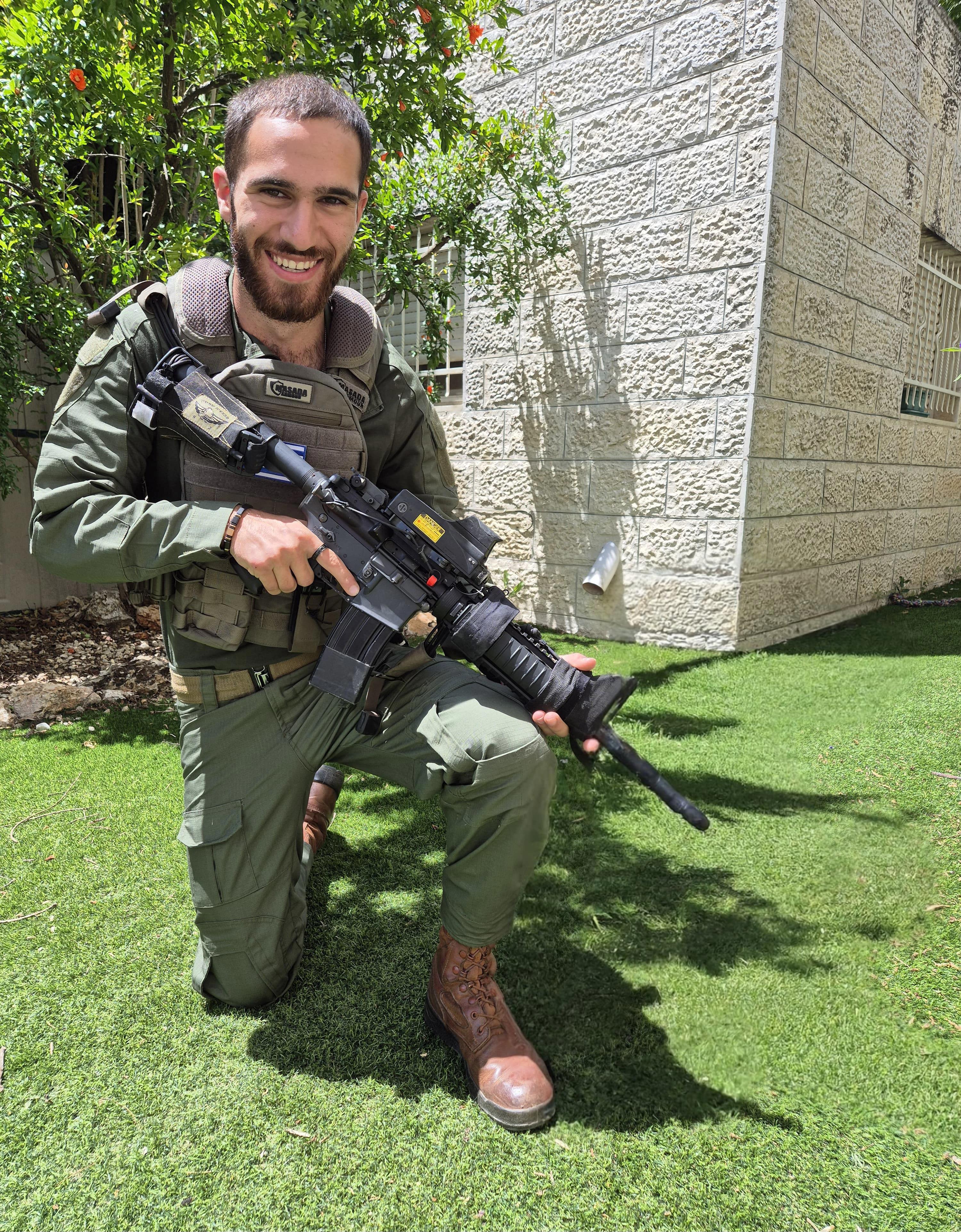
The story
The air in the community of Elazar always carried the scents of earth after rain, the blossoming of almond trees in spring, and sometimes the aroma of wood smoke in the cold winter of the Judean Hills. In the heart of this landscape, in a warm, open home whose doors were always bustling with activity, Natanel Pesach was born on the 24th of Adar Bet, 5763, which was March 28, 2003. He was the fourth of eight siblings, a vibrant and boisterous human mosaic of parents, Revital and Elad, and seven other children: Hodayah, Rotem, Hadar, Dvir, Tsofia, Herut, and Talia. Amidst this family commotion, which included rolling laughter from the living room, brief arguments from the bedrooms, and the constant hum of activity in the kitchen, young Natanel grew up as a quiet and gentle child, possessing an enormous soul, a sweet smile that readily graced his lips, and sparkling eyes that never ceased to explore the world around him, carrying within them a touch of mischief mixed with a unique cynicism. He wasn't the child who rushed first into everything, nor the one whose voice was heard above all others, yet his presence was deeply felt, profound, like still waters running deep, leaving an indelible mark.
Even from childhood, an intense curiosity was evident in him. Not the curiosity of a child peeking into a forbidden room, but that of a true explorer. He would sit on the floor, taking toys apart into their smallest components, not just to destroy, but to understand how they worked, what made them tick. When he asked a question, it wasn't trivial; it was focused, penetrating to the core of the matter, and he wouldn't rest until he fully understood the answer. He knew what he wanted, and even if he didn't always express it in loud words, he radiated a quiet determination. "Mom, why is the sky blue, specifically?" he would ask, and even after the explanation about the scattering of light rays, he would persist: "But why blue? Why not red or green?" Revital would smile, knowing she wouldn't easily win this battle. He didn't let anyone decide what was right for him. If he was convinced of a certain path, he would follow it, even if it went against common opinion, but always with gentleness and respect, without creating unnecessary commotion. In the elementary school in Elazar, when he would sit aside, drawing small, precise details of birds he had seen on the way in his notebook, while the other children ran around the playground, the teachers already noticed his special character – a calm child, seemingly introverted, yet possessing a rich and active inner world, meticulously observing the world and translating it into his thoughts.
Love for others and unity were not empty slogans for Natanel, hung on synagogue walls or uttered in political conversations. They were a way of life, a cornerstone of his personality. He didn't seek a stage or praise; he simply acted. If he saw someone sad, he would quietly approach them, offering help, a small gesture, a kind word. He didn't judge people by their clothes, origin, or opinions, but accepted everyone as they were, out of a deep understanding of human complexity. Everyone remembers the times he pitched in to help at home; during Friday night dinners, when the house would fill with guests, he would see his mother Revital rushing between the pots, and then quietly get up, take plates, set the table, asking, "Need anything else, Mom?" without being asked, purely out of a desire to ease her burden, to bring joy. When one of his younger siblings struggled with homework, Natanel, despite his introverted nature, would sit patiently and explain again and again, until the material was understood, filled with satisfaction by the spark of comprehension that lit up in his sibling's eyes. He acted much more than he spoke, and all of this without seeking attention or honor. His actions stemmed from a pure place of giving, an inner need to be good, to illuminate, without seeking the spotlight.
His rich inner world and strong desire to contribute to society led him, at a young age, to significant volunteer work. He wasn't content with being a "good kid"; he actively sought ways to make the world a better place. He volunteered with the "Revolution of Joy" association, an organization dedicated to bringing joy to patients and their families in hospitals. This volunteering wasn't just another chore or pastime for him. He would arrive at the hospitals, often after a long school day at the "Or Torah Derech Avot" religious high school in Efrat, take his backpack off his shoulders, and immediately transform his demeanor. In the hospitals, amid sterile corridors and the scent of disinfectants, he would find his way to the children's wards, to the internal medicine departments, bringing with him a guitar, balloons, games, and most importantly – a wide, authentic smile. He would sit by patients' beds, listening patiently to their stories, allowing them to express themselves, and with his sparkling eyes, which saw deep into their souls, he would convey a message of love and acceptance. One time is particularly remembered: he sat by the bed of a small girl who refused to eat. Natanel didn't try to persuade her by force; he simply began to tell her a fictional story about a brave hero, accompanying the narrative with amusing facial expressions and funny voices, until the girl burst into laughter, and in that moment of respite, suddenly asked to eat. He didn't do it to draw attention to himself, but so the girl would smile. He succeeded in transforming difficult moments into moments of humanity, of light, of pure joy.
In addition to his work in hospitals, Natanel was also active at the "Azmera Open House for Youth" in Jerusalem. This was a meeting place for teenagers from all walks of Israeli society, a safe space where young people could come, talk, create, simply be. There, amidst deep conversations about life and board games, Natanel found his natural place. He would sit aside, listening to the discussions, and only when he felt he had something substantial to say would he interject with measured and precise words that immediately resonated in the room. He wasn't the loud leader, but rather the one whose presence stabilized, calmed, and instilled an atmosphere of acceptance. He would sit with teenagers who felt different, alienated, and managed, simply through listening and nodding, to make them feel seen, to feel they belonged. He brought to Azmera that same enormous soul, that same sweet smile, and that rare ability to see the person behind every mask.
In eleventh grade, when asked to write an essay on a topic that preoccupied him, Natanel naturally chose to focus on the "Revolution of Joy" association. This essay, written in his clear and sincere language, reflected exceptional depth of thought and sensitivity for his age. "For me," he wrote, "the value of giving and bringing a smile to someone in distress is a central value that guides me in life, that gives me satisfaction and a sense of mission." He didn't write it as a slogan, but as an accurate description of an inner feeling. He described the elation he felt each time he managed to alleviate, even slightly, another person's pain or sadness, the satisfaction that filled his heart when he saw a spark of hope in a patient's eyes. But Natanel, with his keen insight, saw beyond the single patient's room. In his essay, he also addressed the broader social aspect of his volunteering. "I live in a religious community that is relatively homogenous," he noted, "and precisely the regular encounters I have through volunteering with volunteers from different sectors of society – secular, religious, ultra-Orthodox – is for me another reason I am so connected to this work. I feel that getting to know people I don't meet daily in such positive work lowers barriers and breaks down stereotypes, enriching my perspective on the world and the challenges facing Israeli society in all its diverse shades and sectors." These words, written with remarkable maturity by a seventeen-year-old, revealed his broad and deep worldview. He was not just a good child, but a person with a clear moral compass, who saw Israeli unity as a supreme value, and believed in the power of giving to bridge gaps and make society more united and strong. He saw the beauty in difference, the strength in connection, and strived for them in all his actions.
Years passed, and Natanel grew and developed. From the quiet, observant child, he became a mature young man, with the same sensitivity and curiosity, only now directed towards the wider world beyond the confines of home and community. He completed his studies at "Or Torah Derech Avot" high school, equipped not only with knowledge but also with solid values and a strong inner compass. The transition from the protected environment of home and high school to the military world was a natural step for him, another expression of that sense of mission he had written about in his essay. On March 22, 2023, close to his twentieth birthday, Natanel enlisted in the IDF. He was assigned to the Kfir Brigade, Shimshon Battalion (92), a brigade known for its combat and complex missions. He entered the military system carrying those same "still waters" – external quiet, but immense inner determination. He loved the battalion, his role, and his comrades. The army, with its difficulties and demands, did not deter him. On the contrary, he found meaning, challenge, and another place where he could express his values. When asked, "How are you?" – a routine question among soldiers – he would reply with his endearing cynicism, a small smile in his sparkling eyes: "Alive and breathing." This seemingly simple answer reflected his worldview – an acknowledgment of life's complexities, but also a deep joy for life and a sense of gratitude for existence itself. He wasn't afraid of dangers; he accepted them as part of the path, part of the service, part of life itself.
When the war broke out on October 7, 2023, Natanel was still in training, a recruit at the very beginning of his military path. But on that black Sabbath morning, when news of the murderous invasion penetrated every home in Israel, there was no room for waiting, not even for the relatively calm routine of basic training. He was immediately deployed to the Gaza Envelope area. The buses carrying the recruits, who just the day before had been engaged in basic shooting drills, now sped into an inferno. The echoes of explosions, the incessant gunfire, and the general commotion of a sudden war, constituted his first baptism by fire. Natanel, who had not yet completed his basic training, quickly found himself on the front lines of the fighting, and his role as a medic gave him immediate purpose. He did not hesitate for a moment. The air was saturated with the smell of gunpowder, cries of pain, and the metallic scent of blood. He treated the wounded, applied tourniquets, injected morphine, and evacuated casualties, all under fire, amidst a chaos difficult to imagine. His hands, which until recently held a guitar or textbooks, now tended to deep wounds, as he maintained an astonishing composure, as he had learned in his first medic lessons. The still waters within him ran deep, now revealing a determination and inner strength that few his age could muster. He witnessed the horrors of war, the face of death, and yet, he continued to act, to save, to offer hope.
The fighting in the Gaza Envelope, which was just the opening shot of a prolonged war, turned Natanel's routine upside down. He completed his training course, but instead of returning to a normal routine, he went straight into the Squad Commanders' Course (M.K. – *Mefakdei Kita*). Even during the course, the fighting in the Gaza Strip continued in full force, and Natanel and his fellow course participants found themselves repeatedly in the thick of the combat. He moved from one intensive training exercise to the next, practicing again and again the skills required of a commander, while simultaneously applying them immediately in the field. He learned to lead, to plan, and to make decisions under pressure, all the while carrying his role as the company medic.
In one of the most difficult incidents during the fighting, explosive devices were detonated on the platoon adjacent to Natanel's. The explosion was deafening, a column of smoke and dust rose to the sky, and immediately afterward, cries of pain and calls for help were heard. Three soldiers fell on the spot, and fourteen others were wounded. It was a mass casualty event, one that leaves a deep scar on the souls of all who witnessed it. Natanel, as a medic, was called to the scene within seconds. He ran into the inferno, into the thick smoke and confusion, navigating between concrete debris and shrapnel. He saw his comrades lying on the ground, severely wounded, and immediately began treatment. He acted with astonishing professionalism and composure. While others were paralyzed by shock or acting in a panic, Natanel focused on the mission: he triaged the wounded, provided life-saving first aid – stopped bleeding, stabilized fractures, injected painkillers – and coordinated the evacuation. He worked quickly, efficiently, speaking to the wounded in a quiet, reassuring voice, trying to instill hope in them. He cared for everyone, and especially the wounded, seeing in them the person, the friend, not just the injury. He remained on site until the last wounded person was evacuated, ensuring that each and every one received the best possible care.
When he returned to base, exhausted, covered in dust and bloodstains, and when his comrades approached him to ask about his actions, to try to understand the magnitude of the heroism he displayed, he, as was his custom, humbly downplayed the significance of his actions. When asked about what happened and his performance, he replied with characteristic cynicism, with that mischievous twinkle in his eyes: "Boring... I'm not doing anything there." He didn't seek glory, didn't expect praise. He did what needed to be done, out of a deep sense of responsibility and inner duty. For him, it was simply "doing the job," even though everyone who witnessed the events knew it was an extraordinary act of heroism. These words, "Boring, I'm not doing anything there," became his personal code, his way of expressing his humility and his unwillingness to stand out, even when saving lives.
Upon completing the Squad Commanders' Course, Natanel expected to return to his combat battalion, but he was assigned to the role of a recruit squad commander. For many, this role would have been considered a promotion, a move away from the line of fire, a role with command responsibility but safer. But Natanel was not "many." He didn't seek safety or comfort. He demanded to return to his combat battalion, to his friends, to the front. He believed in his place there, in his influence, and in his true contribution to the fighting. He insisted, approached his commanders, and explained his intense desire to be where the war was raging at full intensity. After some time, his request was granted, and he was assigned the role of Deputy Company Commander's (DCC's) radio operator. This was a significant role, requiring great responsibility, technical understanding, and, most importantly – constant proximity to the DCC, at the core of operational activity, under harsh front-line conditions. He was glad to return to the field, to the adrenaline, to the deep meaning of fighting alongside his comrades.
In November 2024, months after the start of the war, Natanel entered intense fighting in the northern Gaza Strip with the Shimshon Battalion. The objective was clear and difficult: to conquer the area, clear it of terrorist presence, and destroy the vast and threatening network of tunnels dug beneath the surface, endangering the northern Gaza Envelope communities. The fighting in the Strip was different from anything he had known. No longer open battles, but fighting in densely built-up areas, through narrow alleys, inside semi-destroyed buildings, and under the constant threat of explosive devices, snipers, and anti-tank squads. Every step was fraught with danger. The air was always saturated with the smell of smoke, dust, and tension. The nights were long and cold, the days short and dangerous. Natanel, as the DCC's radio operator, was the eyes and ears of the Deputy Company Commander, relaying reports, coordinating forces, and ensuring continuous communication, all while carrying extensive equipment on his back – radio devices, batteries, maps, and personal weapon. He worked tirelessly, focused on the mission, always caring for his comrades, checking on their well-being, offering help. He was a pillar in the company, quiet yet steadfast, one you could rely on with your eyes closed. He saw the fatigue in his comrades' eyes, the fear that sometimes flickered for a moment, but also the determination and the belief in the righteousness of their path. He himself, despite all the difficulties, continued to maintain that same steadfast spirit, that sweet smile that would sometimes emerge in moments of respite, and that unique cynicism that would slightly relieve the tension.
On December 23, 2024, the 22nd of Kislev, 5785, during an operational activity in the Sheikh Zayed neighborhood in the northern Gaza Strip, Natanel's company encountered a squad of terrorists. The ensuing battle was short and violent. Our forces returned fire, and amidst the exchange of gunfire, as they advanced through the area, a deadly explosive trap was detonated precisely along their path. The explosion was massive, deafening, and a powerful blast wave swept through the area. In that tragic moment, Sergeant First Class Natanel Pesach fell. He was just twenty-one years old. Two other soldiers, his comrades in the company and on their path, fell with him: Deputy Company Commander, Captain Ilai Gabriel Atadgi, of blessed memory, and Staff Sergeant Hillel Dinar, of blessed memory. The three fell together, defending their home, defending their people.
The difficult news of Natanel's fall reached his parents' home in Elazar like a bolt from the blue. The lights in the house, which until that moment had shone warmly, extinguished all at once. The silence that fell upon the house was deafening, unlike any silence they had ever known. A silence of unimaginable pain. Revital and Elad, his parents, and his seven brothers and sisters, were left gripped by shock and grief. Natanel, the quiet and gentle child, with the enormous soul and the sweet smile, would not return. He was laid to rest in the military section of the Kfar Etzion cemetery, in the heart of the landscape where he grew up, surrounded by the Judean Hills earth he so loved. After his fall, he was posthumously promoted to Sergeant First Class, in recognition of his heroism and immense contribution.
At his funeral, under gray skies and before an immense crowd of family members, friends, neighbors, and soldiers, his parents stood and eulogized him. Their words, broken by pain yet full of love and pride, painted Natanel's portrait. His father, Elad, stood there, trying to find words that hadn't already been said hundreds of times. "Natanel, our sweet one, what can one say?" His voice trembled, "All the clichés about a fallen soldier have already been said at over eight hundred funerals. I've stood here in this cemetery many times, at the funerals of community members, with tears in my eyes, as if they were my own children. I didn't believe then, and still don't now, that I would have to stand on this side. What can one say about you, Natanel? That you are sweet, loyal to your path, a quiet and humble child, that you love all your siblings. Everything that has been said about every soldier applies to you too, hero. We already miss you. May your memory be a blessing." Elad spoke of Natanel's humility, his love for his family, and his kindness, which constituted his essence. He saw Natanel not just as a hero who fell in battle, but first and foremost as his sweet son, whose absence leaves an immense void.
His mother, Revital, also approached the microphone, her voice breaking but full of infinite love. "My Natanelush, our enormous soul," she said, tears streaming down her face, "I miss your furry bear hug so much. Your laughter, your sweet smile, your sparkling eyes. Your mischief. Your unique cynicism. Who will explain the jokes I don't understand now?" She described the deep bond between them, the small moments of closeness, his unique humor. She spoke of the dreams that vanished, of the future that was stolen: "I was so curious about who your wife would be, what an amazing father you would be to your children, and especially how you would learn to answer your wife with more than just 'okay.'" In her words, she reflected Natanel's special character – quiet, introverted, yet full of love and humor. And then, with a look of unwavering faith, she turned to him, as if he were still there, listening: "Now you have business with God up there, you'll have to face Him face-to-face, like a man, just as you faced everything in life in the best possible way. So you have connections there. Use them well, ask Him to 'end our troubles.'" Her words were the cry of a grieving mother, but also an expression of immense pride in her son, in the man he was, and in his eternal contribution.
In an interview conducted with Revital before the funeral, when the pain was fresh and searing, she made a special request to the people of Israel, a request that expressed everything Natanel represented in his life: unity, giving, and a pursuit of inner and outer peace. "That everyone stop for five minutes," she asked, "think of someone with whom they are not at peace, call them, and say: 'In memory of Israel's hero, Natanel Pesach, I am willing to take one tiny step, lower one barrier, and give a hug.'" This request, which resonated across the country, was not just a private plea from a bereaved mother; it was a testament, a call to action that reflected the essence of Natanel's life – his belief in unity, in the ability to bridge gaps, and in the power of a simple human gesture. She spoke of the strength in a small concession, in lowering a barrier, in giving a hug, as a true way to perpetuate the memory of her son, who was entirely about giving and love for humanity.
As part of her request, she established, together with the family, the "I See You" initiative, on Natanel's twenty-second birthday, approximately three months after his fall. This initiative, intended to continue Natanel's giving and special light in the world, is not just a memorial project, but a way of life. Its purpose is to distribute warm soup – a symbol of warmth, comfort, and care – to exhausted soldiers in the field, to tired parents in hospitals, to patients themselves, to lonely seniors, and to anyone needing a warm hug, a kind word, a feeling of being seen, of not being alone. In every warm bowl of soup, in every hug given, lies Natanel's spirit: his quietness, his gentleness, his enormous soul, his sweet smile, and his sparkling eyes that saw the person behind every pain. The initiative is a tangible expression of those "still waters running deep," continuing to influence, warm hearts, and unite people around values of love and giving.
Natanel Pesach lived a short life, yet one full of meaning. He was not a man of grand words or dramatic declarations, but a man of action, of quiet giving, of deep love for humanity. He was a pillar for his family, a loyal friend, a devoted volunteer, and a brave warrior. His heroism did not stem from battle cries or ostentatious acts, but from the simple truth of who he was: a person who chose to live a life of meaning, of defending his home, his people, and his values. He was a hero by virtue of being a human being, a person who saw others, who cared for them, and who did not hesitate to sacrifice what was most precious for his inner truth. An immense void was left by his passing, but his legacy continues to live on through the initiatives established in his memory, through the love he spread, and through the call for unity that echoed from his mother's pain. He remains the child with the sweet smile, the sparkling eyes, and the unique cynicism, a hero of Israel whose memory will be etched forever in the hearts of all who knew him, and in the story of heroism of the War of Revival, as a testament to the human light that never extinguished, even in the most difficult moments. May his memory be a blessing.
Moments of a life

All photographs · 1
In the media
Articles
- Netanel’s smile continues to warm hearts
ערוץ 7 ·
- Grieving family uses son’s death to unite the nation
SA Jewish Report ·
- The message Netanel left behind
ערוץ 7 ·
- “We miss you, it really burns”: Staff Sergeant Netanel Pesach, of blessed memory, laid to rest
ערוץ 7 ·
- Funerals of Kfir soldiers
חדשות 13 ·
- Three IDF Soldiers Killed in Battle in the Northern Gaza Strip
Dom.co.il ·
Podcasts
Memorial sites
- Netanel Pesach
צה״ל
- Netanel Pesach
יזכור
Memorial projects
The “I See You” initiative continues his memory by distributing hot soup to soldiers and people in need of support. A teammate also initiated a wedding canopy in memory of Netanel, Hillel Diener and Ilay Atedgi, for use at their friends’ weddings.
His mother Revital called on people to reach out to someone with whom they were not on good terms, renew contact, and embrace in her son’s memory. The article describes acts of reconciliation prompted by the appeal.
The Mantzichim organization dedicated a Torah scroll in Netanel’s memory at Kibbutz Kramim; the final letters were written at the home of Elisha Medan.
Stories told about them
His father said that following Revital’s request for reconciliation in Netanel’s memory, a friend of his contacted his sister, with whom he had not spoken for years because of a political disagreement, and the two arranged to meet. This is a specific example the father described of the response to the family’s appeal.
Life & service
Profile
Service
- Rank
- First sergeant
- Unit
- Kfir Brigade
- Honours
- Posthumously Promoted
- Battle Location
- Northern Gaza Strip
Family
- Father
- Elad
- Mother
- Revital
Burial
Tributes & remembrance
*התנצלות*. התכוונתי לכתוב בסוף ההקדשה - 'בריאות למשפחה'. ונמחק חלק, בגלל תקלת תקשורת. *התנצלות שוב*. (אין אפשרות לערוך לאחר שנשלח. שלחתי בקשה לאתר ש-יתקנו)
לא הכרנו, לצערי. אהבתי את מה שכתוב במדבקה . ששום דבר לא מובן מאליו. נשמע בן אדם שחווה את הלב. ונדיבות להעניק לאחרים בנוסף. גם לשונה ממך.מדהים. בתקווה שאתה עטוף בכל הטוב והחברות שאיתך.
למרות שאנחנו לא מכירים , חבר קרוב אלייך סיפר לי קצת שיתף אותי והלוואי והיה אפשר לחזור אחורה ולהחזיר אותך אלינו אבל זה בגדר חלום תמיד אזכור אותך ומדביקה את המדבקות בכל מקום אפשרי שכולם יזכרו אותך
גיבור ישראל. תודה
מתגעגעת אלייך אח קטן ואהוב שלי
רויטל וכל משפחת פסח היקרה! לא זכיתי להכיר את נתנאל הי"ד,אבל זכיתי להכיר את אימו שתחיה, ולא מפתיע בכלל שנתנאל היה ככ טוב ואצילי ומלא בערכים. מתפללת שהקב"ה יתן לכם כוחות ותעצומות לקום מהאובדן הקשה הזה. את המשפט המדהים של נתנאל לא רוצה אבל בשמחה"
אני משתדלת ליישם... נתנאל הלך להילחם ברוע כדי שאנחנו נחיה בטוב, ושילם בחייו.
תודה לו. תודה לכם.
· בכאב גדול התבשרנו היום, על בוגר רביעי ממכינת איתן שלנו, שנפל בקרבות בהגנה על העם והארץ. נתנאל פסח הי״ד, לוחם מחטיבת כפיר, בן 21 בנפלו. יחד עם מעלה אדומים כולה, אני שולח את תנחומיי הכנים מעומק הלב למשפחתו ולקהילת היישוב אלעזר. ת.נ.צ.ב.ה מכינת איתן מכינה קדם צבאית Guy Yifrach
לעילוי נשמת אדם יקר
נתנאל בן רויטל
ה יקום דמך
יהיה זכרו ברוך
מועצה אזורית גוש עציון מודיעה בצער על נפילתו של סמ"ר *נתנאל פסח* הי"ד חייל מחטיבת כפיר, בנם של אלעד ורויטל מאלעזר. נתנאל נפל בקרב בבית להיא, היה בן 21 בנופלו. אנו שולחים תנחומים להוריו, לשבעת אחיו ואחיותיו ולקהילת היישוב אלעזר. נתנאל יובא למנוחות בבית העלמין בכפר עציון מחר (יום ג) בשעה 12:00. הציבור מתבקש לעמוד לצדי הדרך עם דגלי ישראל ולכבדו בדרכו האחרונה.
מתגעגע מאוד ילד זהב שכולו טוב וטהור
בן דוד אהוב שאין שני לו
מרכין ראשי
בן אדם פשוט זהב
ביום זיכרון זה, אני מדליק נר זיכרון לזכר 217 נופלי חטיבת כפיר בשמי ובשם לוחמי ומפקדי החטיבה.
חטיבת כפיר כולה עומדת דום, מרכינה ראשה ומצדיעה לבניה ובנותיה.
כל נר הוא זיכרון שתמיד יוביל את החטיבה קדימה ויסמן את נתיב הגבורה שעלינו ללכת בדרכו
יהי זכר הנופלים ברוך לעד.
אל״ם, יניב בראוט
מפקד חטיבת כפיר
בשמי ובשם לוחמי ומפקדי גדוד שמשון, אני מדליק נר לזכרם של 26 נופלי הגדוד אשר נפלו בעת שירותם הצבאי. גדוד שמשון ימשיך לצעוד לאורם ולזכרם של הנופלים. יהיה זכרם של הנופלים לעד
סא״ל , יואל כהן
מפקד גדוד שמשון
שנזכה ללמוד ממך נתינה מתוך צניעות אמיתית .
כאב לב עצום למשפחה כל כך חזקה ונהדרת!
שלא תדעו עוד צער
יהי זכרו ברוך, שנהיה ראויים.
חיל הרפואה מתייחד עם זכרם של נופליו.
אנו מדליקים נר לזכר כוחות הרפואה שנפלו בעת מילוי תפקידם, במסירות אין קץ ובאהבת האדם.
אנו מרכינים ראש לזכרם, מוקירים את תרומתם ומתחייבים לשאת את מורשתם עמנו, בכל אשר נלך.
כי מדי דברי בו, זכור אזכרנו עוד. (ירמיהו לא)
I was blessed with a nephew who is a good, close friend. Thank you for that privilege.
Source:ערוץ 7
Read the Hebrew original
זכיתי באחיין שהוא חבר טוב וקרוב. תודה לך על הזכות הזו.
We were given him as a gift for 21 years
Source:ערוץ 7
Read the Hebrew original
קיבלנו אותו במתנה ל-21 שנה
He accepted everyone without discrimination.
Source:SA Jewish Report
He was grateful for every little thing
Source:ערוץ 7
Read the Hebrew original
הוא הודה על כל הדברים הכי קטנים
We already miss you. May your memory be a blessing
Source:ynet
Read the Hebrew original
אנחנו כבר מתגעגעים. יהיה זכרך ברוך
You taught me how to love even when we disagree
Source:ynet
Read the Hebrew original
לימדת אותי איך לאהוב כשלא מסכימים
With Netanel's wonderful smile, we could never be angry with him. He taught us to bridge differences
Source:קול חי — אמס
Read the Hebrew original
עם החיוך המופלא של נתנאל לא יכולנו לכעוס עליו מעולם. הוא לימד אותנו לגשר על פערים
but he always worked quietly and made sure he did everything to the best of his ability.
Source:SA Jewish Report
None of us chose this, but we were chosen for it, and that has meaning
Source:צה״ל
Read the Hebrew original
אף אחד מאיתנו לא בחר בזה אך נבחרנו לזה ויש לזה משמעות
Remembrance Day addresses
יום הזיכרון לחללי מערכות ישראל התשפ"ה – 2025
בכל יום שעובר, אזכור יותר! אזכור, את אלו שיצאו עימי לקרב ולא שבו, ולהם אין מי ידמה ומי ישווה. אזכור, שהכאב לא יעבור לעולם, והזמן, הוא לא מרפה ולא מרפא. אזכור, את שיברון הלב הגובר ואת הבית שבוער. אזכור, את צדקת הדרך, ואשבע שוב, שמה שהיה לא יהיה יותר. אזכור, שיותר מכל דבר אחר – אני חסר! ביום הזה, אני נתקף געגוע לדמותם, לחיתוך דיבורם, לחיוכם, ומדליק נר לזיכרון דרכם ומורשתם!
משרד הביטחון
אגף משפחות, הנצחה ומורשת
יום הזיכרון לחללי מערכות ישראל התשפ"ה – 2025
בכאב, בהצדעה ובתקווה אני מתכבד להדליק נר זיכרון זה. השנה, כשאנו נלחמים במלחמה ארוכה, רב זירתית וצודקת, הזיכרון נושא משמעות עמוקה. ביום זה נעצור ונתייחד עם זכרם של טובי בנינו ובנותינו שנפלו בהגנה על המדינה. מורשתם היא המצפן שמתווה את דרכינו, והיא המעניקה לנו כוח להמשיך ולהגן על מדינת ישראל ותושביה. משפחות יקרות, אנו מרכינים ראשנו ומתחייבים שנעמוד לצידכן תמיד. יהי זכר הנופלים ברוך.
אלוף דדו בר כליפא
ראש אגף כוח האדם, צה"ל
יום הזיכרון לחללי מערכות ישראל התשפ"ה – 2025
בשעה שאנו זוכרים את גודל תרומתם ועומק מסירות נפשם של טובי בנינו ובנותינו, נופלי מערכות ישראל לדורותיהן, ממשיכים צה"ל וכוחות הביטחון במימוש המשימה למענה לחמו ועבורה נפלו: הכרעת אויבינו מדרום, מצפון, ביהודה ובשומרון, וגם בזירות רחוקות יותר. בהערכה רבה ובגאווה אדירה אנו מרכינים ראש בפני הנופלים והנופלות, מאמצים את משפחותיהם אל לבנו, וממשיכים במשימה להבטחת קיומה של ישראל לדורי דורות. יחד נעשה ונצליח.
רב אלוף אייל זמיר
הרמטכ"ל, צה"ל
יום הזיכרון לחללי מערכות ישראל התשפ"ד – 2024
כאשר דגלינו מורדים לחצי התורן וראשינו מורכנים לזכר הנופלים והנופלות במערכות ישראל, ממשיכים לוחמי צה"ל ומפקדיו בלחימה בדרום, בצפון, ביהודה ובשומרון ובזירות נוספות. על כל דור מוטלת המשימה של הגנת העם והארץ – משימה שאף פעם אינה פוסקת. נצדיע בגעגוע ובגאווה לנופלים ולנופלות, נחבק את משפחותיהם, ונמשיך ברוח הציווי שהותירו לנו. עם ישראל חי.
רב ניצב יעקב שבתאי
המפקח הכללי, משטרת ישראל
יום הזיכרון לחללי מערכות ישראל התשפ"ד – 2024
אחיי הנופלים, כל נר הוא זיכרון יחיד ומיוחד, על חיים שהיו ואינם, געגוע שנצרב עמוק בלב, עולם ומלואו. הנרות כולם הם זיכרון של אומה כי לעולם לא עוד, בשורת הציונות וקוממיות ישראל. זיכרון כי הדרך לעם חופשי בארצנו עוברת דרך מסדר הנופלים. אור הנר יזכיר לנו את מסירות נפשכם להציל חיים, להגן על הבית. הנרות מסמנים לנו נתיב גבורה ערכי מחייב שאנו מצווים ללכת לאורו. נמשיך להילחם ולהוסיף אור מתוך אמונה בנצח ישראל.
יואב גלנט
שר הביטחון
יום הזיכרון לחללי מערכות ישראל התשפ"ד – 2024
בהצדעה ובכאב, בשם צה"ל כולו, אני מדליק נר זיכרון. בעיצומה של מלחמה, הזכרון נושא משמעות יום-יומית, שעבר והווה מתלכדים בה. לאורם של הנופלים נמשיך לצעוד, חיילי הסדיר והמילואים. לאורם של הנופלים נמשיך להגן על ארצנו ועל מולדתנו, גם כשהמחיר כבד. להבת-הזכרון תבער בנו בעודנו ממשיכים להלחם ונזכור את הנופלים ואת אומץ ליבם. משפחות יקרות, צה"ל מרכין היום ראש, מצדיע לכן וכואב איתכן. יהי זכר הנופלים ברוך.
אלוף יניב עשור
ראש אגף כוח האדם, צה"ל
יום הזיכרון לחללי מערכות ישראל התשפ"ד – 2024
בהוקרה, בגאווה ובכאב שאין לו סוף, אני מתכבד להדליק נר לזכרם של הנופלים והנופלות במערכות ישראל. סיפור חייהם בארץ הזאת, מסכת שירותם, גבורתם והקרבתם – הם סיפורה של הארץ הזאת, אך גם סיפור המחיר הכבד שהיא תובעת מאוהביה. מחויבותנו לזכר הנופלים ולדרך שהותירו לנו ניצבת תמיד לנגד עינינו. את המשימה שלא זכו להשלים, משלימים כיום, וישלימו, אנשי כוחות הביטחון, הממשיכים בדרכם ולאורם. יהי זכרם של הנופלים ברוך.
משרד הביטחון
אגף משפחות, הנצחה ומורשת
יום הזיכרון לחללי מערכות ישראל התשפ"ד – 2024
בחרדת קודש אני מתכבד להדליק נר לזכרם של חללי מערכות ישראל, חברנו שנפלו, מראשית היציאה מהחומות ולאורך כל שנות עצמאותנו המדינית והציונית, מהווים תמרור זיכרון לדרך חיינו ולמחוייבות הלאומית להנצחת זכרם. דרכם נותרה דרכנו ומורשתם נר להמשך עשייתנו. יהי זכרם ברוך!
בני גנץ
שר הביטחון
יום הזיכרון לחללי מערכות ישראל
נזכור אותם, כולנו יחד. כל אחד ואחת מהם, מדי יום ביומו, והיום ביתר שאת, כך – לנצח. "כי מדי דברי בו זכור אזכרנו עוד"
משרד הביטחון
אגף משפחות, הנצחה ומורשת