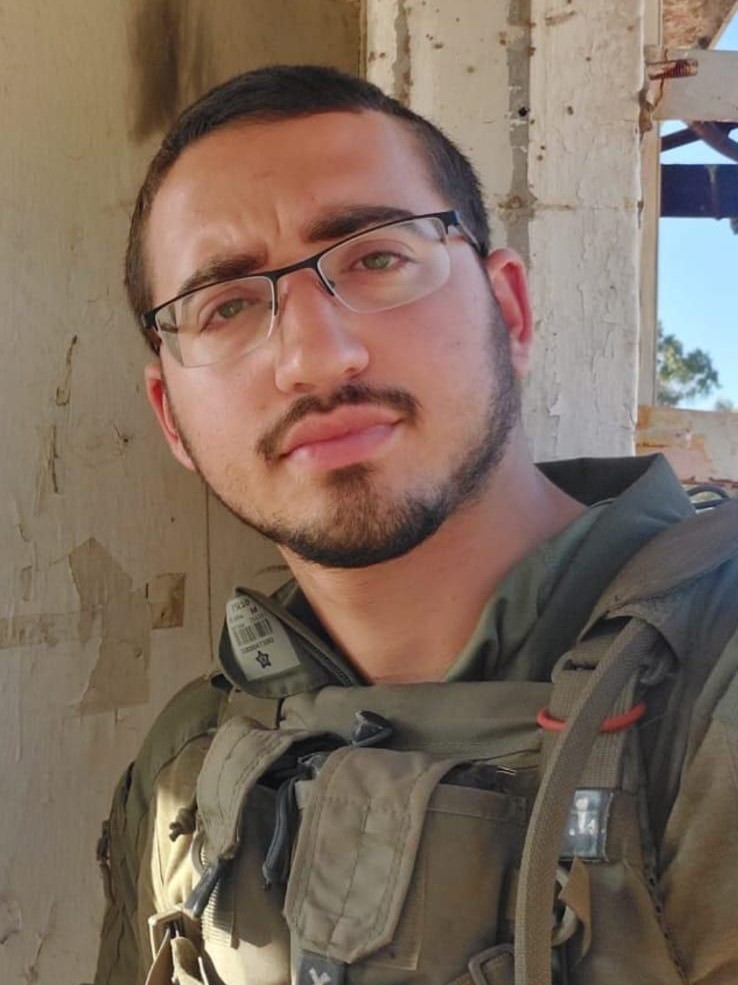
The story
In the sun-drenched expanses of Neve Dekalim, within Gush Katif, Dvir was born on the 24th of Sivan, 5762 (June 4, 2002). He was the third child and first son of Nava and Nissan, a younger brother to Shira and Ora, and later an older brother to Meir, Talia, David, Yehuda, and Yisrael. Their home was always vibrant, filled with laughter and countless voices, the aroma of Shabbat meals wafting through the air, and evening conversations that stretched late into the night. Dvir grew up amidst desert sands that met the sea, in a small community where everyone knew everyone, the quiet of the dunes only occasionally broken by children's shouts during play or the warm breeze blowing in from the sea. He was a sweet child with large, inquisitive eyes that absorbed the entire world—every tiny detail, every movement, every color. He loved to run barefoot on the hot sand, feeling the grains slip between his toes, building sandcastles that the waves repeatedly washed away, discovering unique shells left behind by the receding tide. Childhood in Neve Dekalim was a complete world of simplicity, nature, and security, woven with threads of warm community and enveloping family life.
However, this tranquility was abruptly and painfully shattered when Dvir was just three years old. In 2005, an unbearable decree fell upon the family and all residents of Gush Katif: their home, their community, the life they knew—all were to be uprooted as part of the Disengagement Plan. The hazy memories of a three-year-old intertwined with feelings of tension in the air, of boxes piling up, of heartbreaking goodbyes. Little Dvir surely sensed the strained atmosphere, the tearful eyes of his parents, the long embraces from neighbors. When the family was forced to leave Neve Dekalim, the familiar sands, the home where he was born, he couldn't fully grasp the magnitude of the loss, but the uprooting left a deep, hidden mark of uncertainty and a need to find stability and footing anew. They moved to the community settlement of Nitzan, not far from Ashkelon beach, but a world away from Neve Dekalim. The beginning in Nitzan was fraught with challenges, adapting to a new environment, a temporary home, a developing community, but the close-knit family remained Dvir's pillar, his source of strength and security amidst the uncertainty.
As he grew a little older, Dvir began his studies at the "Torat HaChaim" Talmud Torah in Yad Binyamin. The transition from Neve Dekalim to Nitzan, and then to school, was a significant change for him. In the classrooms, between stone walls and wooden benches, young Dvir discovered his endless curiosity. He wasn't the type of child who merely listened but rather questioned, explored, delved deep. His elementary school teacher, Avishai, remembered him as a captivating, funny child with a sparkle in his eyes. He recounted how Dvir, even before his Bar Mitzvah, skillfully and charmingly wrote an illustrated booklet of articles on all the weekly Torah portions. He didn't simply summarize the portions but approached them as a young journalist, reporting on the events unfolding within them with vivid and engaging coverage, as if he were there, among the biblical heroes, interviewing them, describing the landscape and the atmosphere. The scent of fresh pages, the colors of the pencils he used to illustrate the characters, the excitement he felt as he created his inner world on paper—all these were an inseparable part of his creative process. He memorized the Five Books of Moses, the books of the Prophets and Writings, and even many Mishnayot, not merely out of obligation, but from a deep desire to understand, interpret, and offer his own commentary on the ancient stories.
Dvir was blessed with many talents that burst forth from him like a flowing spring. Writing, drawing, drumming, singing, and playing music—all were an integral part of him. His mother, Nava, described him as a smart, curious, and very talented child in many areas. In his youth, he loved to play and sing; his voice was wonderful and powerful, and he was very musical. One could see him sitting for hours, his fingers dancing on guitar strings or piano keys, producing melodies that captivated everyone around him. He was funny and witty, with a sharp sense of humor that could light up any room. Drawing was another tool for self-expression. He developed a unique caricature style, with rounded figures and prominent eyes, and often drew rebbes with swords or playing music—a unique combination of worlds that only he knew how to bring together into a single creation. All these were expressions of a rich inner world, full of imagination, humor, and endless curiosity.
Upon completing his elementary studies, Dvir moved on to study at the "Bnei Tzvi" high school yeshiva in Beit El. His time in high school yeshiva was not easy. He was quick-witted, sharp-minded, and possessed an excellent memory, so it took a long time to realize he suffered from significant attention deficit disorder. When he began treatment, the side effects of Ritalin took a heavy toll on him. He felt the medication stripped him of who he was—his humor, his natural sociability, the sparkle in his eyes. He preferred to be the real Dvir, with all his difficulties and challenges, rather than a muted version of himself. In eleventh grade, he made a courageous decision to forgo Ritalin, and to some extent, his matriculation certificate. He chose a life full of activity, creativity, and action. He was very active during that period, full of joyful mischief, odd jobs that provided him with independence, and creative stage designs for events and operations at the yeshiva, which were legendary in their quality and originality. He loved to hike with friends on the mountain trails surrounding Beit El, to have fun, celebrate, and enjoy life to the fullest. "He was insanely funny," his friends described, recalling his witty jokes and his ability to turn any situation into a source of rolling laughter. "He had out-of-the-box thoughts, big dreams, and a desire to soar forward," they added, emphasizing the spirit of freedom and imagination that pulsed within him.
Yet, alongside all this, Dvir was also deeply engaged in building his path and personality, grappling with profound questions about life, meaning, and faith. He wasn't afraid to discuss them with anyone willing to listen: educators and staff at the yeshiva, his grandmother who lived in Beit El and hosted him often, close friends, and even casual guests. These conversations could extend into the night, as he presented his questions with sincerity and passion, listening attentively to the answers, and delving deeper and deeper in his search for his own truth. He didn't take things for granted but always explored, dismantled, and rebuilt his inner world.
At the end of his high school yeshiva years, Dvir decided he wanted to further clarify his path and strengthen his beliefs and opinions. He chose to continue his studies at the "Oz VeEmuna" yeshiva, but not just any yeshiva—a yeshiva in the Neve Sha'anan neighborhood in South Tel Aviv, an area saturated with foreign workers and refugees, facing complex social and economic challenges. This choice was not accidental. The yeshiva's location offered him a perfect combination of continued Torah study and the clarification of identity and path, alongside significant national and social engagement. He wanted to be part of Tikkun Olam, not just to learn about it. "There," his friend recounted, "he truly began to do what he loved: to contribute! To contribute to his neighbor, to the neighborhood, and to the community." This wasn't just any contribution, but deep and personal action. He would pay water and electricity bills for the less fortunate, often in secret, without anyone knowing who was behind the good deed. He dedicated time to study with fatherless children, serving as an educational and supportive figure, patiently listening to their stories, enveloping them with warmth. He visited lonely elderly people, sitting with them for hours, listening to their hearts, their life stories, their loneliness, and instilling in them a little hope and light. "Quietly. He didn't speak, didn't tell, didn't hint," his friend recounted. "He just went to bed at the end of the day, utterly exhausted with a small smile. A small smile for him. A big smile for them." Dvir was always a few steps ahead of everyone in acts of kindness and contribution, a pioneer of social action among the yeshiva students. The presence of the yeshiva students in the area even increased the security of the Jewish residents, and Dvir and his friends began to restore abandoned synagogues and mikvahs, returning their beauty and their communal role. They did not shy away from confronting migrants when necessary, standing by their principles and defending order and security in the public space.
Alongside his acts of kindness and studies, Dvir was also blessed with a developed business sense. When he saw that electric scooters and bicycles were the primary modes of transportation in the South Tel Aviv area, he recognized an opportunity. First, he bought a vehicle for himself, then for his brothers and friends, understanding the need and convenience they provided. He loved the feeling of freedom and speed, the wind on his face. He kept his motorcycle driving lessons a secret from his parents, knowing they wouldn't like the idea. But one day, he came home with a new motorcycle and a driver's license, much to their evident displeasure. He even managed to buy a private car, and after it "passed away" (probably because he forgot to add water and the engine burned out, which caused much laughter among his friends), he bought another, and then another, as if vehicles were an inseparable part of his search for new paths and new experiences. He loved the good life, the freedom of riding, the feeling of independence.
After about two years in the advanced yeshiva, Dvir understood that it was time for the next stage in his life—the army. He planned a meaningful service and prepared for it for a long time, physically and mentally. He trained extensively, ran, strengthened himself, preparing his body and soul for the challenge. "He decided he wanted to enlist in Golani," his mother, Nava, recounted. "Although throughout the years we had educated him and his brothers to full partnership in national missions, and it was clear that combat service was part of it, suddenly doubts arose in me." Nava, out of deep concern and love, spoke with him about the value gaps guiding the state and its decisions, and suggested he try to serve in places where one influences public consciousness: Galei Tzahal (Army Radio), IDF Spokesperson's Unit, and so on. She thought that perhaps there he could contribute his special skills in writing and expression. Dvir asked to think about it. He consulted, deliberated, thought deeply for about two weeks, and then returned to her with a clear and resolute answer: "Regarding the situation, I agree with you. It's far from what it should be, and there's much to fix. But regarding the conclusions, I disagree. It doesn't work that way. We need to work from within and influence from within. We are part of the people of Israel, and we go with them, at their pace. Even if it takes time, and even if there are costs." His voice was steady, his gaze piercing. She had nothing to say. He was right. They gave him their full blessing, understanding that this was his path, a path of truth and deep loyalty.
His friends, who knew how much he loved the good life and how much he disliked being told what to do, bet among themselves how long it would take for Dvir to be kicked out of service due to rebelliousness or fatigue. They knew his free spirit, his desire to follow his own path. But Dvir had no such plans. On the advice of the Rosh Yeshiva, he did not enlist through the Hesder yeshiva program but chose full service, out of a deep understanding of the commitment he had undertaken. On August 17, 2022, Dvir enlisted in the IDF, in the Golani Brigade, Battalion 51. He was full of motivation, determined to give his all for the country.
The beginning of his army service was difficult. Since he enlisted after two years in an advanced yeshiva, he was two years older than his squad mates and the same age as many of his commanders. The age gaps were noticeable, and loneliness was unfamiliar to him. Most of the time, he was the only religious soldier in the squad, which added to his feeling of being different. But despite these difficulties, Dvir was very much loved by his friends and commanders. His unique personality, his humor, his sensitivity, and his caring nature won everyone over. His commander recounted: "Dvir was a pleasant and humble person... I enjoyed commanding such a person, one of our best. I remember one day I entered the operations room in the early morning hours and saw Dvir teaching one of the company commanders to play music. They sat laughing and enjoying themselves together." This description painted a vivid picture of Dvir—the small hours of the morning, the sound of rolling laughter, soft piano melodies filling the sleepy operations room, and he, Dvir, breathing life and music into the place. "Dvir was like that, always there for everyone, whenever and wherever needed. I so appreciated the person and the fighter he was," the commander concluded.
Dvir's father, Nissan, recounted that Dvir "stayed for several extra Shabbats in the army just to be with a classmate who was confined to base or because he replaced someone who needed to leave." This was a clear example of his caring nature, his ability to put the needs of others before his own. His friends and commanders said he was aware of their low spirits or difficult times, and knew how to be there and cheer them up with sensitivity and humility, without drama, just with a kind word, a small joke, or sincere listening. Almost all his squad mates imitated him singing loudly, throughout the outpost or in the shower; his powerful voice and the melodies he loved to sing were part of the base's soundtrack. "And how did he get a piano to the outpost? That was a special talent of his," his mother recounted, and the question hung in the air—how did he truly manage to bring such a large musical instrument to a remote location? This was part of his charm, his ability to make any place feel more like home, more joyful.
Dvir meticulously observed Jewish law even during his military service, despite most of his friends not being religious. His commanders recounted that Dvir never missed his prayers, but he made sure they didn't come at the expense of training or operational activities, finding the delicate balance between his religious and military commitments. They also said that in his free time, he could be found in the outpost's synagogue, studying alone or with someone, delving into pages of Gemara or other holy books. A team member recounted an amusing and characteristic story: "One day, all the newly purchased cutlery disappeared. There was nothing to eat lunch with. Suddenly Dvir arrived with a box full of the new cutlery, after having immersed it in the sea. 'It's manufactured abroad. It needed to be immersed,' he said simply, as if it were the most natural thing in the world." This act, which combined adherence to Jewish law with a practical sense of humor, left everyone speechless and smiling.
He was assigned to the "Alon" platoon, a platoon of Namer teams. This was almost a breaking point for him. He was very frustrated by the assignment, as it distanced him from going to officer's training, an aspiration that was very significant for him. He wanted to influence, to lead, to take on greater responsibility. "It was only from his deep frustration that we understood that command was a significant aspiration for him," said his father, who knew his son and understood how important meaningful contribution was to him. Despite the disappointment, he continued to function as a dedicated fighter. Dvir was a soldier who knew how to read the terrain and warn when there was a concern for security. He was assigned to roles in the operations room (HML) thanks to these skills, where he could demonstrate his sharp thinking and quick analytical abilities. His commanders recounted that he also expressed his opinions regarding military conduct, something less common for a soldier of his rank, but he did so out of deep commitment and belief in the righteousness of his path, out of a desire to improve and influence. A few weeks before the attack, he showed exceptional vigilance when he identified suspicious training by Hamas terrorists near the border, near Netiv HaAsara. He filmed videos and took photos and sent them to his family, a first, chilling sign in retrospect, of the terrible events that were about to unfold.
Shabbat, the 22nd of Tishrei, Simchat Torah 5784, October 7, 2023. The morning broke at six-thirty, and the holiday's quiet shattered instantly. The Hamas terrorist organization launched a murderous surprise attack on Israel. Tens of thousands of missiles and rockets were fired from the Gaza Strip into wide areas of the country, and under the cover of the massive barrage, thousands of terrorists—by land, sea, and air—infiltrated and began a murderous rampage on the communities surrounding Gaza, on Sderot, Ofakim, and Netivot, on attendees of nature parties near Kibbutzim Re'im and Nir Oz, on IDF bases, and on those traveling on the roads in the area. Dvir was at the Erez regional control center (MASH'A) that Shabbat, in the northern Gaza envelope, located just one hundred meters from Zikim beach.
That cursed morning began with intense explosions. The soldiers awoke to unusual barrages of missiles, sounds of close explosions that shook the ground. They quickly ran to the base's reinforced shelter, where they found cover from the missiles. But in addition to the missile noise, they also heard personal weapon fire—close, sharp gunshots that made it clear something entirely different was happening. Dvir, with his sharpened senses and exceptional alertness, did not hesitate. He went out to check the source of the gunfire, the nature of the new threat. Within moments, he understood—this was not another regular missile barrage; this was something entirely different. "We need to gear up," he told his friends, his voice resolute, understanding the magnitude of the approaching danger. He rushed to arm himself, donning his protective vest, taking his weapon, ready for any scenario.
During the rapid preparations, the situation at the outpost became clear: terrorists were infiltrating from the sea onto Zikim beach, just meters away from them. A force quickly moved towards the beach to block the infiltration. Dvir, who had just finished a night shift and was not assigned to the mission, insisted on joining the force. He could not stand idly by when he knew his brothers in arms were in danger and civilians were under threat. He jumped into the Savannah vehicle with the commander, and they sped towards the beach. The air was thick with the smell of gunpowder, shouts, and gunfire.
Upon reaching the beach, they quickly identified the terrorists. Within seconds, a fierce and merciless face-to-face gun battle erupted. Fire poured in from all directions: the terrorists shot at them with personal weapons, grenades, and RPGs, and simultaneously, a Navy "Dvora" patrol boat also fired at the terrorists from the sea, attempting to assist the ground force. The soldiers found themselves under crossfire, with the terrorists' shots coming from very close range. The soldiers' fire towards the terrorists was not effective enough, as the beach's canopy pillars obstructed their view, providing cover for the terrorists.
The force was compelled to move to a higher position, from which they could better understand what was happening and make tactical decisions. At this point, communication between the soldiers on the beach was cut off. Dvir and another soldier were in a more forward position, closer to the enemy, while the commander and the rest of the force were behind, and their line of sight was broken. Adrenaline surged through his veins, his concentration was at its peak, and the understanding that every second was critical permeated. After a short time, in a moment of supreme heroism, Dvir emerged from his concealed position. He ran, seeking contact, towards the terrorists, attempting to outflank them, to surprise them, perhaps to save his friends and the civilians. As he leaped over the beach fence, the terrorists' bullets found him. He was killed instantly, falling in battle, fighting for his home, for his people, for his future. Staff Sergeant Dvir Lisha fell on the 22nd of Tishrei 5784, October 7, 2023. He was twenty-one years old at his fall, so young, full of life, plans, and dreams.
The news of his fall struck his family in Nitzan like a bolt from the blue. The pain was unfathomable, the void immense. He was laid to rest in the military cemetery on Mount Herzl in Jerusalem, among the nation's heroes, alongside a grieving family, tearful friends, and a shocked nation. He left behind his parents, Nava and Nissan, three sisters and four brothers, seven siblings who lost their older brother, their anchor, their comedian, their deep questioner, their musician. After his fall, he was posthumously promoted to the rank of Sergeant, in recognition of his heroism and self-sacrifice.
Nava, his mother, eulogized him with chilling words that connected the past and present: "Three years and a bit after you were born, we were uprooted together from the sands of Gush Katif. It is no coincidence that so close to there you ascended again. But the searing personal pain, and the terrible general pain, these are birth pangs. We are about to be born into our new stature as a people: to be a Jewish, Israeli people, proud of its Torah throughout all our land. Illuminating the light of God to the entire world." Her words reflected her deep faith, her understanding that Dvir's sacrifice was part of a larger process, of national resurgence, of rebuilding.
Bar, his close friend from the yeshiva, who eulogized him, revealed the depth of the connections Dvir forged in his life: "When you went to the Oz VeEmuna yeshiva, you sacrificed your comfort. When you acted endlessly to do good and kindness in the city, you sacrificed your time. When you chose to defend the country in your beautiful years, you sacrificed your freedom. When you were the first to fall in defense of the homeland, you sacrificed your life." He described Dvir as someone who was always ready to pay the price, to give his all. "It was no accident that you were the first casualty of the war. This was the moment you had waited for your whole life—to bring justice to the world. You jumped into the Savannah and went towards them as one against many. You charged forward and fell with a weapon in your hands..." Bar described the pain and longing: "We will miss your voice every visit to the yeshiva. We will miss your music that swept everyone along. We will miss your plans to change the world. We will miss your creative thinking that made us all laugh. We will miss arguing with you, where everyone somehow always thought differently. We will miss deep conversations with you into the night." He also spoke of the less fortunate people Dvir secretly helped: "The day after you fell, all of them came to the yeshiva. They knocked on the gate and asked anxiously if it was you. We told them with broken voices that it was. There were Jews there with tears in their eyes and cries of anguish. You were the only person in their world. The only person who came, helped, and supported them. Now they are alone again. Dvir, you were not just a friend and brother, you were a figure, you were a symbol. You had a great life. A life with purpose." Bar recalled an argument a year ago in their room at the yeshiva, where a difficult question was posed: who would truly be willing to testify about themselves that they are ready to give everything—their life, family, and future for the sake of the collective? "Many thought and deliberated, only you answered immediately without hesitation—'Here I am.' The collective before everything. That's who you were. A life of depth. A life of truth. Not everyone asks, not everyone wants. These are lives full of challenges and battles. You wanted and you fought!"
The head of the "Oz VeEmuna" yeshiva, who saw Dvir develop and flourish under his tutelage, eulogized him with emotion: "Dvir was privileged to be an expression of the spirit of heroism that arose from the brokenness and burst forth to give birth and renew our national stature... This spirit was alive in Dvir and it intensified and reached powerful dimensions within his soul during the yeshiva, and finally revealed its greatness in his supreme self-sacrifice. His spirit lives and beats within us, his heroism is infused in our lives, and his self-sacrifice is bound forever in our souls." The Rosh Yeshiva's words connected Dvir's personal story to the national narrative, to the spirit of resurgence felt within the people of Israel after the great rupture.
Dvir Lisha, of blessed memory, the child from Neve Dekalim who was uprooted, the talented and curious youth, the young man who insisted on his path and on doing good, the brave fighter who ran into the fire—left behind a rich legacy and a missing presence. To commemorate his memory, his family republished the "Morning News" books that Dvir and his brother Meir created in their youth about the weekly Torah portions and the Book of Joshua, so that his young and creative voice would continue to resonate. At the Shapira school, the "I Belong to the People" project was established in his memory, where all students teach Jewish concepts in their classrooms, are tested, and deepen their connection to the Torah, the people, and the land. In the settlement of Kochav HaShachar in Binyamin, "Mitzpe Dvir" (Dvir's Lookout) was established in his memory, an observation point offering a magnificent view of the land he so loved and wanted to protect. In the "Oz VeEmuna" yeshiva where he studied, a study hall was established in his memory, a place where Torah will continue to be studied and kindness performed in his spirit. In the outpost of Oz Zion in Binyamin, a synagogue was named after him—"Dvir Kodshecha" (Dvir, Your Sanctuary), and a study hall was also inaugurated with the same name in the Nitzan Talmud Torah. In the "Oz Shlomo" pre-military academy of the "Or Etzion" institutions in Merkaz Shapira, a study room was inaugurated in his memory, and a sacred texts library was established in the Ashkenazi synagogue in Nitzan. His memory is also commemorated on the "+memoriz" website, on the "Bnei David" institutions' website, and on the "Kavim LeDmutam" project website, where illustrator Limor Tzur Magen captured his unique spirit.
His parents wrote: "Dvir was beloved and captivated hearts. Full of joy, humor, sensitivity, and caring. He was unique in his demand for truth, and in his simple faith in God's goodness. Dvir was God-fearing, loved the Torah, and strived to maintain his connection with it. And he was a hero. A hero in his life as he overcame temptations and personal desires from childhood for the sake of fulfilling God's commandments, when he preferred the good of others and the collective over his personal good, when he fought for the weak while endangering himself, and also in the last minutes of his life as he sought contact and ran towards the enemy. He was privileged to live and die in the way he desired and chose, thereby joining the nation's heroes who bound their lives to the eternity of Israel."
Dvir Lisha, of blessed memory, who lived a short but full and meaningful life, who fell as a hero in battle defending the land, became a symbol of human heroism, self-sacrifice, and love of humanity and homeland. His spirit, his heroism, and his deeds continue to beat in our hearts, to light our way, and to be a pillar of fire before the camp, leading the people to eternal Israeli resurgence and pride.
Moments of a life
All photographs · 1
In the media
Articles
Memorial sites
- Dvir Lisha - memorial page
כאן 7.10.360
Memorial projects
Commemorations listed on Yizkor: the books Chadashot Haboker by Dvir and Meir; the Ani Shayach La’am project at Shafir School; Mitzpe Dvir in Kochav Hashachar; study rooms at Oz Ve’emuna and Oz Shlomo; a synagogue in Oz Tzion and a study hall in Nitzan called Dvir Kodshecha; a religious library in Nitzan.
Stories told about them
In a public comment, Gila Bensoussan said she met Dvir on a bus on the way to Givat Washington when she did not know where to get off. According to her, he and his brother made sure she reached the campus safely; this is a recollection by an identified commenter rather than an independently checked report.
As a teenager, Dvir wrote illustrated booklets presenting the weekly Torah portions as news reports. During his service, he managed to bring a piano to the outpost and stayed close to his friends even when they remained there for an additional Shabbat.
Life & service
Service
- Rank
- Sergeant
- Unit
- Golani Brigade
- Honours
- Posthumously Promoted
Family
- Father
- Nissan
- Mother
- Nava
Burial
Cemetery
Mount Herzl Military Cemetery
- Area
- ד
Tributes & remembrance
יהי זכרם ברוך
היינו במצפור לזכר דביר לישה, ה יקום דמו יהי זכרו ברוך, שנהיה ראויים
גיבור ישראל לא נשכח אותך
דביר
נולדת באדמה אוהבת ונפלת על אדמה אוהבת.
אוהבים אותך.
בורנשטיין
אחי היקר , תמיד בלב שלי
יהיה זכרו ברוך
צדיק טהור ! גומל חסדים ועוזר דלים . בן נאמן לקב"ה ולתורתו ,ארץ ישראל ועם ישראל .
זכרו נצור בליבנו לעולמים . ת.נ.צ.ב.ה.
יהי זכרו ברוך!
יהי זכרו ברוך!
ת.נ.צ.ב.ה
דביר אחייננו היקר שהתעלה על קידוש ה בשמחת תורה בקרב גבורה יחיד מול רבים יהי זכרך ברוך! אתה בליבנו לעד
גיבור ישראל
משפחה מיוחדת, שה ישלח לכם נחמה ותקומה אמיתית עד לביאת משיח
גיבור ישראל.
נוח על משכבך בשלום.
צדיק עליון
ניקטף נער צעיר אוהב אדם ואוהב את ארצו מולדתו.
דביר נזכור אותך!
גיבור ישראל ומלח הארץ מילים לא יכולות לתאר את הכאב והסבל ה״יד.
יהי זכרו ברוך תודה על הזכות להיות המפקד שלך
טופלת במשמרת שלי, והלוואי שעל הצד הטוב ביותר.
מבטיח להשתדל ללמוד על האור והטוב שעשית בחייך והשארת לנו בעולם.
זה מהקצת שלמדתי עליך
דבוק באמת ושמר על ההלכה גם במצבים דחוקים. התנדב רבות ביקורי ערירים, תשלום חשבונות לנזקקים בסתר, למד עם יתומים ועוד. הצהיר בחייו כי מוכן להקריב את חייו למען הכלל, וכך עשה בשמחת תורה, כשהסתער על המחבלים בעודו יחיד מול רבים.
תודה מקרב לב.
ת.נ.צ.ב.ה
יהי זכרו ברוך
זאת נטע, חברה של טליה
אני זוכרת את דביר תמיד ברקע, את החיוך שלו, את המנגינות שלו על הפסנתר, את הנוכחות שלו בבית
האור שלו היה בכל מקום
ותמיד יהיה
אני יעל אלבוים, אמו של שריה מגדוד 51, מדליקה נר לזכרו של דביר בשם כל האימהות של החברים וחיילי גולני
הספקתי להכיר את דביר רק חודשיים בערך, אבל אפילו בכל-כך קצת זמן היה אפשר לראות איזה אדם הוא. מקווה שנלמד ממנו קצת
יהי זכרו ברוך.
זכינו לשמוע על סיפור חייו מאביו.
יהי זיכרון ברוך
לא הכרתי אותך בחייך, אך במותך ליוויתי אותך בדרכך האחרונה.
הספיק לשמוע את ההספדים, כדי להבין איזה אדם מיוחד היית. כואבת את לכתך מבלי להכיר אותך אישית.
אני רועי דן בנימין מ״פ ברובאית 51 , מדליק נר בשמי ובשם גדוד 51 וחטיבת גולני.
מורשתו מאירה לנו את הדרך ואנו נזכור ונמשיך להזכיר את זכרם של נופלי החטיבה , יהי זכרו ברוך !
אני נהוראי בנימין בחטיבת גולני, בשמי ובשם החטיבה אני מדליק נר לזכור של סמ״ל דביר לישא ז״ל
אני אוהד אלבלה חייל בחטיבת גולני , בשמי ובשם החטיבה אני מדליק נר לזכרו של דביר לישה ז״ל.
מורשתו מאירה לנו את הדרך ואנו נמשיך לזכור ולהזכיר את זכרם של נופלי החטיבה. ״יהי זכרו ברוך!״
They are tarnishing the name of my heroic son who gave his life
Source:ישראל היום
Read the Hebrew original
מכתימים את שמו של בני הגיבור שנתן את נפשו
This is a day of great heroism
Source:ערוץ 7
Read the Hebrew original
זה יום שיש בו גבורה גדולה
He stayed on base for several extra Shabbats just to remain with a squadmate who was confined to base, or because he stood in for someone who needed it
Source:כאן 7.10.360
Read the Hebrew original
הוא סגר כמה שבתות נוספות בצבא רק בשביל להישאר עם חבר לכיתה שרותק או כי החליף מישהו שהיה צריך
Dvir, you were not just a friend and brother; you were a figure to look up to, a symbol.
Source:ynet
Read the Hebrew original
דביר, לא היית סתם חבר ואח, היית דמות, היית סמל.
I will never forget Dvir.
Source:The Yeshiva World
I knew his for less than an hour and never forgot how he helped me.
Source:The Yeshiva World
He had a pure and simple faith
Source:The Times of Israel
Every week he wrote several articles about the weekly Torah portion. He chose the topics and wrote everything with a very high level of creativity.
Source:ישראל היום
Read the Hebrew original
בכל שבוע הוא כתב כמה כתבות על פרשת השבוע. הוא בחר את הנושאים, וניסח הכל ברמה יצירתית גבוהה מאוד.
But the searing personal pain and the terrible collective pain are the pangs of birth.
Source:יזכור
Read the Hebrew original
אבל הכאב הפרטי הצורב, והכאב הכללי הנורא, אלו צירי לידה.
We will miss deep conversations with you late into the night
Source:יזכור
Read the Hebrew original
נתגעגע לשיחות עומק איתך לתוך הלילה
His spirit lives and beats within us
Source:יזכור
Read the Hebrew original
רוחו חיה ופועמת בנו
Dvir was loved and won people's hearts.
Source:יזכור
Read the Hebrew original
דביר היה אהוב ושובה לבבות.
Remembrance Day addresses
יום הזיכרון לחללי מערכות ישראל התשפ"ה – 2025
בכל יום שעובר, אזכור יותר! אזכור, את אלו שיצאו עימי לקרב ולא שבו, ולהם אין מי ידמה ומי ישווה. אזכור, שהכאב לא יעבור לעולם, והזמן, הוא לא מרפה ולא מרפא. אזכור, את שיברון הלב הגובר ואת הבית שבוער. אזכור, את צדקת הדרך, ואשבע שוב, שמה שהיה לא יהיה יותר. אזכור, שיותר מכל דבר אחר – אני חסר! ביום הזה, אני נתקף געגוע לדמותם, לחיתוך דיבורם, לחיוכם, ומדליק נר לזיכרון דרכם ומורשתם!
משרד הביטחון
אגף משפחות, הנצחה ומורשת
יום הזיכרון לחללי מערכות ישראל התשפ"ה – 2025
בכאב, בהצדעה ובתקווה אני מתכבד להדליק נר זיכרון זה. השנה, כשאנו נלחמים במלחמה ארוכה, רב זירתית וצודקת, הזיכרון נושא משמעות עמוקה. ביום זה נעצור ונתייחד עם זכרם של טובי בנינו ובנותינו שנפלו בהגנה על המדינה. מורשתם היא המצפן שמתווה את דרכינו, והיא המעניקה לנו כוח להמשיך ולהגן על מדינת ישראל ותושביה. משפחות יקרות, אנו מרכינים ראשנו ומתחייבים שנעמוד לצידכן תמיד. יהי זכר הנופלים ברוך.
אלוף דדו בר כליפא
ראש אגף כוח האדם, צה"ל
יום הזיכרון לחללי מערכות ישראל התשפ"ה – 2025
בשעה שאנו זוכרים את גודל תרומתם ועומק מסירות נפשם של טובי בנינו ובנותינו, נופלי מערכות ישראל לדורותיהן, ממשיכים צה"ל וכוחות הביטחון במימוש המשימה למענה לחמו ועבורה נפלו: הכרעת אויבינו מדרום, מצפון, ביהודה ובשומרון, וגם בזירות רחוקות יותר. בהערכה רבה ובגאווה אדירה אנו מרכינים ראש בפני הנופלים והנופלות, מאמצים את משפחותיהם אל לבנו, וממשיכים במשימה להבטחת קיומה של ישראל לדורי דורות. יחד נעשה ונצליח.
רב אלוף אייל זמיר
הרמטכ"ל, צה"ל
יום הזיכרון לחללי מערכות ישראל התשפ"ד – 2024
כאשר דגלינו מורדים לחצי התורן וראשינו מורכנים לזכר הנופלים והנופלות במערכות ישראל, ממשיכים לוחמי צה"ל ומפקדיו בלחימה בדרום, בצפון, ביהודה ובשומרון ובזירות נוספות. על כל דור מוטלת המשימה של הגנת העם והארץ – משימה שאף פעם אינה פוסקת. נצדיע בגעגוע ובגאווה לנופלים ולנופלות, נחבק את משפחותיהם, ונמשיך ברוח הציווי שהותירו לנו. עם ישראל חי.
רב ניצב יעקב שבתאי
המפקח הכללי, משטרת ישראל
יום הזיכרון לחללי מערכות ישראל התשפ"ד – 2024
אחיי הנופלים, כל נר הוא זיכרון יחיד ומיוחד, על חיים שהיו ואינם, געגוע שנצרב עמוק בלב, עולם ומלואו. הנרות כולם הם זיכרון של אומה כי לעולם לא עוד, בשורת הציונות וקוממיות ישראל. זיכרון כי הדרך לעם חופשי בארצנו עוברת דרך מסדר הנופלים. אור הנר יזכיר לנו את מסירות נפשכם להציל חיים, להגן על הבית. הנרות מסמנים לנו נתיב גבורה ערכי מחייב שאנו מצווים ללכת לאורו. נמשיך להילחם ולהוסיף אור מתוך אמונה בנצח ישראל.
יואב גלנט
שר הביטחון
יום הזיכרון לחללי מערכות ישראל התשפ"ד – 2024
בהצדעה ובכאב, בשם צה"ל כולו, אני מדליק נר זיכרון. בעיצומה של מלחמה, הזכרון נושא משמעות יום-יומית, שעבר והווה מתלכדים בה. לאורם של הנופלים נמשיך לצעוד, חיילי הסדיר והמילואים. לאורם של הנופלים נמשיך להגן על ארצנו ועל מולדתנו, גם כשהמחיר כבד. להבת-הזכרון תבער בנו בעודנו ממשיכים להלחם ונזכור את הנופלים ואת אומץ ליבם. משפחות יקרות, צה"ל מרכין היום ראש, מצדיע לכן וכואב איתכן. יהי זכר הנופלים ברוך.
אלוף יניב עשור
ראש אגף כוח האדם, צה"ל
יום הזיכרון לחללי מערכות ישראל התשפ"ד – 2024
בהוקרה, בגאווה ובכאב שאין לו סוף, אני מתכבד להדליק נר לזכרם של הנופלים והנופלות במערכות ישראל. סיפור חייהם בארץ הזאת, מסכת שירותם, גבורתם והקרבתם – הם סיפורה של הארץ הזאת, אך גם סיפור המחיר הכבד שהיא תובעת מאוהביה. מחויבותנו לזכר הנופלים ולדרך שהותירו לנו ניצבת תמיד לנגד עינינו. את המשימה שלא זכו להשלים, משלימים כיום, וישלימו, אנשי כוחות הביטחון, הממשיכים בדרכם ולאורם. יהי זכרם של הנופלים ברוך.
משרד הביטחון
אגף משפחות, הנצחה ומורשת
יום הזיכרון לחללי מערכות ישראל התשפ"ד – 2024
בחרדת קודש אני מתכבד להדליק נר לזכרם של חללי מערכות ישראל, חברנו שנפלו, מראשית היציאה מהחומות ולאורך כל שנות עצמאותנו המדינית והציונית, מהווים תמרור זיכרון לדרך חיינו ולמחוייבות הלאומית להנצחת זכרם. דרכם נותרה דרכנו ומורשתם נר להמשך עשייתנו. יהי זכרם ברוך!
בני גנץ
שר הביטחון
יום הזיכרון לחללי מערכות ישראל
נזכור אותם, כולנו יחד. כל אחד ואחת מהם, מדי יום ביומו, והיום ביתר שאת, כך – לנצח. "כי מדי דברי בו זכור אזכרנו עוד"
משרד הביטחון
אגף משפחות, הנצחה ומורשת