
The story
Binyamin Meir Erly was born on the 26th of September, 2002, in New York City, USA, a world of colors, sounds, and sensations still ahead of him, destined to leave their deep imprint. He was the son of Rachel Pasi, better known as Jennifer, and Zev David, whom many called Robert, joining the family as the youngest for a short period, a little brother to Sarah. His first four years unfolded amidst the hustle and bustle of New York, a city whose pace, noise, and lights perhaps somehow blended with the inner joy that already began to pulse within him. In 2006, when he was just four, the family made a significant move, one that would shape his entire future – they made Aliyah, leaving behind the glass and concrete towers, the smog and anonymity of the vast metropolis, and settled in Beit Shemesh. The transition was dramatic, from a dense urban landscape to a developing city still breathing the mountain air of Jerusalem, with open fields and a relatively pristine landscape, utterly different from anything he had known. Here, among the vineyards and hills, Binyamin grew up, and here, four younger siblings were born after him – Yehuda, Akiva, Yaakov, and Hannah – who, together with him, created a large, vibrant, and warm family that was the anchor of his life and his source of strength.
Binyamin spent his early years in Israel within the local education system of Beit Shemesh. He was a happy child, his broad smile almost always lighting up his face, and his curious eyes examining every detail of the world around him. He was mischievous, full of bursting energy, the kind of presence that was impossible to ignore, even if he tried to downplay it. His love for sports and movement was evident from a young age, and at every opportunity, he found himself engaged in physical activity, running, jumping, or climbing. He was naturally sociable, finding it easy to connect with other children, and soon found his place in neighborhood gangs, playing soccer on makeshift fields, riding bicycles on narrow paths between houses, or simply sitting and talking for hours with his good friends. His curiosity knew no bounds, and he would ask incisive questions, delve deeply into any topic that interested him, and develop his own firm opinions, which he was not afraid to express, even if they differed from the norm. When he reached high school age, he made an unconventional decision, one that attested to his unique character – he chose to study at the "Tzvia" Yeshiva High School in Eilat. The move to the southern tip of the country, far from home and family, was not easy, but Binyamin sought a framework that would combine sacred studies with a deep connection to nature, the desert environment, and the sea. He found this in the Eilat Yeshiva, where he could study Torah alongside marine and environmental studies, with the red desert and the blue sea becoming an integral part of his life, providing him with inspiration and tranquility. This experience, of living and being educated in breathtaking scenery, between the volcanic mountains of Eilat and the clear waters of the Red Sea, strengthened his love for the land, its wild beauty, and its power.
Binyamin's teenage years were rich and full of content. He was an active member of the "Bnei Akiva" youth movement, where he served as a counselor, passing on the values he believed in – love of the land, mutual aid, and quiet but influential leadership. In his free time, his many talents were revealed. Binyamin was an impressive breakdancer, his body flexible and agile, performing complex moves with ease and grace. He found the rhythm within himself and could turn any corner into an impromptu dance floor. Beyond that, he was a talented musician and drummer. His hands knew how to play the drums, producing captivating rhythms, and he led a musical ensemble of yeshiva students. Every Rosh Chodesh (new month), he would initiate a lively yeshiva dance party, with his band playing and Binyamin as the driving force, exciting everyone and bringing joy to their hearts. These were the only moments he allowed himself to be the center of attention, surrounded by his sweating, smiling friends, spreading infectious energy. In other areas of his life, Binyamin preferred to avoid the spotlight, to blend into the background, not to seek attention. But even though he never tried to stand out, everywhere he went, people were drawn to him as if by magic. He possessed a rare human quality, an ability to connect with every person he met – from small children to adults, from religious to secular, from city dwellers to settlers. He gathered hundreds of friends from all corners of the country, each of whom felt that Binyamin saw them, listened to them, and accepted them unconditionally. These friends became an extensive support network, an extended family, strengthening the sense of belonging and love in his life.
When he was sixteen, a deep insight into Binyamin's soul was revealed. He prepared a detailed list of fifty-five wishes, dreams, and goals, and simply called it "I Want." This list, written in his neat and orderly handwriting, was a moving document, a window into his rich inner world. It included a combination of personal, social, and spiritual aspirations, painting a portrait of a young man with an old soul. Among other things, Binyamin wished "to have good friends who will influence me for the better," a wish that attested to the importance of human connections in his eyes and his desire to grow and develop through them. He wanted "to have good relationships with all family members and the extended family," which indicated the supreme value he placed on family, cohesion, and mutual support. Other dreams reflected his love for nature and a simpler life: "to know how to ride horses well, to have horses," an aspiration that combined his love for animals with a desire for freedom and open spaces. Alongside these, the list also included deep spiritual aspirations, indicating his profound connection to tradition and his Jewish identity: "that the Messiah will come and the resurrection of the dead and the Temple, to be a Kohen." These were not just words, but an expression of a deep yearning for redemption, for the rectification of the world, and for a life full of holiness and meaning. He also wanted "people to say only good things about me, to enjoy my company," a desire for modesty and mutual respect, which expressed his wish to positively influence his surroundings without seeking praise. "To understand why I came into the world, to be in love, to be modest, to be without a smartphone, to have experiences, to experience the delight of Shabbat, to have an open miracle, not to waste my abilities" – all these together created a complex mosaic of a rich personality, who sought truth, meaning, a deep connection to himself and the world, and resisted the superficial trends of the modern world. This list was not just a collection of wishes, but an internal roadmap that served as a compass for his short but full life.
From a young age, it was clear to Binyamin that his destiny was combat service in the IDF. It wasn't a question of "if," but of "when" and "where." This decision stemmed from his deep love for the land and his commitment to its security. When the time came, he chose a path that combined his two worlds – the spiritual and the practical – and joined the Hesder Yeshiva in Safed. In this yeshiva, located in the heart of the mountainous holy city, he combined Torah study, delving into the worlds of spirit and Jewish law, with physical and mental preparation for significant combat service. He found a balance between studying Gemara with a study partner late into the night, the cold air of Safed cooling the open window, and grueling fitness training and lessons on weaponry and tactics. Leading up to his enlistment, his mother, Jennifer, offered to buy him all the necessary equipment for a new soldier – a backpack, warm clothes, a headlamp, a durable watch. But Binyamin politely but firmly refused. "I don't need anything," he told her with his familiar smile. "What's needed they'll give me, and what's not, well, you can probably get by without it." His relatives and acquaintances say that his modesty was not an act, but a way of life. He never showed much interest in materialism, did not chase brands or gadgets, and was content with little. What truly mattered to him were experiences, human connections, learning, and contributing to the greater good.
On November 11, 2021, on a cool winter day, Binyamin enlisted in the IDF. He fulfilled his dream and joined Battalion 101 of the Paratroopers Brigade, an elite combat unit known for its fighting spirit and the high demands it placed on its soldiers. He underwent rigorous training, which included long marches with heavy weights, intensive shooting drills in open terrain and complex scenarios, and learning combat tactics and survival in the field. He was trained as a Negev machine gunner – a soldier who uses a "Negev" light machine gun. This role is not merely technical; it demands immense responsibility, composure, and the ability to operate under fire. The Negev gunner is usually at the tip of the spear, leading the force, first exposed to threats, and bearing the brunt of the initial fire. It was a role that suited Binyamin's character – someone who always wanted to be at the front, to lead, to set a personal example, and not to hide behind others. Among his fellow soldiers, Binyamin quickly became known as a courageous fighter. He was not only physically strong but also possessed an exceptionally strong mentality. Even in the most difficult moments, when exhaustion threatened to overwhelm and danger loomed, he managed to instill confidence in those around him. He knew how to motivate his weary friends with a kind word, a light joke, or a broad, encouraging smile. "Come on, guys," he would say in his deep, calm voice, "a little more, we can do this." He was the one who could make everyone laugh, even when the situation was challenging to the point of unbearable, releasing the tension in the air and creating a sense of lightness and optimism. For him, military service was not just a duty, but a privilege. "It's a great privilege to take part in the fighting and defense of the country," he used to say, "if I have to die for the Land of Israel, that's what I must do." This statement was not uttered as an empty slogan, but out of a deep and clear conviction that was an integral part of his identity.
Binyamin was an exceptionally positive person. He possessed a high and fun energy that drew people to him and spread a good atmosphere around him. He was full of empathy, a rare ability to understand and identify with the feelings of others. He was always willing to listen, truly listen, not just to hear the words but to feel the meaning behind them. Often, his friends and family found themselves sharing their dilemmas and difficulties with him, and Binyamin was there, with an understanding and patient gaze, offering advice or simply a listening ear. He was always happy, smiling at everyone – soldiers, commanders, kitchen officers, children on the street, the grocer. His smile was his calling card, opening doors and warming hearts. He helped in every way he could, not waiting to be asked, but actively seeking where he could contribute. Within the family, Binyamin was an anchor. He served as a role model for all his younger siblings and an object of their admiration. They saw him as a stable, wise, joyful figure, and above all, a person with clear principles and a generous heart. They knew that if they had a question, a dilemma, or just needed a hug, Binyamin would be there for them.
Beyond the formal frameworks of the army and the yeshiva, Binyamin nurtured a great love for the landscapes and natural treasures of the Land of Israel. He knew every path, every hidden corner, every breathtaking view. He especially loved the natural springs scattered throughout the country – the clear waters gushing from the depths of the earth, the rich vegetation growing around them, and the calming quiet they offered. During every leave, between training sessions, he would find himself on his way to one spring or another, immersing himself in the cold water, refreshing himself, and connecting to the land he loved so much. He loved to explore, to delve deep and learn on his own, not content with superficial knowledge. Books on Israeli history, modern and biblical, filled his shelves, and he read them with great interest, trying to understand the roots of the nation, its development, and its challenges. He also studied Jewish law and psychology, out of a desire to understand the human soul and the complex relationships between us. His love for the land was not just a romantic love for its landscapes, but a practical, committed love. Settling the land was very important to him, and he saw it as a life mission. During his army leaves, instead of resting or socializing, he would volunteer on farms in Judea and Samaria. He herded sheep on the exposed hills, with the wind caressing his face and the sun scorching his neck. He guarded the lands, helped with agricultural work, planted trees, and repaired fences. He saw this not just as manual labor, but as an expression of a deep ideology – to ensure that every Jew could live in peace and security anywhere in Israel, out of a deep connection to roots and identity. As part of this mission, he planted and cultivated a vineyard near the community of Neve Tzuf in the Binyamin mountains. He tended the vines with devotion, ploughed the soil, pruned the branches, caring for each plant as if it were his child. He dreamed that one day, when the vineyard yielded abundant fruit, his family and friends would sit with him, under a star-studded sky, and drink together the fine wine produced from the fruits of his labor. It was a dream of a future, of tranquility, of community, and of a deep connection to the land, a dream that reflected everything Binyamin represented.
That Saturday, the 7th of October, 2023, the holiday of Simchat Torah, began as a normal holiday. The first light of morning began to rise on the eastern horizon, spreading shades of pink and gold over the Gaza envelope communities. It was six-thirty in the morning, and thousands of Israelis were preparing for joyful holiday prayers, for dancing with Torah scrolls, for family meals. But the peaceful quiet was suddenly shattered. The Hamas terrorist organization launched an unprecedented, brutal, and murderous surprise attack on the State of Israel. A massive barrage of thousands of missiles and rockets was fired from the Gaza Strip into wide areas of the country, as the sounds of explosions and sirens broke the holiday tranquility. Under the cover of fire and confusion, thousands of terrorists – terrestrially through the border fence, by sea, and by air using drones and paragliders – infiltrated the communities of the Gaza envelope, Sderot, Ofakim, and Netivot. They raided IDF bases, nature parties near Kibbutzim Re'im and Nir Oz, and those traveling on the roads. What happened next was a massacre. The terrorists murdered in cold blood some eight hundred civilians in their homes, in their cars, after committing severe and cruel crimes against them. They abducted hundreds of Israelis, babies, children, women, and men, to the Gaza Strip, and destroyed, looted, and set fire to homes and property. Hundreds of soldiers, police officers, security forces personnel, and members of local emergency response teams fell in battle, trying to defend defenseless civilians with their bodies. On this morning, all at once, a war began – "Operation Iron Swords," which shook the very foundations of the entire country.
Binyamin's battalion, Battalion 101 of the Paratroopers Brigade, was immediately called up. There was no time for deliberation, only action. From the first moment, the battalion participated in the fighting, carrying out various operational activities, responding to incidents, and defending communities. The first days were chaotic, full of adrenaline and tension, with every soldier understanding the gravity of the hour and the mission entrusted to him. At the same time, the battalion conducted intensive and short training sessions in preparation for ground combat in the Gaza Strip, practicing various scenarios, improving tactics, and preparing for what awaited them beyond the fence. Towards the end of October, the order was given. Binyamin, along with the battalion's combat forces, entered the Strip. This was not another routine entry. This was war, real combat, where every step could be the last. He fought for long days, long hours that merged into one, operating his "Negev" machine gun with professionalism, courage, and heroism. The smells of smoke, dust, and burnt metal filled the air. The sounds of gunfire and explosions were incessant. Binyamin advanced between ruined buildings, in narrow alleys, under incessant fire, focused on the mission, defending his friends and the country. He knew that every action he took had meaning, and that every moment was critical.
On Saturday morning, November 18, 2023, about a month and a half after the outbreak of the war, Binyamin's team was called to join another combat force as reinforcements. This force was in the midst of a fierce battle against a squad of terrorists, some of whom were barricaded in a nearby building and firing non-stop in all directions, creating a constant threat to the forces in the field. The air was thick with tension, with the sounds of gunfire and the understanding that every minute was critical. The force commander, after a quick situation assessment, made a difficult decision: to enter the fortified building and neutralize the terrorists. He decided to enter with another soldier, with the aim of breaching inside. Binyamin, who heard the decision, did not hesitate for a moment. He immediately joined them, his face determined, his gaze clear. "You can't go in there without me," he said in his deep, authoritative voice, "I have a 'Negev' machine gun." He knew that his role as a Negev gunner, as the one carrying the greatest firepower, was vital for such a breach. He didn't think of himself, only of the mission, of his friends, and of the need to defeat the enemy. The three of them – the commander, the other soldier, and Binyamin with his "Negev" – entered the building, into the unknown. Their steps were measured, their eyes scanning every corner, every shadow, every opening. They began to search the rooms of the house, room after room, looking for the terrorists. The tension was at its peak, with every moment potentially being the last. They located and neutralized one of the terrorists who was barricaded inside. A slight breath of relief, but the battle was not over yet. A moment later, the three were flanked by another terrorist, who ambushed them from a hidden corner. Everything happened with dizzying speed, in a fraction of a second. Binyamin was shot and killed on the spot, as were the commander and the soldier who engaged with him. Corporal Binyamin Meir Erly fell in battle on the 18th of November, 2023. He was only twenty-one years old at the time of his death.
The bitter news struck his family and friends like a bolt from the blue. Binyamin was laid to rest in the military cemetery on Mount Herzl in Jerusalem, in a moving and sad ceremony, under gray skies, as many tears flowed onto his fresh gravestone. He left behind heartbroken parents – Rachel Pasi and Zev David – and two sisters and three brothers, who were left with an immense void and unimaginable pain. After his fall, Binyamin was posthumously promoted from the rank of Corporal to Sergeant, in recognition of his heroism and dedication.
His father, Robert, eulogized him at the funeral, his voice breaking but his eyes shining with pride and pain: "For those who didn't have the privilege of knowing Binyamin, he would hate all this, that people came for him. He didn't like attention. He was humble. He didn't like his name mentioned. But he can't stop me now." Robert described Binyamin as a true leader, even if he didn't seek the title. "He had a smile that lit up the room," the father said, "he wasn't like a typical teenager. He had principles. He would come back exhausted after army training, but preferred to go to the farm he called home, to work with the cows and stand guard on his free Shabbat. He was a hero. He always wanted to be at the front." The father's words painted a portrait of a young man with a mature soul, modest yet stubborn, a lover of people and land, and possessing a deep sense of mission. Rabbi Eyal Yaakobovich, head of the Hesder Yeshiva in Safed, also eulogized him, his voice trembling with emotion: "Our Binyamin, a brave and true young man, strong in body and spirit. Binyamin, a gentle soul with a deep voice and captivating beauty... You sought strength in the service of God and gathered every crumb with love and gratitude. The soil of the land burned in your heart. With a rare talent for manual labor, you connected the land to the Blessed God in a life of holiness. You could not compromise on anything less than the truth, regarding yourself in your personal life and regarding the nation and the land. And all in quiet with a rich and solid inner world... Binyamin, the illuminating and strong. Binyamin, who seeks truth and goodness. Always volunteering. The burning heart." The words of the father and the rabbi completed a full picture of a unique personality, combining humility with strength, spirituality with practicality, and a deep love for people and the land.
The legacy of Binyamin Meir Erly continues to live on and illuminate through a wide range of initiatives and projects established in his memory. The Beit Shemesh Municipality, the city where he grew up and was educated, commemorates his name on its website, as a son of the city who fell in its defense. His family, in their immense pain, chose to transform their grief into action, and to continue Binyamin's path of spreading goodness and love. They established "Beit Binyamin" in Safed in his memory – a special place intended to serve as a home for rest, recovery, and renewal for combat soldiers, bereaved families, families displaced from their homes, and anyone suffering from the traumatic consequences of the war. This place, in the heart of the holy city where Binyamin studied Torah, stands as a living testament to his generosity, his empathy, and his desire to help others. In addition, the family launched a moving initiative asking all of Israel to perform good deeds in Binyamin's memory. These deeds, small and large, were recorded in a special book created by the family, and its pages quickly filled with inspiring stories of kindness, mutual aid, and connection. At the "Tzvia" Yeshiva High School in Eilat, the place where Binyamin discovered his musical talents, a magnificent music room is being established in his memory. In this room, yeshiva students will be able to learn to play, play together, create music, record, and edit, thereby continuing Binyamin's creative and joyful spirit. Leading up to Purim 5784, a party was held in Jerusalem in his memory, with all proceeds donated to charity, continuing the tradition of dance parties he initiated at the yeshiva, and echoing the spirit of giving and joy that characterized him. Finally, Binyamin is also commemorated by the organization "Binyamin's BBQ Brigade." This organization, bearing his name, continues Binyamin's path of spreading light and joy among soldiers, through indulgent BBQ meals, good music, performances by artists and entertainers, enriching lectures, and more. All these together express the immense void Binyamin left behind, but also the rich and enduring legacy of love, giving, modesty, heroism, and a deep connection to the land and the people. The short but full life of Binyamin Meir Erly, of blessed memory, which ended prematurely in defense of his home, his people, and his land, constitutes a living and breathing memory of Israeli heroism, one that stems from humanity, seemingly simple actions, and unconditional love. He fell as a hero, and his spirit continues to light our way, as an integral part of all our stories of revival.
In the media
Articles
- Mother of fallen soldier: 'He would have done the same thing a thousand times over'
Israel National News ·
- Binyamin Airley Invitational Tournament
Jewish Hoops America ·
- Sgt. Binyamin Airley, 21: Had a ‘love affair’ with the Land of Israel
The Times of Israel ·
Podcasts
- Jen Airley: Healing the Nation in Memory of Binyamin Airley Z"l
Hero Israel / Zeno.FM ·
- Jen Airley | Mother of Fallen IDF Soldier's Message To The World
Meaningful People / Apple Podcasts ·
Songs
Memorial sites
- Sergeant Binyamin Meir Airley
יזכור משרד הביטחון
Memorial projects
An update on Beit Binyamin: his mother describes four guest units operating in Safed for people affected by the war, full occupancy and a waiting list. She asks to purchase another property to expand the work; the expansion is described as a fundraising goal, rather than a completed fact.
A basketball tournament in his memory in South Florida, supporting Beit Binyamin in Safed, a place of rest for soldiers and bereaved and evacuated families; the second tournament was announced for January 2026.
A women’s dance party was dedicated to his memory in March 2024; the announcement describes his love of dancing and joy in life.
The Arley family launched a campaign to establish a music room at Tzviya Yeshiva in Eilat for playing, creating and recording music. The March 2024 article describes a fundraising initiative, without verification that the room was completed.
Binyamin’s BBQ Brigade — a volunteer group supporting IDF soldiers, founded in his memory.
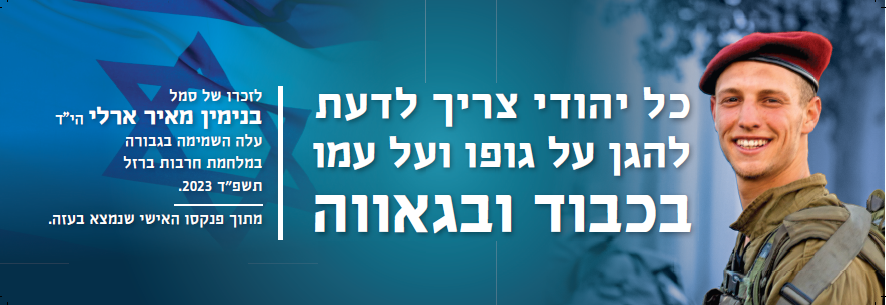
“Every Jew must know how to protect his body and his people with honor and pride.”
Life & service
Profile
- Date of birth
- September 26, 2002
- Birthplace
- Beit Shemesh
- Date of death
- November 18, 2023
- Age
- 21
- Hometown
- Beit Shemesh
Service
- Rank
- Sergeant
- Honours
- Posthumously Promoted
- Battle Location
- Northern Gaza Strip
Family
- Father
- Ze'ev David (Robert)
- Mother
- Rachel Pasi (Jennifer)
Burial
Tributes & remembrance
ה' בכסלו.
לימוד הדף היומי היום מוקדש לזכרו.
זוכרים ומצדיעים
בנימין בחור טהור. חבר של אחי. כמה אחי הצטער לשמוע תוך כדי לחימה שנפלת . ברגע שיכל התקשר לומר לנו ואנחנו כבר ידענו. ואי כמה שהוא הצטער אך לא לגמרי עיכל. סיפר לנו עליך. אחי אהב ביציאות מהצבא ישר ללכת לחבורה שהיית חלק ממנה ועכשיו אתה חסר
שתהיה עליה לנשמתו
שתהיה עליה לנשמתו
נזכור אותו
אני בן דוד שלו
יהי זכרו ברוך.
יהי זכרו ברוך!
יהי זכרו ברוך
במותך ציוות לנו חיים..
gone too soon, we miss you.
יהי זכרו ברוך
יהיה זכרו ברוך תהא נשמתו צרורה בצרור החיים מנוחתו בגן עדן . היה מופת ודוגמה לבן עליה אציל בעל מידות נעלות, אוהב התורה ומכבד כל אדם.
אוהבים ומתגעגעים אליך כל יום
אתה כ"כ חסר לנו בבית שמש
יהי זכרו ברוך
בנימין היקר וואלה היית עוד פרח שנקטף זכיתי להיות השמיניסט שלך האומץ והאין פחד בכלל מי גדול ממך מי קטן,כי היית כל כך שמח מלא אנרגיות ושמחה ואהבת כל אחד אזכור אותך בתור האחד שלא פוחד האחד שאהב את המולדת תודה לך על אומץ וגבורה תודה שנלחמת בשבילנו נזכור אותך לעד חמשוש יקר.
אוהבים ומתגעגעים
בס"ד
מחכים לשובך עלם חמודות
בע"ה גאולה ברחמים ותחיית המתים והרוגי המלכות הקדושים והטהורים במהרה בימינו אמן!
Binyamin's passion for his homeland was evident in every aspect of his life
Source:שמשנט
Read the Hebrew original
תשוקתו של בנימין למולדתו ניכרה בכל תחומי חייו
It was not easy to raise a boy like him—he had energy and pushed limits
Source:JNS
Binyamin personified modesty.
Source:The Times of Israel
At the yeshiva, Binyamin is a symbol of courage and sanctifying God's name in his life and in his death.
Source:ערוץ 7
Read the Hebrew original
דמותו של בנימין היא סמל בישיבה לגבורה וקידוש השם בחייו ובמותו.
Rav Amnon gave him the wings to fly,
Source:Israel National News
always sporty and social
Source:The Times of Israel
Remembrance Day addresses
יום הזיכרון לחללי מערכות ישראל התשפ"ה – 2025
בכל יום שעובר, אזכור יותר! אזכור, את אלו שיצאו עימי לקרב ולא שבו, ולהם אין מי ידמה ומי ישווה. אזכור, שהכאב לא יעבור לעולם, והזמן, הוא לא מרפה ולא מרפא. אזכור, את שיברון הלב הגובר ואת הבית שבוער. אזכור, את צדקת הדרך, ואשבע שוב, שמה שהיה לא יהיה יותר. אזכור, שיותר מכל דבר אחר – אני חסר! ביום הזה, אני נתקף געגוע לדמותם, לחיתוך דיבורם, לחיוכם, ומדליק נר לזיכרון דרכם ומורשתם!
משרד הביטחון
אגף משפחות, הנצחה ומורשת
יום הזיכרון לחללי מערכות ישראל התשפ"ה – 2025
בכאב, בהצדעה ובתקווה אני מתכבד להדליק נר זיכרון זה. השנה, כשאנו נלחמים במלחמה ארוכה, רב זירתית וצודקת, הזיכרון נושא משמעות עמוקה. ביום זה נעצור ונתייחד עם זכרם של טובי בנינו ובנותינו שנפלו בהגנה על המדינה. מורשתם היא המצפן שמתווה את דרכינו, והיא המעניקה לנו כוח להמשיך ולהגן על מדינת ישראל ותושביה. משפחות יקרות, אנו מרכינים ראשנו ומתחייבים שנעמוד לצידכן תמיד. יהי זכר הנופלים ברוך.
אלוף דדו בר כליפא
ראש אגף כוח האדם, צה"ל
יום הזיכרון לחללי מערכות ישראל התשפ"ה – 2025
בשעה שאנו זוכרים את גודל תרומתם ועומק מסירות נפשם של טובי בנינו ובנותינו, נופלי מערכות ישראל לדורותיהן, ממשיכים צה"ל וכוחות הביטחון במימוש המשימה למענה לחמו ועבורה נפלו: הכרעת אויבינו מדרום, מצפון, ביהודה ובשומרון, וגם בזירות רחוקות יותר. בהערכה רבה ובגאווה אדירה אנו מרכינים ראש בפני הנופלים והנופלות, מאמצים את משפחותיהם אל לבנו, וממשיכים במשימה להבטחת קיומה של ישראל לדורי דורות. יחד נעשה ונצליח.
רב אלוף אייל זמיר
הרמטכ"ל, צה"ל
יום הזיכרון לחללי מערכות ישראל התשפ"ד – 2024
כאשר דגלינו מורדים לחצי התורן וראשינו מורכנים לזכר הנופלים והנופלות במערכות ישראל, ממשיכים לוחמי צה"ל ומפקדיו בלחימה בדרום, בצפון, ביהודה ובשומרון ובזירות נוספות. על כל דור מוטלת המשימה של הגנת העם והארץ – משימה שאף פעם אינה פוסקת. נצדיע בגעגוע ובגאווה לנופלים ולנופלות, נחבק את משפחותיהם, ונמשיך ברוח הציווי שהותירו לנו. עם ישראל חי.
רב ניצב יעקב שבתאי
המפקח הכללי, משטרת ישראל
יום הזיכרון לחללי מערכות ישראל התשפ"ד – 2024
אחיי הנופלים, כל נר הוא זיכרון יחיד ומיוחד, על חיים שהיו ואינם, געגוע שנצרב עמוק בלב, עולם ומלואו. הנרות כולם הם זיכרון של אומה כי לעולם לא עוד, בשורת הציונות וקוממיות ישראל. זיכרון כי הדרך לעם חופשי בארצנו עוברת דרך מסדר הנופלים. אור הנר יזכיר לנו את מסירות נפשכם להציל חיים, להגן על הבית. הנרות מסמנים לנו נתיב גבורה ערכי מחייב שאנו מצווים ללכת לאורו. נמשיך להילחם ולהוסיף אור מתוך אמונה בנצח ישראל.
יואב גלנט
שר הביטחון
יום הזיכרון לחללי מערכות ישראל התשפ"ד – 2024
בהצדעה ובכאב, בשם צה"ל כולו, אני מדליק נר זיכרון. בעיצומה של מלחמה, הזכרון נושא משמעות יום-יומית, שעבר והווה מתלכדים בה. לאורם של הנופלים נמשיך לצעוד, חיילי הסדיר והמילואים. לאורם של הנופלים נמשיך להגן על ארצנו ועל מולדתנו, גם כשהמחיר כבד. להבת-הזכרון תבער בנו בעודנו ממשיכים להלחם ונזכור את הנופלים ואת אומץ ליבם. משפחות יקרות, צה"ל מרכין היום ראש, מצדיע לכן וכואב איתכן. יהי זכר הנופלים ברוך.
אלוף יניב עשור
ראש אגף כוח האדם, צה"ל
יום הזיכרון לחללי מערכות ישראל התשפ"ד – 2024
בהוקרה, בגאווה ובכאב שאין לו סוף, אני מתכבד להדליק נר לזכרם של הנופלים והנופלות במערכות ישראל. סיפור חייהם בארץ הזאת, מסכת שירותם, גבורתם והקרבתם – הם סיפורה של הארץ הזאת, אך גם סיפור המחיר הכבד שהיא תובעת מאוהביה. מחויבותנו לזכר הנופלים ולדרך שהותירו לנו ניצבת תמיד לנגד עינינו. את המשימה שלא זכו להשלים, משלימים כיום, וישלימו, אנשי כוחות הביטחון, הממשיכים בדרכם ולאורם. יהי זכרם של הנופלים ברוך.
משרד הביטחון
אגף משפחות, הנצחה ומורשת
יום הזיכרון לחללי מערכות ישראל התשפ"ד – 2024
בחרדת קודש אני מתכבד להדליק נר לזכרם של חללי מערכות ישראל, חברנו שנפלו, מראשית היציאה מהחומות ולאורך כל שנות עצמאותנו המדינית והציונית, מהווים תמרור זיכרון לדרך חיינו ולמחוייבות הלאומית להנצחת זכרם. דרכם נותרה דרכנו ומורשתם נר להמשך עשייתנו. יהי זכרם ברוך!
בני גנץ
שר הביטחון
יום הזיכרון לחללי מערכות ישראל
נזכור אותם, כולנו יחד. כל אחד ואחת מהם, מדי יום ביומו, והיום ביתר שאת, כך – לנצח. "כי מדי דברי בו זכור אזכרנו עוד"
משרד הביטחון
אגף משפחות, הנצחה ומורשת